BHRC BLOG
How Ultherapy Works: Lift, Results Timeline & What to Expect | Complete Guide
Ultherapy is the only FDA-cleared non-invasive procedure for lifting skin on the neck, chin, and brow, and for improving décolletage lines and wrinkles. It uses micro-focused ultrasound with visualization (MFU-V) to deliver energy at precise depths beneath the skin — targeting the same foundational layer (the SMAS) that surgeons address in a facelift, without incisions or anesthesia.
How Ultherapy Works
Ultherapy works through a process called micro-focused ultrasound with visualization (MFU-V). The device delivers focused acoustic energy to three precise tissue depths — 1.5mm (upper dermis), 3mm (deep dermis), and 4.5mm (the SMAS layer) — without affecting the surface of the skin.
At those target depths, the ultrasound energy creates small thermal coagulation points (TCPs). The body interprets these as micro-injuries and initiates a wound-healing response — synthesizing new collagen and elastin over the following 3–6 months. The cumulative effect is a gradual but genuine structural lift, not just surface tightening.
The “visualization” component distinguishes Ultherapy from other ultrasound devices: the real-time imaging lets the provider see the tissue layers being targeted, ensuring accurate depth delivery and avoiding critical structures.
What Ultherapy Treats
- Brow ptosis (brow drooping) — Ultherapy’s brow lift indication is FDA-cleared and produces measurable elevation without Botox tolerance development
- Neck laxity — loose skin along the jawline, jowls, and under the chin that creates the “turkey neck” appearance
- Submental fat and skin looseness — the platform under the chin that becomes more pronounced with age or after weight loss
- Décolletage wrinkles — chest lines and crepiness that develop from sun exposure and sleeping position
- Nasolabial folds and mid-face laxity — off-label but commonly treated with the 4.5mm transducer
The Ultherapy Treatment Experience
Before: No special preparation is required. Some providers recommend taking ibuprofen 60–90 minutes before to minimize discomfort. Makeup and skincare should be removed before the session.
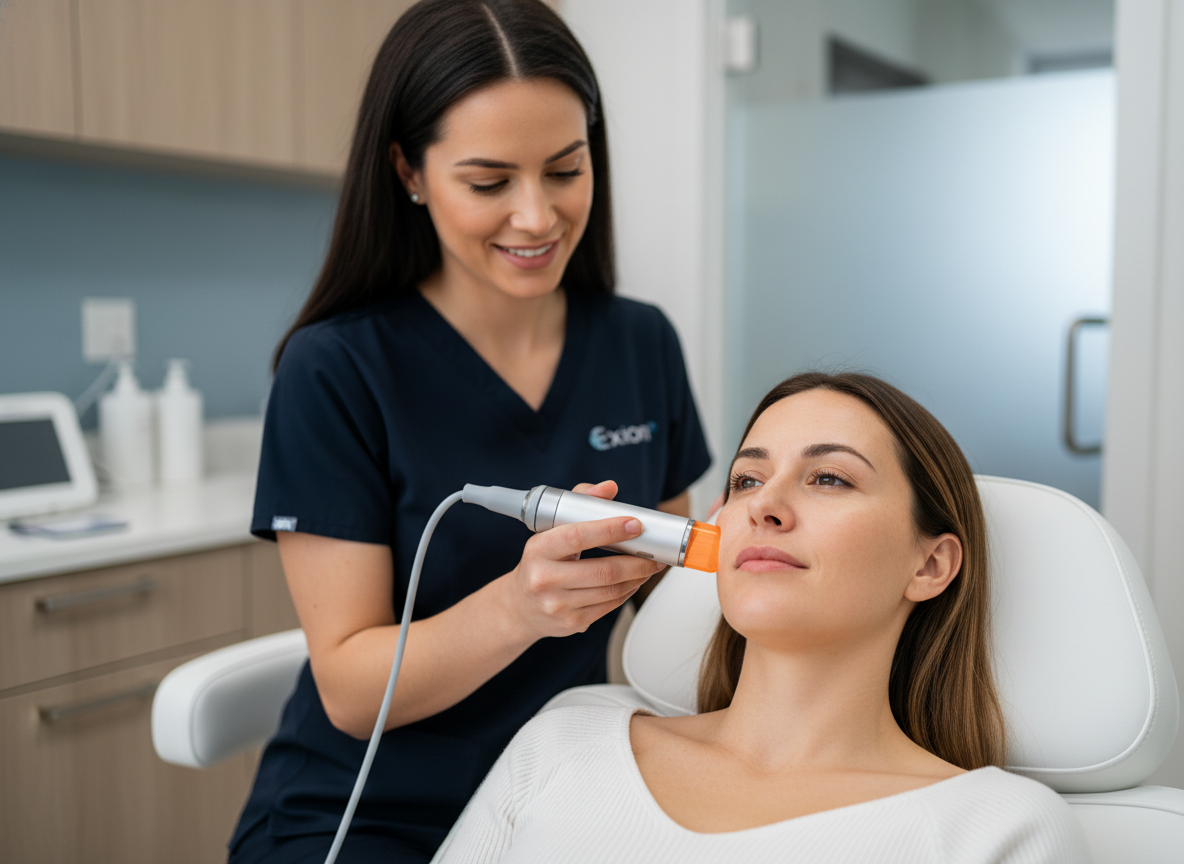
During: Ultrasound gel is applied to the treatment area. The handpiece is moved systematically across the skin, delivering focused energy at each line of treatment. Most patients describe a deep, intermittent warmth or prickling sensation at the moment of energy delivery — particularly over bony areas like the jawline. The sensation is brief (1–2 seconds per pass) and does not persist between pulses. A full face and neck treatment takes 60–90 minutes.
After: No downtime is required. The skin may appear mildly flushed for a few hours. Rarely, mild swelling or temporary numbness can occur along the jawline, typically resolving within 1–2 weeks. Most patients return to work the same day.
Ultherapy Results: Timeline
Ultherapy results develop gradually — this is not an instant-result treatment. The collagen remodeling timeline:
- Weeks 1–4: Minimal visible change. The internal healing process has begun but collagen synthesis is early stage.
- Months 1–3: Progressive improvement. Patients begin to notice skin feeling firmer and jawline looking slightly more defined.
- Months 3–6: Peak results. Full collagen maturation produces the final lift. Most clinical studies document results at 90 days.
Results typically last 12–18 months, after which a maintenance treatment sustains the outcome. Patients who maintain healthy skin with good sun protection tend to see longer-lasting results.
How Many Sessions Are Needed?
Most patients achieve optimal results with a single Ultherapy treatment per year. Unlike laser resurfacing or RF microneedling, Ultherapy is designed as a once-yearly intervention that produces sustained structural lifting. Some patients with more significant laxity may benefit from a second treatment at 6–12 months, but this is less common than with other energy-based treatments.
Am I a Good Candidate?
Ultherapy works best for patients who:
- Have mild to moderate skin laxity — enough that there is meaningful collagen reserve to stimulate, but not so much laxity that surgery is the more appropriate solution
- Are in their 30s to 60s and want to delay or complement a surgical facelift
- Are bothered by brow drooping, neck or jowl looseness, or décolletage lines
- Have realistic expectations for gradual, progressive improvement over 3–6 months
Ultherapy is not appropriate for patients with active skin infections, open wounds in the treatment area, severe or excessive laxity better addressed surgically, metallic implants near the treatment zone, or certain implanted electronic devices (pacemakers).
Ultherapy vs. Other Lifting Treatments
Ultherapy vs. Morpheus8: Ultherapy targets deeper tissue (SMAS at 4.5mm) for structural vertical lift; Morpheus8 targets the dermis and subdermal fat for texture improvement and skin tightening with moderate lift. Both produce collagen — through different mechanisms and depths. Many BHRC patients combine Morpheus8 (for surface quality) and Ultherapy (for structural lift) in the same annual plan.
Ultherapy vs. surgical facelift: A facelift produces more dramatic lifting in a single procedure and addresses very loose or excess skin that energy-based treatments cannot correct. Ultherapy is appropriate for patients who are not candidates for surgery, prefer a non-surgical option, or want to extend the longevity of a prior facelift.
Ultherapy at BHRC
Ultherapy is available at BHRC locations in West Hollywood, West LA, Valencia, Summerlin, Henderson, and Paradise Valley. All treatments are performed using the Ulthera System — the original FDA-cleared platform — not aftermarket devices. Your provider will use real-time imaging to map your tissue layers before each pass.
Frequently Asked Questions
Does Ultherapy hurt?
Ultherapy involves a distinctive deep warmth or prickling sensation at the moment of energy delivery — particularly over bony landmarks like the jaw and cheekbone. Most patients find it very tolerable; some take ibuprofen beforehand. Providers can also apply topical numbing or offer oral anxiolytics for more sensitive patients. The sensation occurs only during the energy pulse (1–2 seconds), not continuously.
Is there any downtime?
No required downtime. Mild flushing resolves within hours. Infrequently, temporary nerve-related symptoms (tingling, mild numbness along the jaw) can occur and typically resolve within 1–2 weeks.
When will I see results?
Initial improvement can be subtle at 4–6 weeks, with primary results building over 3–6 months as new collagen matures. Some patients notice changes earlier; others see the full result closer to the 6-month mark. Taking photos at baseline and 3 months helps document progress that can be hard to notice day-to-day.