
BHRC BLOG
Botox Near Me — What It Costs, How Many Units, and What to Ask First
Neurotoxins · Cost, Units & What to Ask
Botox is sold by the unit, dosed by the label, and quoted honestly only when you know both numbers. Here are both numbers.

1. Why per-unit pricing is the only honest way to quote this
A “unit” of onabotulinumtoxinA is a defined measure of biological activity, not a volume. Two clinics can both say “we treat the forehead for $350” and be doing entirely different things — one using 12 units conservatively, the other using 24. You would have no way to know, and you would have no way to reproduce the result somewhere else.
Per-unit pricing makes the transaction legible. You know the rate, your injector tells you the unit count before the first injection, and you can do the arithmetic yourself. It also means a light touch costs less than a heavy one, which is how it ought to work.

2. What the FDA label actually says about dosing
Botox Cosmetic holds FDA approval for three specific cosmetic indications, each with a defined dose in the prescribing information:

3. Botox, Dysport, Xeomin, Daxxify — do the differences matter?
All four are botulinum toxin type A. They work the same way: blocking acetylcholine release at the neuromuscular junction so the targeted muscle cannot contract as strongly. The differences are in formulation, in the accessory proteins each carries, and in unit potency — which is why units are not interchangeable between brands.
The one that trips people up: Dysport units are not Botox units. A Dysport quote of “60 units” is not three times a Botox quote of “20 units” — the conversion ratio is roughly 2.5 to 3 Dysport units per Botox unit, so those two quotes are describing similar treatments. Compare prices for the result, not unit counts across brands.
Xeomin is the one worth knowing about for a practical reason: it is formulated without the accessory proteins the others carry. Whether that matters clinically for most people is debatable, but it is the reason Xeomin is sometimes suggested for patients who have stopped responding to another product. At BHRC it is also the lower-priced option at $12 per unit.
4. What you should ask before anyone injects you
This is the section we would want a family member to read.
- “How many units are you using, and where?” Ask before, not after. A competent injector answers immediately and specifically.
- “What is your per-unit price?” If the answer is a per-area price, ask again for the unit count. You are entitled to both numbers.
- “Who is injecting me, and what is their license?” In California and Nevada, neurotoxin injection is a medical act. Know whether you are seeing a physician, nurse practitioner, physician assistant or registered nurse, and who is supervising.
- “What happens if I don’t like it?” Neurotoxin is not reversible the way filler is. The honest answer is “we wait” — but the follow-up question is whether a two-week check-in is included.
- “Is this on-label or off-label for the area you’re treating?” A good injector will not be thrown by this question.
- “How long has this vial been open?” Reconstituted neurotoxin has handling standards. Asking signals that you know they exist.
The best injectors we know are the ones most willing to talk you out of something. If you are being upsold on your first visit, that is information.
5. The timeline — what happens over the next four months

A two-week follow-up is worth taking seriously. Small asymmetries are normal at that point and are easy to correct with a unit or two. Waiting three months to mention it means living with it for three months.
6. Aftercare that is actually evidence-based
Most aftercare advice in this category is convention rather than trial data. Here is the honest version:
- Stay upright for about four hours. Conventional, low-cost, widely advised.
- Do not rub or massage the area for the rest of the day.
- Skip strenuous exercise for 24 hours.
- Expect small bumps at the injection sites for 20–60 minutes. That is fluid, not a problem.
- Bruising is possible and more likely on blood thinners, fish oil, NSAIDs or alcohol the night before. Arnica does not have strong evidence but does not hurt.
- Do not book anything important for 14 days. Not because it looks bad — because if something needs adjusting, you want the adjustment to have settled.
7. Who should not have neurotoxin
Known hypersensitivity to any botulinum toxin product or to the formulation components; infection at the proposed injection site; pregnancy and breastfeeding (no safety data, so the convention is to postpone); neuromuscular disorders such as myasthenia gravis, Lambert-Eaton syndrome and ALS, where toxin effects can be amplified; and certain medications including aminoglycoside antibiotics. Bring your full medication list — this is not a formality.
8. Botox or filler? The question behind the question
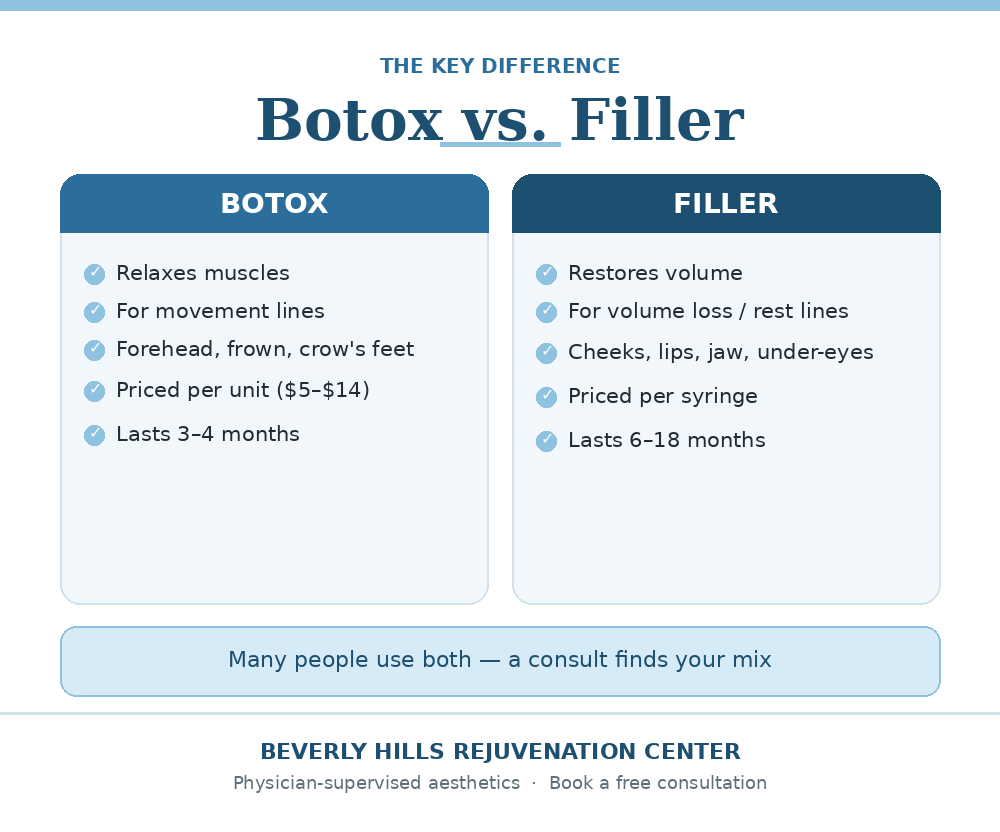
A large share of people who search for Botox are describing something Botox does not fix. The test is simple and you can do it at a mirror right now: relax your face completely and look again.
If the line disappears when you stop moving, it is a dynamic line and neurotoxin is the right tool. If the line is still there on a completely still face, it is static — etched into the skin, or sitting in a fold created by lost volume. Neurotoxin will soften it a little over time by stopping the folding, but the thing you are actually looking at is skin quality or structure.

This matters financially. Someone who books 40 units of neurotoxin every quarter hoping to fix a nasolabial fold is spending real money on the wrong thing. A consultation that redirects them costs nothing and saves several hundred dollars a year. That is genuinely why we ask people to come in and talk before booking a treatment — not as a sales step, but because the wrong treatment is the most expensive thing in this industry.
9. Where to have it done
We treat neurotoxin at all six BHRC locations. If you are searching “Botox near me” from Los Angeles, West Hollywood and West Los Angeles are the two closest; from the Conejo Valley it is Westlake Village; from Santa Clarita, Valencia; from Las Vegas, Summerlin; and from Scottsdale or Phoenix, Paradise Valley.
8550 Santa Monica Blvd, Suite 101, West Hollywood, CA 90069
(323) 859-1257 · Monday–Friday 9:00 AM – 6:00 PM, Saturday 9:00 AM – 4:00 PM
Treatment by the BHRC clinical team
4.8 stars across 312 verified reviews
Consultations are free and carry no obligation.
Full pricing, including the pre-purchase rate, is on our neurotoxins service page. If you are in Santa Clarita specifically, we broke the numbers down separately in our Botox guide for Santa Clarita and Valencia.
Questions we get asked
How much does Botox cost near me?
At BHRC the standard rate is $14 per unit for Botox and $12 for Xeomin, with 50 units for $500 when pre-purchased. Using FDA label doses that works out to roughly $280 for frown lines, $280 for the forehead and $336 for crow’s feet — or about $896 for all three at the standard rate.
How many units will I need?
The label doses are 20 units for glabellar lines, 24 for crow’s feet and 20 for forehead lines. Your injector may use fewer depending on your muscle mass and how much movement you want to keep. Men typically need more units than women for the same area because of greater muscle mass.
How long does it last?
Three to four months for most people. Regular treatment sometimes extends the interval over time. Very active people and those with strong expressive muscles often metabolise it faster.
Will I look frozen?
That is a dosing and placement decision, not an inherent property of the drug. Tell your injector explicitly how much movement you want to keep, and ask for a conservative first treatment — you can always add units at the two-week check. You cannot remove them.
Botox or filler — which do I need?
They solve different problems. Neurotoxin softens lines caused by muscle movement. Filler replaces lost volume and supports structure. Lines that are visible when your face is completely still are usually a volume or skin-quality question, not a neurotoxin one.
Is there anything I should stop taking beforehand?
Blood thinners, fish oil, high-dose vitamin E, NSAIDs and alcohol all increase bruising. Do not stop a prescribed medication without asking the prescriber — just tell us, and we will adjust technique.
Keep reading
- Neurotoxins at BHRC — full pricing and areas treated
- Botox in Santa Clarita and Valencia — cost and units
- Botox and neurotoxins at BHRC Summerlin
- Botox, lip filler and dermal fillers near me
- Dermal fillers at BHRC West Hollywood
- How to choose a med spa — what to look for
- The Rejuvenation Club — 20% off every treatment
Book at any of our six locations
References
- U.S. Food and Drug Administration — BOTOX Cosmetic (onabotulinumtoxinA) for injection — full prescribing information, including cosmetic dosing and the boxed warning. accessdata.fda.gov
- U.S. Food and Drug Administration — XEOMIN (incobotulinumtoxinA) for injection — prescribing information. accessdata.fda.gov
- U.S. Food and Drug Administration — DYSPORT (abobotulinumtoxinA) for injection — prescribing information, including the note that units are not interchangeable between products. accessdata.fda.gov
- U.S. Food and Drug Administration — Dermal fillers (soft tissue fillers) — approved uses and risks, for the neurotoxin-versus-filler distinction. fda.gov
- American Academy of Dermatology — Chemical peels: overview — for static lines and skin-quality concerns neurotoxin does not address. aad.org
Beverly Hills Rejuvenation Center. This content is for general education and does not create a physician-patient relationship or constitute medical advice. Botulinum toxin products carry an FDA boxed warning regarding distant spread of toxin effect. Treatment of areas outside the approved glabellar, lateral canthal and forehead indications is off-label use. Candidacy, dosing, results and pricing vary by person and are confirmed at a free consultation. Reviewed by the BHRC clinical team.