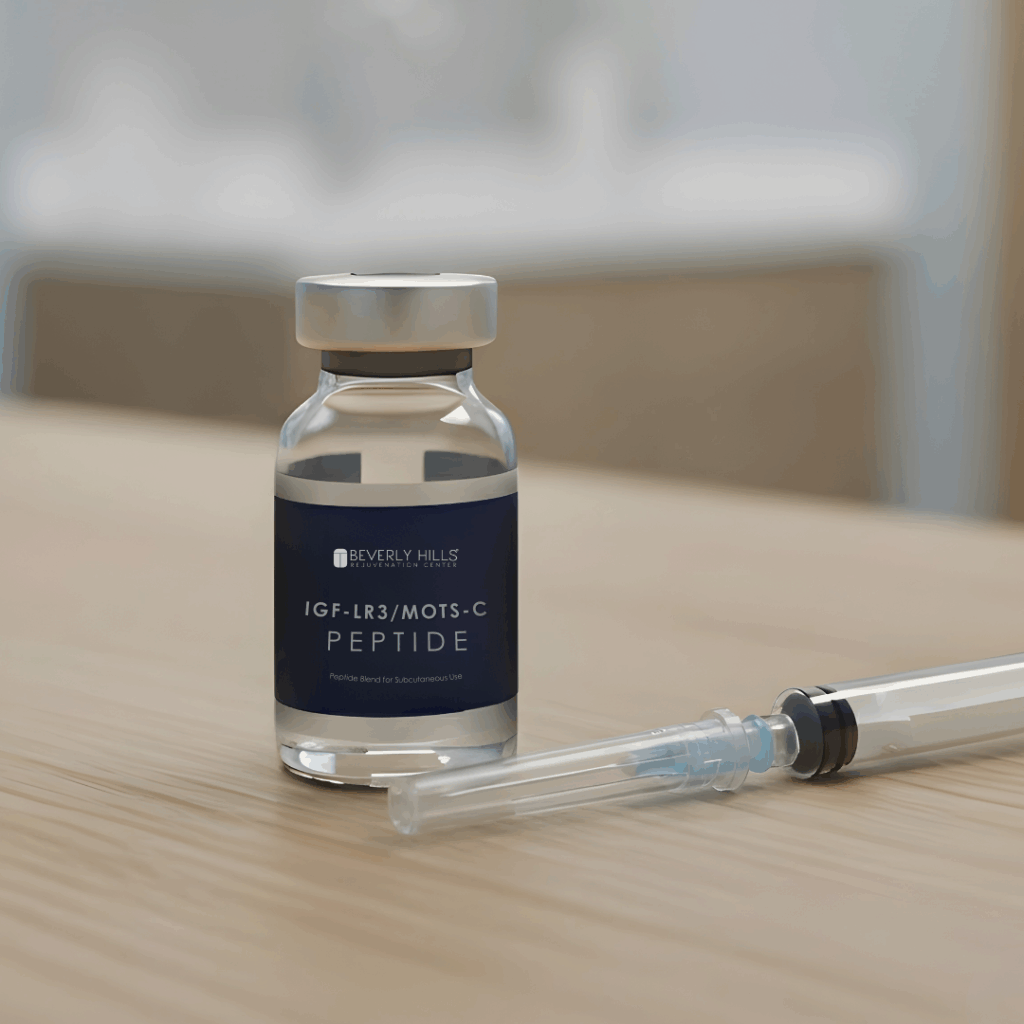
IGF-1 LR3 is a long-acting variant of insulin-like growth factor with enhanced stability and bioavailability. Engineered with a 13-amino acid extension, it delivers sustained anabolic signaling for muscle growth, recovery, and metabolic optimization beyond what natural IGF-1 can achieve.
A synthetic analog of insulin-like growth factor engineered for extended half-life and enhanced anabolic activity through direct IGF-1 receptor activation.
Extended Release
1mg
IGF-1 LR3 1mg per vial
20-30 hour half-life
Enhanced protein synthesis
Subcutaneous administration
Ideal For
Athletes and patients seeking accelerated muscle growth, enhanced recovery, improved body composition, and sustained anabolic signaling with fewer administrations.
IGF-1 LR3 (Long R3 Insulin-Like Growth Factor-1) is a synthetic analog of human IGF-1, modified with a 13-amino acid N-terminal extension that dramatically extends its half-life from minutes to 20-30 hours. This structural modification also reduces its binding affinity to IGF binding proteins, allowing it to remain bioactive in circulation significantly longer than endogenous IGF-1.
By binding directly to IGF-1 receptors on muscle cells, IGF-1 LR3 activates downstream anabolic pathways including PI3K/Akt and MAPK signaling—promoting protein synthesis, glucose uptake, cellular proliferation, and satellite cell activation. This makes it exceptionally effective for muscle growth, recovery from injury, and metabolic optimization.
Unlike growth hormone which works upstream through the GH/IGF-1 axis, IGF-1 LR3 provides direct receptor activation with sustained exposure—offering a targeted approach to anabolic enhancement. At BHRC, we leverage this peptide for patients seeking optimized body composition, athletic performance, and recovery acceleration.
IGF-1 LR3 binds directly to IGF-1 receptors on muscle and other tissues, triggering powerful anabolic cascades that promote protein synthesis, cellular growth, and metabolic enhancement with sustained activity.
IGF-1 Receptor Activation
Binds to IGF-1 receptors on muscle cells with high affinity, initiating tyrosine kinase signaling that activates critical anabolic pathways for growth and recovery.
PI3K/Akt Pathway
Activates the PI3K/Akt pathway which increases protein synthesis, glucose uptake, and cellular survival while inhibiting muscle protein breakdown.
Satellite Cell Proliferation
Stimulates muscle satellite cells to proliferate and differentiate, supporting muscle repair, hypertrophy, and the creation of new muscle fibers for enhanced growth capacity.
Direct IGF-1 receptor activation promotes rapid muscle protein synthesis and satellite cell proliferation, supporting significant hypertrophy and strength gains beyond natural capacity.
Enhanced Recovery
Stimulates cellular repair mechanisms and reduces recovery time between training sessions, allowing for higher training frequency and faster return from injury.
Improved Body Composition
Promotes lean muscle mass while supporting fat oxidation through enhanced metabolic activity, improving muscle-to-fat ratio and overall physique aesthetics.
Metabolic Enhancement
Increases glucose uptake in muscle tissue and enhances insulin sensitivity, supporting improved nutrient partitioning and metabolic health markers.
Extended Half-Life
The 20-30 hour half-life means sustained anabolic signaling with fewer administrations compared to regular IGF-1, providing convenience and consistent results.
Reduced Binding Protein Interference
Lower affinity for IGF binding proteins means more free, bioactive IGF-1 LR3 in circulation—maximizing receptor engagement and anabolic effects.
Our medical team guides you through every step—from initial consultation to ongoing optimization.
1
Consultation
Meet with our physician to assess your goals, health status, and determine if IGF-1 LR3 therapy is appropriate for your needs.
2
Lab Testing
Comprehensive testing including IGF-1, glucose, insulin, metabolic panel, and hormone levels to establish baseline health markers.
3
Custom Protocol
Personalized treatment plan with precise dosing, injection training, cycle duration, and lifestyle recommendations to maximize muscle growth and recovery.
4
Ongoing Care
Regular follow-ups with progress tracking, lab monitoring, and protocol adjustments to ensure safe, effective anabolic results.
IGF-1 LR3 is a well-researched peptide analog with documented anabolic effects in preclinical and research settings. While not FDA-approved for performance enhancement, it’s used in supervised medical protocols for body composition optimization and recovery support.
Direct mechanism — activates IGF-1 receptors for anabolic signaling
Extended activity — 20-30 hour half-life for sustained effects
Reduced binding — lower affinity to binding proteins increases bioavailability
Medical supervision — requires physician oversight and monitoring
Typical cycle duration with proper medical monitoring and planned rest periods
1x/day
Once-daily subcutaneous injection due to extended half-life
Questions
Frequently Asked
IGF-1 LR3 features a 13-amino acid N-terminal extension that extends its half-life from minutes to 20-30 hours and reduces binding to IGF binding proteins. This means it stays bioactive in your system much longer, provides more sustained anabolic signaling, and requires less frequent administration compared to regular IGF-1.
IGF-1 LR3 is administered via subcutaneous injection, typically once daily due to its extended half-life. Our clinical team provides comprehensive training on proper reconstitution, injection technique, site rotation, and storage. Some protocols may use post-workout timing to maximize nutrient partitioning to muscle tissue.
Users typically report accelerated muscle growth, enhanced recovery between training sessions, improved muscle fullness and vascularity, better nutrient partitioning, and noticeable body composition changes within 2-4 weeks. Results are maximized when combined with proper training, nutrition, and adequate protein intake. Individual responses vary based on training status, diet, and genetics.
Typical cycles range from 4-6 weeks under medical supervision, followed by an off period to maintain receptor sensitivity. Longer continuous use may lead to receptor downregulation and diminished returns. Your physician will design a protocol based on your goals, response, and monitoring data including glucose metabolism and IGF-1 levels.
Potential side effects include hypoglycemia (low blood sugar), joint discomfort, water retention, and jaw/facial changes with prolonged use. Some users experience increased appetite or insulin sensitivity changes. Blood glucose monitoring is important, especially for those with diabetes or insulin resistance. All use should be under physician supervision with regular lab monitoring.
Ideal candidates are adults seeking accelerated muscle growth, enhanced recovery, or body composition optimization who have plateaued with conventional training and nutrition. Contraindications include active malignancy, uncontrolled diabetes, pregnancy, or history of certain cancers. A physician consultation with comprehensive lab work is required to assess candidacy.
Monitoring includes regular glucose testing, IGF-1 levels, metabolic panels, insulin sensitivity markers, and clinical assessments. Body composition tracking via DEXA or other methods quantifies muscle gain and fat loss. Your physician schedules follow-ups every 2-4 weeks during active cycles to ensure safety and optimize results.
*These statements have not been evaluated by the Food and Drug Administration. IGF-1 LR3 is not FDA-approved for performance enhancement or body composition optimization. Use is off-label and administered under medical supervision for research and therapeutic purposes. Results vary by individual based on genetics, training, nutrition, and adherence. IGF-1 LR3 may affect glucose metabolism and insulin sensitivity. Contraindicated in patients with active malignancy, uncontrolled diabetes, or certain medical conditions. A consultation with our medical team and comprehensive laboratory testing are required to determine if this therapy is appropriate for you. This product is intended for use only under qualified medical supervision.
IGF-1 LR3 at BHRC: At a Glance
Administered
Subcutaneous injection
Supervision
Strict — provider-prescribed and monitored only
Baseline required
IGF-1, fasting glucose, HbA1c, metabolic panel
Typical course
Short, defined, with scheduled reassessment
Key risk
Hypoglycaemia; requires patient education before use
Screening
Cancer history is a firm contraindication
What a IGF-1 LR3 Protocol Actually Involves
IGF-1 LR3 is a long-acting analogue of insulin-like growth factor 1. It is one of the more potent compounds discussed in the peptide space and, correspondingly, one of the least appropriate for casual or self-directed use. Most people researching it online are not good candidates for it, and a responsible consultation frequently ends in a different recommendation.
Screening — and this is where many enquiries endIGF-1 is a growth factor. Any personal history of cancer, or a significant family history, is a firm contraindication and screening happens before anything else. Undiagnosed metabolic disease, uncontrolled diabetes and certain retinal conditions also rule it out. This screen is not a formality.
Establishing whether it is even indicatedThe goals patients bring to IGF-1 LR3 — muscle gain, recovery, body composition — are frequently better served by growth-hormone secretagogues, a properly structured training and nutrition plan, or addressing an underlying hormone deficiency. Your provider will say so if that is the case. Wanting a compound is not an indication for it.
Baseline laboratory workIGF-1 levels, fasting glucose, HbA1c and a full metabolic panel at minimum. Because IGF-1 has insulin-like activity, baseline glycaemic status is not optional — it is the reference point for the main safety risk.
Education before dispensingIf a protocol proceeds, you are taught to recognise and respond to hypoglycaemia before you receive anything. Shakiness, sweating, confusion, palpitations — what they mean and what to do. Patients who cannot articulate this back are not dispensed the compound.
Close monitoring on a short, defined courseFollow-up labs are scheduled rather than optional, and courses are kept short and defined. This is not a compound to run continuously or to titrate upward on your own judgement.
We would rather lose the sale than dispense a growth factor to someone who has not been screened, has not had baseline glucose testing, and cannot recognise a hypoglycaemic episode. Specific dosing, reconstitution and cycle length are set by your provider at consultation rather than published as a general protocol, because the right numbers depend on your labs, goals and what else you are taking.
Response varies between individuals, and the timeline below reflects what patients on a supervised protocol commonly report rather than a guaranteed outcome. Your provider will set expectations specific to your labs, history and goals.
Timeframe
What patients typically report
Before starting
Screening and baseline labs. If screening raises anything, the protocol does not begin — this is the most important stage.
Week 1
Introduction at a conservative dose with close attention to glycaemic symptoms. Any hypoglycaemic episode is reported immediately, not at the next appointment.
Weeks 2–4
Patients commonly report changes in recovery and training capacity. Response varies substantially between individuals and depends heavily on training and nutrition.
Weeks 4–6
Scheduled follow-up labs. Glycaemic markers are reviewed alongside IGF-1 levels.
End of course
Courses are deliberately short and finite. Continuation is not automatic and requires the follow-up labs to support it.
Note: Symptoms of hypoglycaemia — shakiness, sweating, confusion, palpitations, unusual hunger — require immediate action and prompt contact with your provider. Severe hypoglycaemia is a medical emergency. If you are not prepared to take this seriously, this compound is not for you.
How IGF-1 LR3 Compares to Other Options
Most patients enquiring about IGF-1 LR3 have goals that another approach addresses with a considerably better risk profile. This comparison is here to make that conversation easier, not harder.
Option
Primary use
Administration
Best suited to
IGF-1 LR3
Direct growth-factor activity
Subcutaneous
Narrow, carefully screened cases under close supervision
CJC-1295 / Ipamorelin
Stimulates the body’s own GH release
Subcutaneous, typically nightly
Most patients seeking recovery and body-composition support
Tesamorelin
Visceral fat reduction via the GH axis
Subcutaneous, daily
Patients with a specific visceral fat concern
BPC-157 / TB-500
Tissue repair and recovery
Subcutaneous or oral
Injury recovery, without growth-factor risk
Testosterone or hormone optimisation
Correcting an actual measured deficiency
Varies
Patients whose labs show a genuine deficiency — frequently the real answer
In practice, growth-hormone secretagogues address most of what patients want from IGF-1 LR3, work with the body’s own regulatory feedback, and carry meaningfully less risk. That is usually the recommendation we make.
Who Is and Isn’t a Candidate
Often appropriate for
Adults with a specific clinical indication established in consultation, not a general performance goal
Patients who have completed full screening including cancer history and baseline glycaemic labs
Patients who can demonstrate they recognise and know how to respond to hypoglycaemia
Patients who accept scheduled follow-up laboratory work as a condition of the protocol
Patients who have already tried and properly exhausted lower-risk approaches
Not appropriate for
Anyone with a personal history of cancer, or a significant family history — a firm contraindication, without exception
Patients with diabetes, prediabetes or any uncontrolled metabolic condition
Patients with proliferative retinopathy or certain other retinal conditions
Anyone pregnant, breastfeeding or actively trying to conceive
Athletes subject to WADA or USADA testing — IGF-1 analogues are prohibited and detectable
Anyone seeking it for general muscle gain without clinical indication, or unwilling to complete baseline and follow-up labs
Minors, and anyone seeking to self-administer without provider oversight
Candidacy is decided in consultation, not online. BHRC providers review your history, current medications and baseline labs before any peptide protocol is prescribed. IGF-1 LR3 is dispensed only under provider supervision.
Monitoring and Follow-Up
Monitoring on this compound is a safety requirement rather than an optimisation exercise. The primary concern is glycaemic control, and it is not something you can assess by how you feel.
Fasting glucose and HbA1c — the central safety markers, checked at baseline and on schedule throughout
IGF-1 levels — to confirm you are within an appropriate range rather than substantially above it
Hypoglycaemic symptom reporting — immediately, not at the next scheduled visit
Blood pressure and metabolic panel — tracked alongside the glycaemic picture
Any new lump, swelling or unexplained symptom — reported promptly and without delay, given the growth-factor mechanism
Injection-site condition — with strict site rotation
If you are unwilling to complete the scheduled laboratory work, we will not continue the protocol. That is not a negotiating position — unmonitored growth-factor use is genuinely unsafe.
IGF-1 LR3 Questions, Answered
Is IGF-1 LR3 safe?
It carries meaningfully more risk than most peptides discussed alongside it. The principal acute concern is hypoglycaemia, given its insulin-like activity. There are also theoretical concerns about growth-factor activity and cell proliferation, which is why any cancer history is a firm contraindication. It can be used under close supervision with proper screening and monitoring — it is not appropriate for unsupervised use under any circumstances.
Can I use IGF-1 LR3 to build muscle?
That is the most common reason people enquire, and it is usually the wrong tool. Growth-hormone secretagogues such as CJC-1295 with Ipamorelin address most of the same goals, work with the body’s own feedback regulation, and carry considerably less risk. If your labs show an underlying hormone deficiency, correcting that is frequently the real answer. Your provider will discuss which applies to you.
Do I need a prescription?
Yes, and it is dispensed only after full screening, baseline labs and hypoglycaemia education. BHRC does not supply it as an unsupervised product. Material sold online under ‘research use only’ labelling is unverified for purity and dose, which is a serious problem for a compound with these risks.
What are the signs of hypoglycaemia I should watch for?
Shakiness, sweating, confusion, palpitations, unusual hunger, dizziness or difficulty concentrating. These require immediate action — consuming fast-acting carbohydrate — and prompt contact with your provider. Severe hypoglycaemia is a medical emergency. You will be taught this in detail before anything is dispensed.
Will IGF-1 LR3 show up on a drug test?
Yes. IGF-1 analogues are prohibited under WADA and USADA and are detectable. If you compete in any tested sport, this compound is not an option for you.
Is IGF-1 LR3 FDA-approved?
No. IGF-1 LR3 is not an FDA-approved drug. Mecasermin, a related IGF-1 product, is approved for specific rare paediatric growth conditions, which is a very different clinical context from how IGF-1 LR3 is discussed in performance settings.
I have a family history of cancer. Can I still use it?
A significant family history is a contraindication and we would not proceed. Given the growth-factor mechanism, this is one of the areas where we take a deliberately conservative position. There are lower-risk alternatives that address most of the same goals, and we would direct you to those.
How much does it cost?
Cost depends on the protocol and the required laboratory work, and is reviewed transparently at consultation. It is worth saying plainly: for most enquiries, the consultation concludes that a different approach is more appropriate, and no protocol is dispensed.
How is IGF-1 LR3 different from regular IGF-1?
LR3 is a modified analogue with a substantially longer half-life, achieved by reducing binding to the proteins that normally regulate IGF-1 activity. That extended activity is precisely why it requires closer monitoring than the native peptide — the effect persists longer, and so does the hypoglycaemia risk.
Where can I discuss this with a provider near me?
BHRC offers physician-supervised consultations across its locations, including West Hollywood, West Los Angeles, Valencia, Paradise Valley and Summerlin. A consultation determines whether IGF-1 LR3 is appropriate at all — and frequently the outcome is a recommendation for something else.
The literature below is peer-reviewed background on IGF-1 LR3 and the mechanisms discussed on this page. It is provided so you can read the primary sources yourself. It is not evidence of any particular outcome at BHRC, and much of it is preclinical — animal or cell-culture work that has not been replicated in humans. Your provider will discuss what the evidence does and does not support for your situation.
Insulin-like growth factor-I deficiency in children with growth hormone insensitivity: current and future treatment options. BioDrugs (2009). PubMed 19627167
Non-islet cell hypoglycemia. Ann Endocrinol (Paris) (2004). PubMed 15122103
Injectable Peptide Therapy: A Primer for Orthopaedic and Sports Medicine Physicians. Am J Sports Med (2026). PubMed 41476424
Safety and Efficacy of Approved and Unapproved Peptide Therapies for Musculoskeletal Injuries and Athletic Performance. Sports Med (2026). PubMed 41966639
NEW PATIENT
15%off
schedule
your free consultation
choose a time that works for your consultation or treatment