BHRC BLOG
Ultherapy Cost in Las Vegas — 2026 Pricing Guide
BHRC · SKIN & LASER · ULTHERAPY
Ultherapy is the most misunderstood treatment on most Las Vegas menus, in both directions. It is genuinely the only non-surgical device that reaches the SMAS — the same fibromuscular layer a facelift repositions — which is a real and unusual claim. It also produced a mean brow elevation of 1.7 millimetres in its pivotal study, which is a real and unusually specific number. Both facts belong in the same conversation. This guide covers what a treatment costs at BHRC Summerlin, how focused ultrasound actually works, the FDA history nearly every article gets wrong, what the pooled evidence shows, and exactly who should be told to see a surgeon instead.
- Where: 1825 Festival Plaza Dr #180, Las Vegas, NV 89135 — free on-site parking
- Who treats you: the BHRC clinical team
- Sessions: usually one, with results over three to six months
- Downtime: essentially none — transient redness and tenderness
- Hours: Monday–Friday 9:00 AM – 7:00 PM, Saturday 9:00 AM – 4:00 PM · (725) 525-6821
1 · What it costs in Las Vegas

2 · How focused ultrasound actually reaches the SMAS
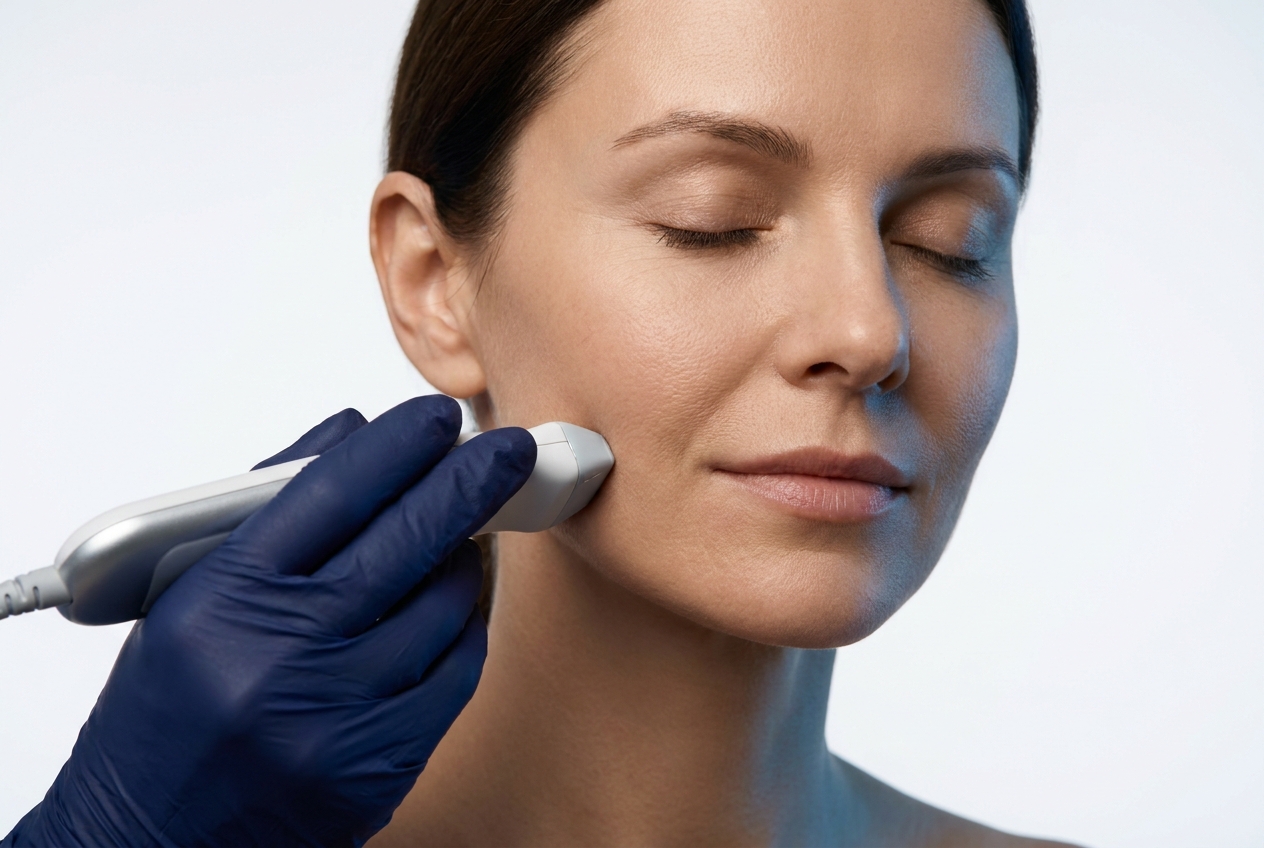
Ultherapy uses microfocused ultrasound with visualisation — MFU-V. The mechanism is genuinely different from every other non-surgical tightening device, and the difference is worth understanding because it explains both what it can do and what it cannot.
Transducers deliver ultrasound that converges at a fixed focal depth — 1.5 mm, 3.0 mm or 4.5 mm. At that focus, energy density is high enough to briefly raise tissue temperature above 60 °C, creating a discrete thermal coagulation point smaller than a cubic millimetre. Collagen contracts at around 65 °C and the body then remodels it. Tissue above and between the focal points is spared entirely — the epidermis is never breached.

The other distinctive feature is imaging. The system visualises tissue to about 8 mm depth. Worth being precise here, because the marketing overstates it: FDA’s cleared indication for the imaging is to ensure proper coupling of the transducer to the skin and to confirm appropriate depth of treatment such as to avoid bone. It is a coupling-and-safety check. The clinical literature describes it more expansively as a targeting advantage, and that is a fair clinical view — but it is not what the clearance says.
3 · The regulatory history, correctly
Almost every article says Ultherapy was “FDA-cleared in 2009 via 510(k).” That is wrong on both counts.

4 · What the evidence shows — including the numbers nobody quotes

The brow lift study
The pivotal published study (Alam et al., Journal of the American Academy of Dermatology, 2010) treated 35 evaluable patients with a median age of 44. Three masked expert raters judged 30 of 35 — 86% — to show clinically significant brow lift at day 90. The mean elevation was 1.7 mm.
That number is the most useful anchor in this article. It is a real, measurable, blinded result. It is also 1.7 millimetres. If you understand that going in, Ultherapy is very likely to satisfy you. If you are expecting a surgical result, it will not.
Duration, and the gap between blinded and unblinded assessment
The ASDS says effects can last up to a year with follow-up treatments possible. The only twelve-month dataset (n=20) reported physician-assessed improvement in 95% of subjects at one year — but blinded photographic assessment found improvement in only 43% at day 90. Both numbers are from the same study. We publish both because publishing only the first would be misleading.
There is also no published trial establishing an optimal maintenance interval. The common annual-touch-up recommendation is practice convention, and a sensible one — but it is convention.
5 · Who it works on — and who should be told no
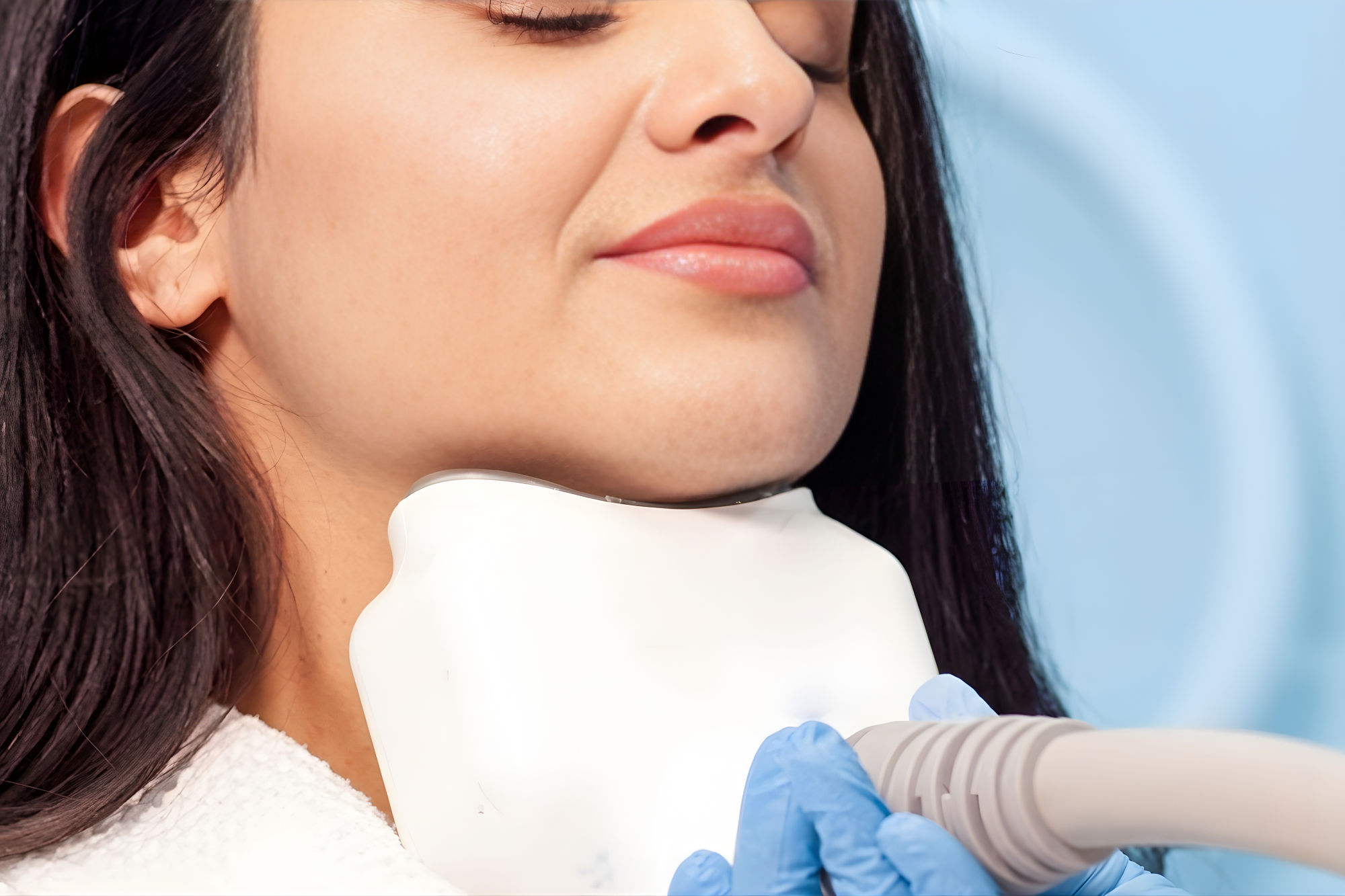

The BMI finding deserves a sentence, because it is rarely mentioned. In the reviewed literature, outcomes were better in patients with a BMI at or below 30, and no change was detected in more than half of patients above that threshold. That is not a moral judgment — it is a physics one about how energy focuses through tissue — and it is the sort of thing an honest consultation covers before you pay.
6 · Discomfort, side effects and the rare ones
Ultherapy has a reputation for being uncomfortable, and the pooled mean pain score of 4.85 out of 10 is a fair reflection. Face and neck averaged 4.62; body work ran higher at 5.58. The sensation is brief, deep heat with each line of energy — intermittent rather than continuous, which most people find manageable once they know what it is.
Common and transient: tenderness, redness and slight swelling. Less common: bruising, welting and nerve-related effects such as paraesthesia.
The review’s own conclusion on the fat-loss concern is worth quoting in spirit: the scientific literature lacks supporting evidence for it, and the reports that exist are anecdotal and largely unverified. That is neither a dismissal nor a confirmation, and pretending otherwise in either direction would be dishonest.
7 · Ultherapy or Morpheus8?
This is the actual decision most patients in Las Vegas are making, and the answer depends entirely on which problem you have.

If you want the Morpheus8 side in depth, we wrote a full guide to Morpheus8 in Summerlin and Las Vegas covering pricing, the acne-scar evidence and the FDA skin-type limit that applies at higher energy settings.
1825 Festival Plaza Dr #180, Las Vegas, NV 89135
(725) 525-6821 · Monday–Friday 9:00 AM – 7:00 PM, Saturday 9:00 AM – 4:00 PM
Treatment by the BHRC clinical team
Free on-site parking in Festival Plaza.
Consultations are free and carry no obligation.
Frequently Asked Questions
How much does Ultherapy cost in Las Vegas?
At BHRC Summerlin: from $1,200 for a single targeted area such as the brow, under-chin or décolletage; from $2,500 for face and neck; and from $3,800 for the full protocol including décolletage. Rejuvenation Club members take 20% off. There is no neutral published Nevada average to compare against — the national RealSelf average was $2,609 in 2023.
How many treatments do I need?
Usually one. Ultherapy is typically a single treatment with results developing over three to six months as collagen remodels. Some patients benefit from a second, and follow-up treatments can be performed — but there is no published trial establishing an optimal maintenance interval.
When will I see results?
Some immediate tightening from collagen contraction, then the real result over three to six months. Neocollagenesis begins within days and continues for weeks, with remodelling reported up to a year. This is not a treatment to judge at two weeks.
How long does it last?
The ASDS says effects can last up to a year, with follow-up treatments possible. The only twelve-month study reported 95% physician-assessed improvement at one year in 20 subjects — though blinded photographic assessment in the same study found improvement in 43% at 90 days. Both figures are real.
Is Ultherapy FDA-approved?
It is FDA-cleared, not approved — premarket approval does not apply to this device. It received De Novo classification in September 2009 for brow lift, then 510(k) clearances adding submental and neck tissue in 2012, décolleté lines in 2014, abdomen and arms in 2025, and knees in 2026.
Does it hurt?
It is uncomfortable rather than painful for most people. Pooled data puts the mean at 4.85 out of 10, with face and neck at 4.62 and body work at 5.58. The sensation is brief, deep heat with each line of energy, and it stops the moment the treatment does.
Is there downtime?
Essentially none. Expect tenderness, redness and slight swelling for a day or so. Bruising and transient tingling are less common but possible.
Am I a good candidate?
The published literature points to patients with mild-to-moderate laxity, normal wound healing, and a BMI at or below 30 — outcomes were notably better below that threshold. Patients with extensive photoaging, severe laxity, marked platysmal banding or a heavy neck are better served by surgery, and a good provider will say so.
Is it as good as a facelift?
No, and no trial has compared them. The honest anchor is the pivotal study’s mean brow elevation of 1.7 mm at 90 days, with 86% of patients judged improved by masked raters. That is a real result and for the right candidate a satisfying one — it is not surgery.
What is the first step?
A free consultation. Your provider will assess whether your concern is laxity, texture or volume, and whether Ultherapy, Morpheus8 or something else is the right answer — including when the right answer is a surgical referral.
Keep Reading
- Ultherapy at BHRC Summerlin
- Ultherapy at BHRC
- Morpheus8 in Summerlin & Las Vegas — Cost, Results & Downtime
- Morpheus8 at BHRC Summerlin
- Dermal Fillers at BHRC Summerlin
- Neurotoxins at BHRC — Botox, Dysport, Xeomin & Jeuveau
- Aging Skin at BHRC
- Rejuvenation Club Membership
Ultherapy at a BHRC Studio Near You
Ultherapy is available at BHRC studios nationwide, including our main six. Tap your closest location to book a free consultation:
References & Further Reading
- U.S. Food & Drug Administration — De Novo Classification DEN080006 — Ulthera System, 2009. accessdata.fda.gov
- U.S. Food & Drug Administration — 510(k) K121700 — Ulthera System, submental and neck indication, 2012. accessdata.fda.gov
- U.S. Food & Drug Administration — 510(k) K134032 — Ulthera System, décolleté indication, 2014. accessdata.fda.gov
- U.S. Food & Drug Administration — 510(k) K233996 — Ulthera System (UC-1 Control Unit PRIME), 2024. accessdata.fda.gov
- U.S. Food & Drug Administration — 510(k) K260618 — Ulthera System, abdomen, arms and knees, 2026. accessdata.fda.gov
- Journal of the American Academy of Dermatology — Alam M et al. Ultrasound tightening of facial and neck skin: a rater-blinded prospective cohort study, 2010. pubmed.ncbi.nlm.nih.gov
- Aesthetic Surgery Journal — Amiri M et al. Microfocused Ultrasound With Visualization (MFU-V) Effectiveness and Safety: A Systematic Review and Meta-Analysis, 2025. academic.oup.com
- Clinical, Cosmetic and Investigational Dermatology — Fabi SG. Noninvasive skin tightening: focus on new ultrasound techniques, 2015. dovepress.com
- Dermatologic Surgery — Humphrey VS et al. Microfocused Ultrasound With Visualization: A Systematic Review of Adverse Events and Risk of Subsequent Facelift Compromise, 2025. pubmed.ncbi.nlm.nih.gov
- Journal of Cosmetic Dermatology — Hitchcock TM, Dobke MK. Review of the safety profile for microfocused ultrasound with visualization, 2014. pubmed.ncbi.nlm.nih.gov
- American Society for Dermatologic Surgery — Ultrasound Therapy for Sagging Skin. asds.net
- Cleveland Clinic — Ultherapy. my.clevelandclinic.org
Beverly Hills Rejuvenation Center. This content is for general education and does not create a physician-patient relationship or constitute medical advice. Ultherapy is an FDA-cleared device, not an FDA-approved one. Published outcome figures are study averages and not a guarantee of result. Candidacy is assessed individually and some patients are better served by surgical treatment. Prices shown are starting rates and are not a quote. Candidacy, dosing, results and pricing vary by person and are confirmed at a free consultation. Reviewed by the BHRC clinical team.