
BHRC BLOG
How to Reconstitute Peptides: Bacteriostatic Water, Syringe Math & Storage
Peptides · Reconstitution, Syringe Math & Storage
Aim at the wall, swirl don’t shake, refrigerate and date the vial. And the number that ruins everything if you get it wrong: how much water you added.
1. Why peptides come as a powder at all
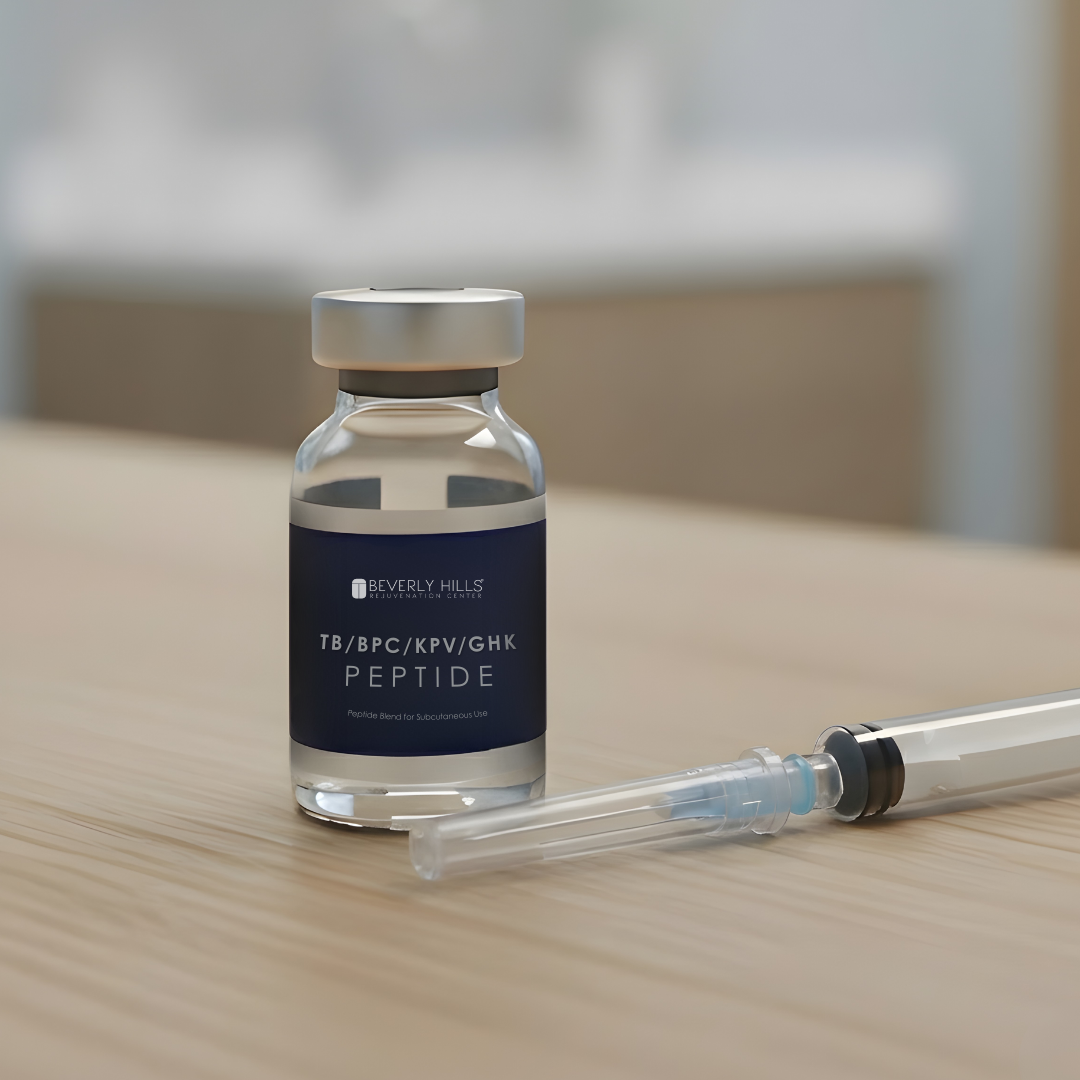
Peptides are short chains of amino acids and they are not stable in solution for long. The manufacturing answer is lyophilization — freeze-drying under vacuum, which removes water and leaves a stable cake. In that state the peptide keeps for months, often much longer, under appropriate storage.
Adding water reverses that. Once reconstituted, stability collapses from months to days or weeks. This is the fundamental reason the storage rules for a reconstituted vial are so much stricter than the rules for the sealed one.
2. Bacteriostatic water — what it is and why the preservative matters
Bacteriostatic Water for Injection is sterile, non-pyrogenic water containing benzyl alcohol as a preservative — 0.9% (9 mg/mL) in 30 mL plastic vials, 1.1% (11 mg/mL) in 30 mL glass vials.
The benzyl alcohol is what makes the vial multiple-dose. It suppresses microbial growth between punctures. Preservative-free Sterile Water for Injection has no such protection and is single-use. That single difference is why bacteriostatic water is the standard diluent for a peptide vial you will draw from repeatedly.

Two label facts worth stating precisely, because they are routinely mangled online:
- Neonates: contraindicated. The label carries the warning “NOT FOR USE IN NEONATES” — benzyl alcohol toxicity in newborns is a documented and serious problem.
- Pregnancy: a precaution, not a contraindication. The label says animal reproduction studies have not been conducted and that it “should be given to a pregnant woman only if clearly needed.” Writing “contraindicated in pregnancy” is inaccurate — though separately, most peptide protocols themselves are not appropriate in pregnancy.
- Not for fluid replacement, and not for epidural or spinal anaesthesia. Injected intravenously without a solute, it can cause hemolysis.
3. The technique — and why every step exists
The best citable sources for reconstitution technique are the FDA-approved labels of lyophilized peptide drugs, which are explicit about it. Here is the sequence, with the reason attached to each step.

Why aim at the wall? Peptides are surface-active. A fast stream landing directly on the cake, or shaking the vial, creates shear and a large air-liquid interface — and that interface is where peptides denature and aggregate. Directing the diluent down the glass lets it wet the cake gently.
Why is foam a problem? Foam is not cosmetic. It is a visible marker of protein denaturation at the air-liquid interface. The tesamorelin label instructs users to “let the vial rest for a few seconds until the layer of foam separates and the solution becomes clear and colorless.”
Why does the alcohol have to dry? USP General Chapter <797>, the sterile compounding standard, specifies that critical sites such as vial stoppers are wiped with sterile 70% isopropyl alcohol which “is allowed to dry” before puncture. The contact and dry time provides the chemical action; the wipe provides the mechanical action. Wiping and immediately puncturing skips half of it.
4. The syringe math, worked twice
A U-100 insulin syringe is calibrated for preparations containing 100 units per millilitre. On that syringe, 1 unit = 0.01 mL. That is all a “unit” means when you are measuring a peptide — it is a volume marking, not a measure of the peptide’s potency.
Worked example: a 5 mg vial, 2 mL of water, a 250 mcg dose
Step 1 — concentration. 5 mg ÷ 2 mL = 2.5 mg/mL, which is 2,500 mcg/mL.
Step 2 — volume for the dose. 250 mcg ÷ 2,500 mcg/mL = 0.1 mL.
Step 3 — convert to units. 0.1 mL × 100 units/mL = 10 units — the “10” mark on a U-100 syringe.
Cross-check, a different way. 2 mL of total volume is 200 units on the syringe. 5,000 mcg ÷ 200 units = 25 mcg per unit. 250 mcg ÷ 25 mcg per unit = 10 units. Both methods agree, which is exactly what you want before you inject anything.

5. Storage and beyond-use dating
This is where most online guidance is confidently wrong, so it is worth being careful.
The often-quoted 28-day figure is real and has a specific source: USP <797> section 15.2 states that a conventionally manufactured multiple-dose container, once entered, “is not used for more than 28 days unless otherwise specified by the manufacturer on the labeling.” The CDC gives the same guidance for multi-dose vials. The underlying basis is USP <51>, the antimicrobial effectiveness standard — the preservative system must be shown effective across that interval.
But 28 days is a ceiling, not a default — and for reconstituted peptides the actual label is almost always shorter. Two FDA-approved examples make the point:

The practical rules that hold across the category:
- Refrigerate the reconstituted vial at 2–8 °C unless the specific product says otherwise. Do not freeze a reconstituted peptide.
- Protect from light — keep it in the original carton or an opaque container.
- Write the date on the vial the moment you reconstitute it. Every source that discusses this agrees on the step and almost nobody does it.
- New sterile needle and syringe for every entry. Non-negotiable.
- Use the beyond-use date your pharmacy assigned, which is based on their stability data — not a number you found online. There is no published beyond-use date that applies to “peptides” as a class.
6. The regulatory context you should know
Good technique cannot fix a bad source. Under section 503A, a bulk drug substance may be compounded only if it has a USP monograph, is a component of an FDA-approved drug, or appears on the FDA’s 503A Bulks List — a list of six substances, none of which is a peptide.
The FDA removed twelve peptides from its Category 2 list in April 2026, and an advisory committee recommended six for the bulks list in July 2026. Neither of those events made any peptide compoundable. Removal from Category 2 does not confer eligibility, and advisory-committee votes are non-binding recommendations the agency has not acted on. We covered this in our guide to the 2026 reclassification and in our piece on provider-led protocols.
What this means practically: a product from a 503A or 503B pharmacy comes with identity, potency, sterility and endotoxin testing, and an assigned beyond-use date. A “research use only” vial comes with none of those things and no recourse if something is wrong with it.
1860 S Sepulveda Blvd, Los Angeles, CA 90025
(310) 861-3748 · Monday–Friday 9:00 AM – 6:00 PM, Saturday 9:00 AM – 4:00 PM
Treatment by the BHRC clinical team
4.8 stars across 287 verified reviews
Provider-led peptide protocols with pharmacy-sourced product.
Consultations are free and carry no obligation.
Questions we get asked
Can I use regular sterile water instead of bacteriostatic water?
Only for a single-use preparation. Sterile Water for Injection has no preservative, so there is nothing suppressing microbial growth after the first puncture. For a vial you will draw from repeatedly, bacteriostatic water is the standard — and your prescriber should specify which.
What happens if I shake the vial?
Shaking creates shear and a large air-liquid interface, which drives peptide denaturation and aggregation. Visible foam is the marker. Swirl with a gentle rotary motion instead, and let any foam separate before drawing.
How long does a reconstituted vial last?
Follow the beyond-use date your dispensing pharmacy assigned. USP <797> caps multi-dose containers at 28 days after first entry, but manufacturer labels are frequently shorter — 14 days for one FDA-approved somatropin product, 7 days for a tesamorelin product. There is no universal number.
Can I freeze a reconstituted peptide to make it last longer?
No. FDA labels for reconstituted lyophilized peptides specify refrigeration and say not to freeze. Freeze-thaw cycles are a known cause of aggregation.
The solution looks cloudy. Is that normal?
No. FDA labels are explicit: if the solution is cloudy immediately after reconstitution or after refrigeration, it must not be injected. Contact your prescriber or pharmacy.
Does the unit count change if my vial is a different size?
Yes, completely. The unit count depends on both the amount of peptide and the volume of water. Always recompute for your specific vial and your specific diluent volume — never carry a number across from a different vial.
Keep reading
- Peptide therapy at BHRC — how the program works
- Provider-led peptide and hormone protocols
- The 2026 FDA peptide reclassification, explained
- Peptide stacking — combining peptides safely
- Sermorelin dosage, protocol timing and results timeline
- What are peptides, actually?
- Peptide therapy at BHRC West Los Angeles
Book at any of our six locations
References
- U.S. NIH DailyMed — Bacteriostatic Water for Injection — FDA label, including the neonate warning and benzyl alcohol content. dailymed.nlm.nih.gov
- Pfizer / Hospira — Bacteriostatic Water for Injection, USP — prescribing information (0.9% and 1.1% benzyl alcohol presentations). labeling.pfizer.com
- U.S. Food and Drug Administration — Nutropin (somatropin) label — reconstitution technique and 14-day refrigerated beyond-use date. accessdata.fda.gov
- U.S. Food and Drug Administration — EGRIFTA WR (tesamorelin) prescribing information and instructions for use — swirl, do not shake; 7-day room-temperature dating. accessdata.fda.gov
- USP General Chapter <797> — Pharmaceutical compounding — sterile preparations, §8.3 (critical site disinfection) and §15.2 (28-day multi-dose limit). floridahealth.gov
- U.S. Centers for Disease Control and Prevention — Preventing unsafe injection practices — multi-dose vial handling and the 28-day rule. cdc.gov
- U.S. NIH DailyMed — HUMULIN R label — U-100 means 100 units per mL, and the warning about using a matching syringe. dailymed.nlm.nih.gov
- Cornell Legal Information Institute — 21 CFR § 216.23 — the 503A bulks list. law.cornell.edu
Beverly Hills Rejuvenation Center. This content is for general education and does not create a physician-patient relationship or constitute medical advice. This article explains reconstitution technique for patients following a prescriber’s instructions. It is not a protocol and does not recommend any dose. Always follow the instructions and beyond-use date supplied with your specific product. Candidacy, dosing, results and pricing vary by person and are confirmed at a free consultation. Reviewed by the BHRC clinical team.