BHRC BLOG
Sermorelin Dosage Guide: Protocol, Timing & Results Timeline
BHRC · LONGEVITY & WELLNESS · PEPTIDES
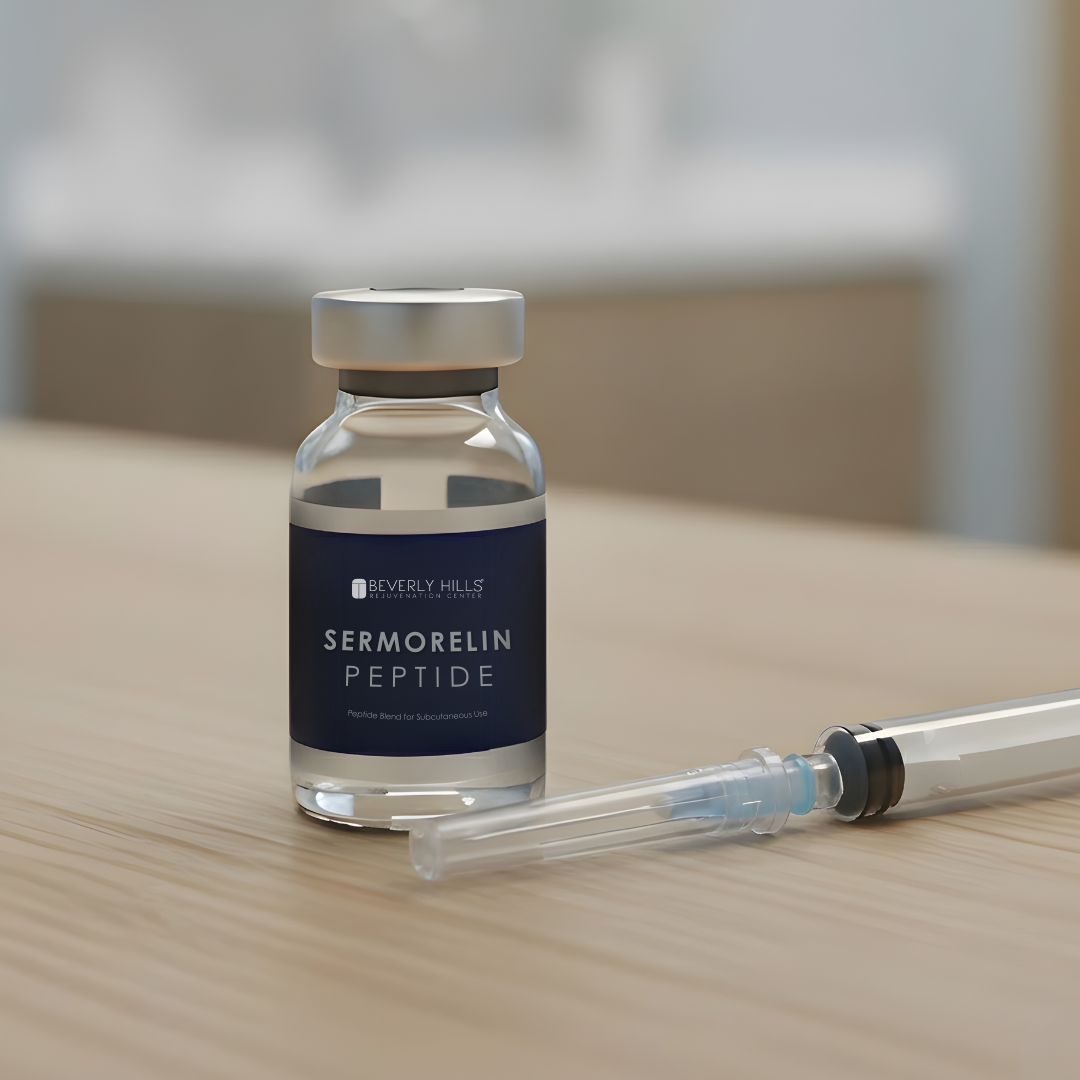
Sermorelin sits in an unusual position: it is one of the better-studied peptides in the wellness category, and also one of the most over-promised. The mechanism is genuinely elegant — it does not replace growth hormone, it asks your own pituitary to make more of it, which keeps the body’s natural brakes connected. What the trials found is real but narrower than the marketing: biomarkers and body composition move, strength and aerobic fitness mostly do not. This guide covers the protocols used in published studies, why bedtime and fasted dosing have a physiologic basis, a results timeline built from measured endpoints rather than promises, and the regulatory history that almost every article gets wrong in one direction or the other.
1 · What sermorelin is, and why the mechanism matters
Your hypothalamus makes a 44–amino-acid peptide called growth hormone–releasing hormone. It travels a very short distance to the anterior pituitary, binds a receptor on cells called somatotrophs, and tells them to transcribe and release growth hormone.
Sermorelin is the first 29 amino acids of that molecule, amidated at the end — written GRF(1-29)NH₂. It is the shortest fragment that retains full biological activity. Everything past amino acid 29 turns out to be structurally useful but not functionally required.

That last row is the part worth sitting with. Because sermorelin acts upstream, output remains subject to two natural brakes — hypothalamic somatostatin tone, and negative feedback from IGF-1 itself, which inhibits GH secretion at both the hypothalamus and the pituitary. Injected growth hormone bypasses both. Whether that difference translates into a meaningfully better safety profile has not been proven head to head, but the mechanism is real and it is why secretagogues exist as a category.
One more thing sermorelin does that rarely gets mentioned: it produces small acute rises in prolactin, FSH and LH alongside the GH response. Worth knowing if you are already being treated for anything hormonal.
2 · Why bedtime, and why fasted
These two instructions get repeated everywhere without explanation, which makes them sound like folklore. They are not — both have a defensible physiologic basis.

So a bedtime injection lands at the moment your own pulse generator is already firing hardest, and a fasted injection removes the glucose-driven brake on it. Neither rule is arbitrary, and neither is optional if you want the protocol to do what it is designed to do.
3 · Doses used in the published trials
We are going to give you the doses that appear in peer-reviewed adult studies, rather than the numbers that circulate on protocol sites. The distinction matters, and we explain why below the table.

You will also see a specific consumer protocol repeated across the internet — something like 200 to 500 mcg nightly, five nights on and two off, in three-to-six-month courses. We could not trace those numbers to any published trial or regulatory source; every source for them was commercial. That does not automatically make them wrong, but it does mean they are practice convention rather than trial-derived, and they should be described that way.
4 · A realistic results timeline
This is the section most sermorelin content gets wrong, usually by promising sleep, skin, libido and energy — none of which has been a primary endpoint in a sermorelin trial. Here is what was actually measured.

What is well supported
- Sermorelin raises endogenous GH — 12-hour mean GH release doubled in elderly men in one review
- IGF-1 rises in a dose-dependent fashion
- Modest body-composition change over months: lean mass up, fat down, visceral fat especially
- A plausible cognitive signal — one 2006 study in 89 older adults found improvement in problem solving, psychomotor processing speed and working memory
What is not supported
Strength and aerobic fitness. The six-month trial found no improvement in either. Vittone’s six-week study found improvement in only two of six strength measures, with no IGF-1 change.
Sleep quality, skin quality, libido, energy. No sermorelin trial has used any of these as a primary endpoint. They may improve; there is simply no trial evidence that they do.
The premise itself, arguably. Endotext, the reference endocrinology text, states that it is unknown whether the age-related decrease in trophic hormones represents an adaptive or a pathological process, and that aging per se is not an indication for growth hormone testing or administration. That is worth reading twice before starting anything.
5 · The regulatory story, told accurately
Sermorelin’s status gets misstated constantly in both directions — some sources call it FDA-approved, others imply it was pulled for safety. Neither is right.

So where does that leave things today?
- There is no FDA-approved sermorelin product in the United States. Any sermorelin you receive is compounded, and compounded drugs are not FDA-approved — FDA does not verify their potency, purity or sterility.
- Sermorelin is not on FDA’s Category 2 list of substances that may present significant safety risks. It was not among the peptides removed from that list in April 2026, and not among the seven peptides the advisory committee reviewed in July 2026.
- It is routinely prepared by 503A compounding pharmacies on physician prescription, on the basis that sermorelin acetate was the active ingredient of an approved drug.
6 · Safety, honestly framed
Sermorelin’s own reported side-effect profile is mild: nausea, facial flushing, and redness or pain at the injection site. One 2020 review characterized the overall profile as very favorable. Vittone’s six-week study at 2 mg nightly reported no adverse effects, and Corpas’s 14-day study found no change in fasting glucose, urinary C-peptide, blood pressure or routine labs.
The more useful risk frame, though, is not sermorelin’s own side effects — it is the class effects of raising GH and IGF-1, because that is the entire point of taking it.

Older adults are more sensitive to GH replacement and more susceptible to adverse events. On cancer risk, the honest statement from the endocrinology literature is that there is no definitive evidence that GH replacement in adult GH deficiency increases the risk of new or recurrent malignancy — which is accurate, and is not the same sentence as “no risk.”
Who should not take sermorelin
There is no current FDA label for sermorelin, so the appropriate guardrails are the contraindications for growth hormone therapy itself — since raising GH is the entire purpose:
- Active, recent or suspected malignancy, or any undiagnosed mass
- Acute critical illness
- Uncontrolled diabetes, or active proliferative / severe non-proliferative diabetic retinopathy
- Pregnancy or breastfeeding
- Known hypersensitivity to sermorelin or its excipients
- Untreated hypothyroidism or adrenal insufficiency — these blunt the GH response and should be corrected first
- Anyone with clinical suspicion of true adult GH deficiency, who should be evaluated by an endocrinologist rather than treated empirically
What should be monitored
At minimum: IGF-1 at baseline and on treatment, read against an age- and sex-adjusted reference range; fasting glucose and HbA1c; thyroid function; and a symptom check for edema, joint pain and carpal tunnel symptoms. If a program is not drawing labs, it is not monitoring you — it is selling you a vial. Advanced diagnostic testing is part of every BHRC peptide program for this reason.

7 · How to have a useful conversation about it
If you are considering sermorelin, these are the questions that separate a real program from a vial subscription.

Physician-supervised peptide programs are available at all six BHRC studios. Consultations are free, include a review of your history and current labs, and carry no obligation.
If sermorelin is not the right tool for what you are actually trying to fix, we will tell you.
Frequently Asked Questions
Is sermorelin FDA-approved?
Not currently. It was approved twice as Geref — in December 1990 as a diagnostic agent and in September 1997 for idiopathic growth hormone deficiency in children. Both products were discontinued in 2008 and the approval formally withdrawn in 2009. In a March 2013 Federal Register notice, FDA determined that Geref was not withdrawn for reasons of safety or effectiveness. Any sermorelin available today is compounded on physician prescription.
What dose is used?
Published adult trials used regimens from 0.5–1 mg subcutaneously twice daily, to 2 mg nightly, to 10 µg/kg nightly, over durations from 14 days to six months. Your dose should be set by a physician against your baseline IGF-1, not chosen from a chart.
Why at bedtime?
Growth hormone release is maximal in the second half of the night, with peak levels occurring within minutes of slow-wave sleep onset. A bedtime injection lands when your own pulse generator is already firing hardest. Fasted dosing matters too, because somatostatin — the brake on GH release — is inhibited by high blood glucose.
How long until I see results?
Biomarkers move before anything visible does. Twice-daily dosing restored GH and IGF-1 to young-adult levels within 14 days in one trial. Body composition changes — lean mass up, visceral fat down — showed up over three to six months. The six-month trial reported IGF-1 up 35%.
Will it make me stronger?
The trials say no. A six-month trial found no improvement in strength or aerobic fitness, and a six-week trial found improvement in only two of six strength measures. It did find that physical functional performance held steady in the treated group while the placebo group declined — a real result, but a different claim.
Is sermorelin safer than growth hormone?
The mechanism is more physiologic: it acts on the pituitary rather than replacing the hormone, so release stays pulsatile and IGF-1 feedback and somatostatin braking remain intact. That is a genuine argument, but it has not been proven head to head. The class effects of raising GH — fluid retention, joint pain, carpal tunnel symptoms, elevated fasting glucose — still apply.
What are the side effects?
Sermorelin’s own reported effects are mild: nausea, facial flushing, and redness or pain at the injection site. The effects worth monitoring come from raising GH and IGF-1 — edema, arthralgia, carpal tunnel symptoms and elevated fasting glucose are all reported across GH and GHRH trials.
Who should not take it?
Anyone with active, recent or suspected malignancy or an undiagnosed mass; anyone acutely critically ill; anyone with uncontrolled diabetes or active proliferative diabetic retinopathy; anyone pregnant or breastfeeding. Untreated hypothyroidism or adrenal insufficiency should be corrected first, since both blunt the GH response.
What labs should be drawn?
IGF-1 at baseline and on treatment, against an age- and sex-adjusted reference range, plus fasting glucose and HbA1c, thyroid function, and a symptom check for edema and carpal tunnel symptoms. A program without labs is not a program.
What is the first step?
A free consultation. Your BHRC provider reviews your history, orders baseline testing, and tells you whether sermorelin is the right tool for what you are actually trying to change — including when the answer is that something else is.
Keep Reading
- Sermorelin at BHRC
- Tesamorelin + Ipamorelin Blend: Dosage, Ratios & Protocol
- Ipamorelin Dosage Guide: Complete Protocol
- CJC-1295 Dosage Guide: Complete Protocol
- Peptide Therapy in Los Angeles
- Advanced Diagnostic Testing
- Longevity & Healthspan at BHRC
- Men’s Health at BHRC
Peptide Therapy at a BHRC Studio Near You
Physician-supervised peptide programs, with baseline and follow-up labs, are available at BHRC studios nationwide, including our main six. Tap your closest location to book a free consultation:
Westlake VillageConejo Valley, CA
West HollywoodLos Angeles, CA
West Los AngelesLos Angeles, CA
SummerlinLas Vegas, NV
Paradise ValleyScottsdale / Phoenix, AZ
References & Further Reading
- Federal Register / U.S. Food & Drug Administration — Determination That GEREF (Sermorelin Acetate) Injection Was Not Withdrawn From Sale for Reasons of Safety or Effectiveness, March 4, 2013. federalregister.gov
- U.S. Food & Drug Administration — Drugs@FDA — GEREF (sermorelin acetate), NDA 020443 — approved September 26, 1997; marketing status discontinued. accessdata.fda.gov
- U.S. Food & Drug Administration — Drugs@FDA — GEREF (sermorelin acetate), NDA 019863 — approved December 28, 1990; marketing status discontinued. accessdata.fda.gov
- U.S. Food & Drug Administration — Bulk Drug Substances Used in Compounding Under Section 503A of the FD&C Act. fda.gov
- Endotext / NCBI Bookshelf — Fredrick JR et al. Growth Hormone and Aging. ncbi.nlm.nih.gov
- Endotext / NCBI Bookshelf — Olarescu NC et al. Normal Physiology of Growth Hormone in Adults. ncbi.nlm.nih.gov
- Journal of Clinical Endocrinology & Metabolism — Corpas E et al. GH-releasing hormone-(1-29) twice daily reverses the decreased GH and IGF-I levels in old men, 1992. pubmed.ncbi.nlm.nih.gov
- Metabolism — Vittone J et al. Effects of single nightly injections of growth hormone-releasing hormone (GHRH 1-29) in healthy elderly men, 1997. pubmed.ncbi.nlm.nih.gov
- Translational Andrology and Urology — Sinha DK et al. Beyond the androgen receptor: the role of growth hormone secretagogues in the modern management of body composition in hypogonadal males, 2020. tau.amegroups.org
- Frontiers in Aging — Fernández-Garza LE et al. Growth hormone and aging: a clinical review, 2025. frontiersin.org
- DailyMed / U.S. National Library of Medicine — GENOTROPIN (somatropin) prescribing information — contraindications and warnings for growth hormone therapy. dailymed.nlm.nih.gov
Beverly Hills Rejuvenation Center. This content is for general education and does not create a physician-patient relationship or constitute medical advice. Sermorelin is not currently FDA-approved and is available only as a compounded preparation on physician prescription. Dosing regimens cited here are drawn from published clinical trials for informational purposes and are not a recommendation or a prescription. Candidacy, dosing, results and pricing vary by person and are confirmed at a free consultation. Reviewed by the BHRC clinical team.