
BHRC BLOG
Hexarelin, GHRP-2 & GHRP-6 — Doses Used in Humans and What the Evidence Shows
Growth Hormone Secretagogues · Evidence Review
This class has more real human data than almost any other peptide group — and no lawful compounding route. Both of those facts deserve saying out loud.
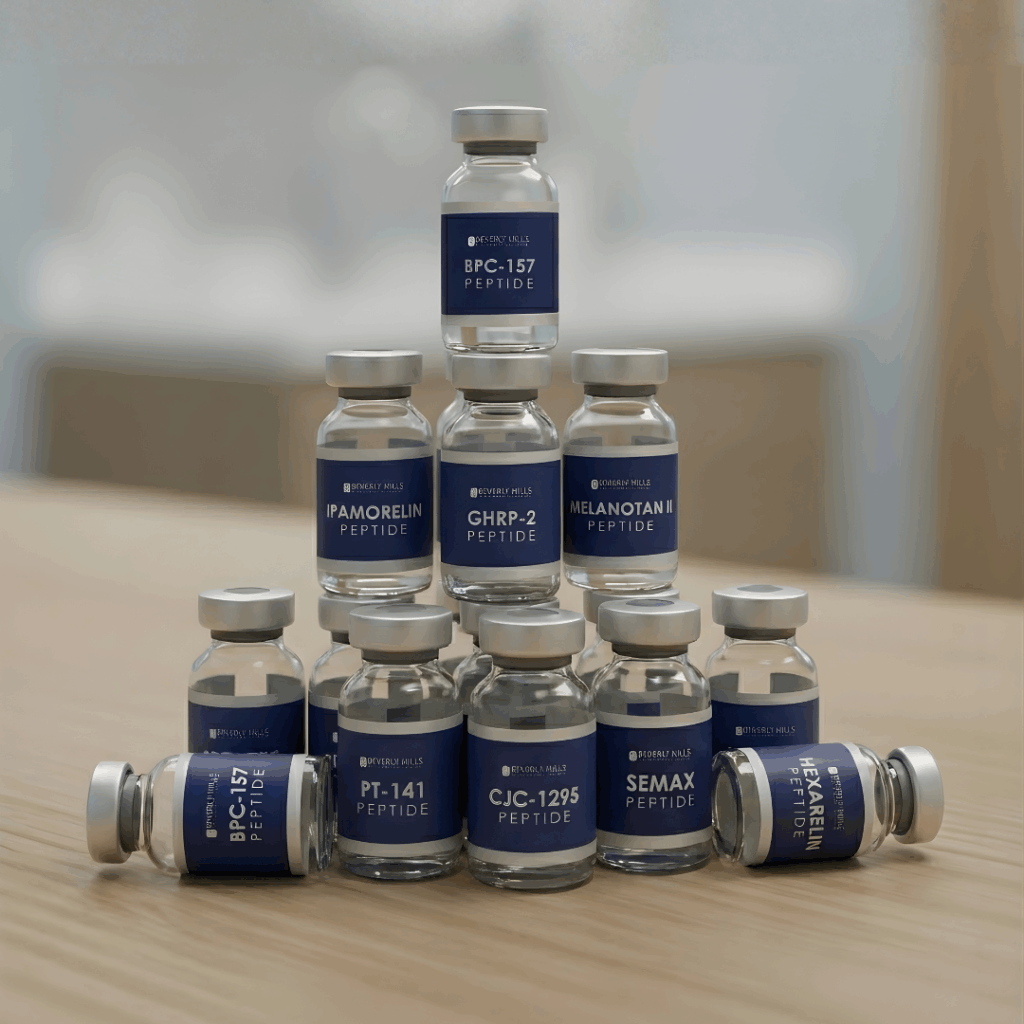
1. One mechanism, three molecules
All three are synthetic agonists of the GHS-R1a receptor — the ghrelin receptor. They predate the 1999 discovery of ghrelin itself; they were the pharmacological tools that led to the receptor being identified in the first place.
- GHRP-6 — a hexapeptide, the prototype of the class.
- GHRP-2 (pralmorelin) — a “non-natural super-analog” of GHRP-6.
- Hexarelin (examorelin) — also a GHRP-6 super-analog; additionally reported to bind CD36, a scavenger receptor, which is the basis of its cardiac claims.
They act on pituitary somatotrophs and on the hypothalamus, and they are synergistic with GHRH because that is a different receptor. Critically, GHS-R1a agonism is not GH-specific: the same pathway drives ACTH and cortisol release and, centrally, appetite.
2. The human doses — from the actual studies
This class is unusual in that the human data is real. It is worth being precise about what was studied, because it is nothing like the way these are marketed.

Two of those deserve attention. Massoud 1996 found that hexarelin’s prolactin ED50 (0.39 µg/kg) was lower than its GH ED50 (0.48 µg/kg) — meaning prolactin rises before growth hormone does. And it found a step increase in cortisol of about 40% at 0.5 µg/kg, with no cortisol rise at all at 0.125 µg/kg. That last detail is the one genuinely useful dosing insight in this literature: low-dose hexarelin combined with GHRH produced large GH release with no rise in cortisol.
Rahim 1998 is the one that should give anyone pause about continuous use. Sixteen weeks of hexarelin at 1.5 µg/kg twice daily saw the GH response fall from 19.1 to 12.3 at four weeks and 10.5 at sixteen weeks — and recover to 19.4 four weeks after stopping. The authors’ conclusion was “partial and reversible attenuation,” with the biological impact on the GH–IGF-I axis described as “minimal.”
3. The off-target effects, attributed precisely

One correction worth making, because it circulates constantly: the appetite data is for GHRP-2, not GHRP-6. The controlled human study showing a 35.9% increase in food intake used GHRP-2. GHRP-6’s reputation as the appetite peptide rests on animal work and mechanistic analogy to ghrelin. We could not find a controlled human trial of GHRP-6 on food intake. If a vendor states it as established, they have not read the source.
Hexarelin’s cardiac claims deserve similar scepticism. They rest on CD36 binding, animal ischemia models and small acute human hemodynamic studies. There is no clinical outcome trial — no mortality, hospitalisation or durable function endpoint. That is not a basis for any cardiac claim in patient-facing content, and we are not going to make one.
4. Where these actually stand with the FDA

The FDA’s stated reasoning for keeping these in Category 2 is specific and worth quoting in substance. For GHRP-2 it cites immunogenicity risk from aggregation and peptide-related impurities, plus serious adverse events in the literature including increased insulin requirement, infection, pancreatitis and death. For GHRP-6 it cites the same immunogenicity concern plus effects on cortisol and blood glucose. Ipamorelin carries the same immunogenicity language, with the agency citing serious adverse events including death via intravenous administration.
5. What has a genuine pathway instead
Tesamorelin is the only agent in this whole class with an FDA approval — a GHRH analog approved in 2010 for reduction of excess abdominal fat in HIV patients with lipodystrophy. Real label, real phase 3 data, real safety monitoring. Everything outside that indication is off-label.
Sermorelin had approvals — GEREF, for pediatric growth hormone deficiency and pituitary testing — and was withdrawn from sale in 2009. The FDA formally determined in 2013 that it was not withdrawn for reasons of safety or effectiveness, which was a business decision. That determination is what permits generic referencing; it is not an endorsement of compounded sermorelin, and no sermorelin product is FDA-approved today. We wrote about it in detail in our sermorelin dosage and protocol guide.
6. What a responsible clinic should tell you
- The human data is real but old, tiny and mostly diagnostic. These were studied as provocative endocrine agents and in short pediatric trials, not as healthy-adult wellness interventions.
- The GH effect attenuates. Chronic hexarelin halved the GH response within sixteen weeks. Continuous use is not supported by the data that exists.
- They are not GH-selective. Cortisol, prolactin and appetite effects are documented in humans at the doses studied.
- There is no lawful compounding route. Not for GHRP-2, GHRP-6, hexarelin or ipamorelin.
- Any tested athlete will fail. All are explicitly named under WADA S2.2 as non-Specified substances prohibited in and out of competition. There is no exemption available.
- If the goal is the GH axis, ask about the agent with a label. That conversation is worth having and is free.
We would rather lose the booking than publish a dosing protocol for something the FDA has placed in a category defined by identified significant safety risks.
If you came here looking for a protocol, we understand the disappointment — and we would point you instead toward provider-led protocols under medical supervision, and toward a baseline panel that tells you whether the GH axis is actually where your problem is. Fatigue and poor recovery are far more often sleep, thyroid, iron or genuine hormone deficiency — all of which have real treatments.
1860 S Sepulveda Blvd, Los Angeles, CA 90025
(310) 861-3748 · Monday–Friday 9:00 AM – 6:00 PM, Saturday 9:00 AM – 4:00 PM
Treatment by the BHRC clinical team
4.8 stars across 287 verified reviews
Provider-led peptide and hormone protocols are run here.
Consultations are free and carry no obligation.
Questions we get asked
What’s the difference between GHRP-2, GHRP-6 and hexarelin?
Less than the marketing suggests. All three are ghrelin receptor agonists. In the key head-to-head human study, GHRP-2 and hexarelin produced similar GH responses, both greater than GHRH, and both raised prolactin, ACTH and cortisol. The differences are potency and selectivity gradations.
Is ipamorelin safer because it’s selective?
The selectivity finding comes from experiments in anesthetized rats and conscious swine — there were no human subjects. Ipamorelin is in FDA Category 2 with the same immunogenicity concerns as GHRP-2 and GHRP-6, and the FDA cites serious adverse events including death via IV administration.
Can a clinic legally prescribe these?
None is on the FDA’s 503A bulks list, none has a USP monograph, and none is a component of an approved drug — so none satisfies any of the three statutory routes for compounding. GHRP-2, GHRP-6 and ipamorelin are additionally in Category 2.
Will the GH effect keep working if I stay on it?
The one chronic-dosing human study found the GH response roughly halved within sixteen weeks, recovering four weeks after stopping. That is the only human data on sustained administration, and it argues against continuous use.
Will these show up on a drug test?
Yes. GHRP-2, GHRP-6, hexarelin (named as examorelin), ipamorelin and sermorelin are all explicitly listed under WADA S2.2 as non-Specified substances prohibited at all times — in and out of competition.
What should I take instead?
That depends entirely on what you are trying to fix, which is why the answer starts with labs. Tesamorelin is the only agent in this class with an FDA-approved indication, and it is narrow. For most people who come in asking about secretagogues, the useful conversation turns out to be about sleep, thyroid or genuine hormone deficiency.
Keep reading
- Peptide therapy at BHRC — how the program works
- Sermorelin dosage, protocol timing and results timeline
- Tesamorelin and ipamorelin blends — dosage and the claims
- Provider-led peptide and hormone protocols
- The 2026 FDA peptide reclassification, explained
- Peptide stacking — combining peptides safely
- Advanced lab testing — start with a baseline
Book at any of our six locations
References
- Arvat E, di Vito L, Maccagno B, et al. — Effects of GHRP-2 and hexarelin on GH, prolactin, ACTH and cortisol levels in man. Peptides 1997;18(6):885–891. doi.org
- Massoud AF, Hindmarsh PC, Brook CG — Hexarelin-induced growth hormone, cortisol and prolactin release: a dose-response study. J Clin Endocrinol Metab 1996;81(12):4338–4341. doi.org
- Rahim A, O’Neill PA, Shalet SM — Growth hormone status during long-term hexarelin therapy. J Clin Endocrinol Metab 1998;83(5):1644–1649. academic.oup.com
- Laferrère B, Abraham C, Russell CD, Bowers CY — Growth hormone releasing peptide-2 (GHRP-2), like ghrelin, increases food intake in healthy men. J Clin Endocrinol Metab 2005;90(2):611–614. academic.oup.com
- Mericq V, Cassorla F, Bowers CY, et al. — Effects of eight months treatment with graded doses of a GH-releasing peptide in GH-deficient children. J Clin Endocrinol Metab 1998;83(7):2355–2360. academic.oup.com
- Raun K, Hansen BS, Johansen NL, et al. — Ipamorelin, the first selective growth hormone secretagogue. Eur J Endocrinol 1998;139(5):552–561 — note: rat and swine experiments. doi.org
- U.S. Food and Drug Administration — Certain bulk drug substances for use in compounding that may present significant safety risks — Category 2, including GHRP-2, GHRP-6 and ipamorelin. fda.gov
- World Anti-Doping Agency — The 2026 Prohibited List — section S2.2, growth hormone releasing peptides and secretagogues. wada-ama.org
- U.S. Federal Register — Determination that GEREF (sermorelin acetate) injection was not withdrawn from sale for reasons of safety or effectiveness, 4 March 2013. federalregister.gov
- U.S. Food and Drug Administration — EGRIFTA (tesamorelin) prescribing information, NDA 022505 — the only FDA-approved agent in this class. accessdata.fda.gov
Beverly Hills Rejuvenation Center. This content is for general education and does not create a physician-patient relationship or constitute medical advice. GHRP-2, GHRP-6, hexarelin and ipamorelin are not FDA-approved, do not appear on either FDA compounding bulks list, and are prohibited at all times under the WADA Prohibited List. This article reports published research doses; it is not a protocol and BHRC does not recommend one. Candidacy, dosing, results and pricing vary by person and are confirmed at a free consultation. Reviewed by the BHRC clinical team.