BHRC BLOG
Joint Injections & Non-Surgical Pain Management in West LA
BHRC · WELLNESS · PAIN MANAGEMENT
Knee pain is where regenerative medicine makes its biggest promises and where the evidence is most worth reading carefully — because unusually for this field, there is a lot of it. There are forty-eight randomized trials, three major guideline bodies with three different positions, and one large rigorous trial whose result contradicts the headline. All of that is genuinely useful if you lay it out honestly. This guide does: what PRP is in a joint, what the positive and negative evidence each show, why the guidelines disagree, who actually responds, what it costs at BHRC West Los Angeles, and the late-presenting complication everyone should know to watch for.
1 · What goes first, before any injection
It is unusual for a clinic to lead with this, but the evidence leaves no room for anything else: exercise is the only intervention that every major guideline body strongly recommends.
The American Academy of Orthopaedic Surgeons gives supervised, unsupervised and aquatic exercise its strong rating — the highest in the guideline. OARSI classifies structured land-based exercise as a Core Treatment for knee, hip and polyarticular osteoarthritis, appropriate for the majority of patients in nearly any scenario. The American College of Rheumatology strongly recommends it, noting the vast majority of patients can participate in and benefit from some form of exercise.
2 · What PRP actually is, in a joint
Blood is drawn, spun in a centrifuge to concentrate the platelets, and the platelet-rich fraction is injected into the joint space. Nothing foreign is introduced — it is autologous, your own tissue.
Platelet alpha-granules release PDGF, TGF-β, VEGF, EGF and IGF-1. Release begins about ten minutes after injection with at least 95% released within an hour. The proposed action in a joint is on the inflammatory environment and on the cells maintaining cartilage and synovium — not on physically rebuilding cartilage, which is a claim worth resisting.

3 · What the evidence shows — both halves of it
This is a field where the positive and negative findings are both real, and reading only one of them gives you a false picture.
The positive evidence

The negative evidence
The RESTORE trial (JAMA, 2021) randomized 288 patients with symptomatic medial knee osteoarthritis, Kellgren-Lawrence grades 2–3, to three weekly injections of leukocyte-poor PRP or saline placebo.
- Pain at 12 months: PRP −2.1, placebo −1.8. Between-group difference −0.4, P = 0.17. Not significant.
- Medial tibial cartilage volume: −1.4% versus −1.2%. Not significant.
- 29 of 31 prespecified secondary outcomes showed no significant difference.
Both groups improved by around two points, which tells you something important on its own: there is a large placebo and contextual effect in this condition.
4 · What the guidelines say, and why they disagree

Two honest observations about that table. First, we will not tell you guidelines support PRP, because two of three recommend against it. Second, both of those recommendations date from 2019 and predate several of the larger positive meta-analyses published in 2024 and 2026. That is a fair argument for the guidelines being due an update — it is not an argument that they currently endorse the treatment.
AAOS’s separate technology overview is explicit that it does not make recommendations for or against PRP, while noting that it has demonstrated statistically significant improvement in some patient-reported outcomes compared with placebo, alongside substantial limitations including inconsistent reporting of leukocyte and platelet concentrations.
5 · Who responds, and what the protocol is
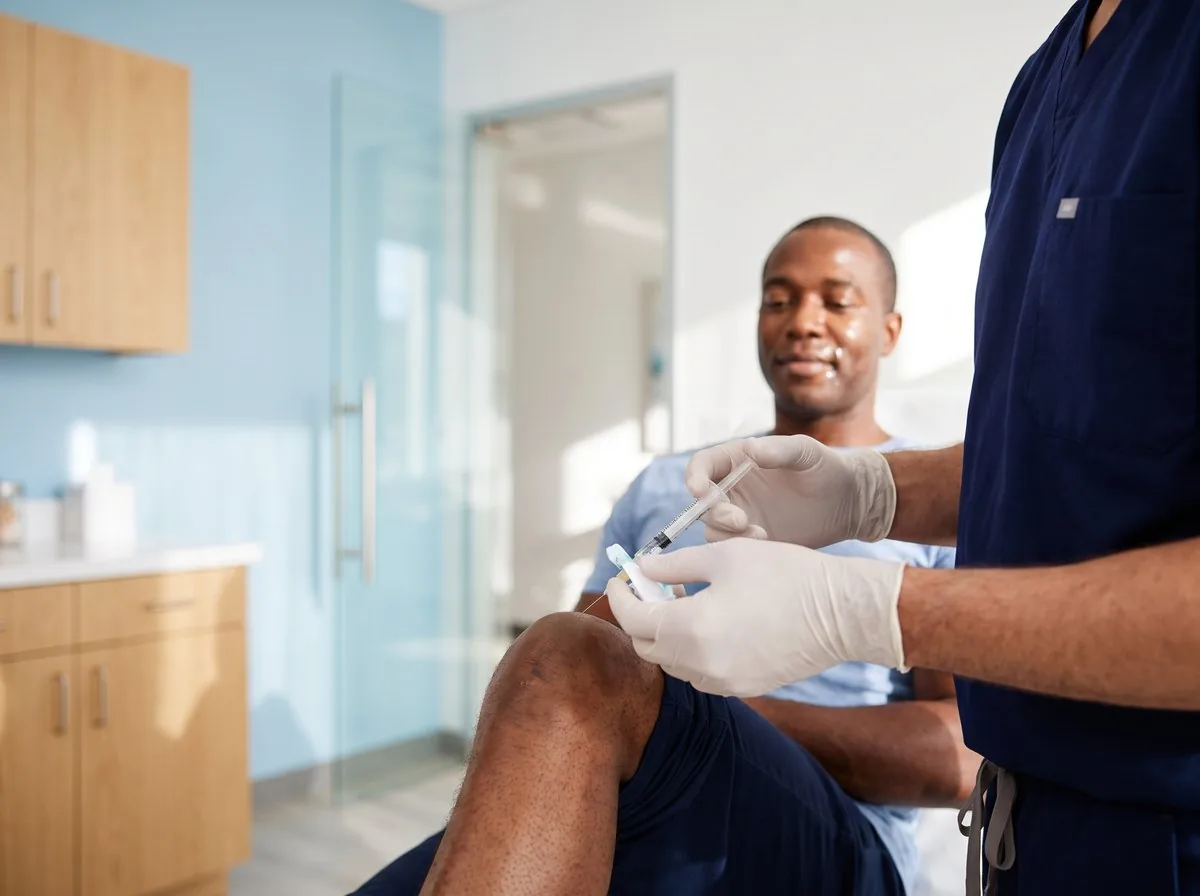

The protocol most consistently used is three injections spaced one to two weeks apart, which is what BHRC’s three-injection series reflects. Reported optimal platelet concentration sits around 600–900 × 10⁹/L.

6 · How it compares to the alternatives
Corticosteroid — and the cartilage question
Steroid injections work in the short term and every guideline body acknowledges it. But a 2017 JAMA randomized trial followed 140 patients given triamcinolone 40 mg or saline every 12 weeks for two years. The result: cartilage thickness loss of 0.21 mm on triamcinolone versus 0.10 mm on saline (P = 0.01), with no significant difference in knee pain. The authors concluded the findings do not support the treatment.
The practical reading: a steroid injection for an acute flare is reasonable. Quarterly injections year after year are not supported and carry a structural signal.
Hyaluronic acid
Contested and trending negative. AAOS does not recommend it for routine use. ACR conditionally recommends against it for the knee and strongly against for the hip, noting that when analysis is limited to low-risk-of-bias trials the effect size versus saline approaches zero. OARSI is conditional for the knee and does not recommend it for hip or polyarticular disease.

7 · Safety — and the complication to actually watch for
PRP’s reported adverse events are mild. Pain was reported as mild in 28.4%, moderate in 15.7% and severe in 3.2%, with local swelling in 19.3%; 83.6% of events occurred within 24–48 hours and 91.2% resolved on their own within 72 hours. Risk was higher with leukocyte-rich preparations, over age 65, and with a BMI above 30.
And as with any injection-based service, facility standards matter. A CDC investigation of one New Jersey outpatient practice documented 41 cases of septic arthritis among 250 patient visits over six days, with 73% requiring surgery. The breaches were basic: no handwashing sink, bulk contrast containers accessed up to fifty times, syringes prepared days in advance, no face mask, nonsterile gloves manipulating needle hubs.
Contraindications
- Active infection at the injection site, or systemic infection or sepsis
- Critical thrombocytopenia or platelet dysfunction
- Hemodynamic instability
- Prosthetic joint in the target site
- Anemia with hemoglobin under 10 g/dL; active malignancy (relative)
- NSAIDs within 48 hours; corticosteroid injection within two weeks
Anticoagulant and antiplatelet therapy needs individual assessment with the prescribing physician. There is no published consensus threshold, and any clinic quoting one is improvising.
On regulatory status
There is no FDA-approved PRP drug. FDA clears the devices used to prepare PRP as Class II, typically for narrow indications such as mixing with bone graft. Using PRP for knee osteoarthritis is off-label use of a cleared device under a physician’s clinical judgment. That is normal and lawful; it is simply not the same as an FDA-approved treatment, and any clinic implying otherwise is overstating it.
1860 S Sepulveda Blvd, Los Angeles, CA 90025
(310) 861-3748 · Monday–Friday 9:00 AM – 6:00 PM, Saturday 9:00 AM – 4:00 PM
Treatment by the BHRC clinical team
Joint injections, PRP and regenerative protocols are all available here.
Consultations are free and carry no obligation.
Frequently Asked Questions
How much do PRP joint injections cost in West LA?
At BHRC West Los Angeles: from $1,200 for a single joint, from $2,200 for a bilateral protocol, and from $3,200 for a three-injection series into one joint spaced four to six weeks apart. Rejuvenation Club members take 20% off.
Does PRP work for knee arthritis?
Partly, and the honest version is specific. Network meta-analyses of 48 randomized trials rank PRP above hyaluronic acid and corticosteroid at six months, with WOMAC improvements exceeding the clinically important threshold. But the RESTORE trial — 288 patients, PRP versus saline — found no significant difference at twelve months. Benefit at six months, attenuating by twelve.
Do the guidelines recommend PRP?
Two of three recommend against it. AAOS gives a limited-strength statement that PRP may reduce pain and improve function; OARSI and the American College of Rheumatology both recommend against it, primarily on the grounds that preparations are not standardized. Both of those date from 2019 and predate the larger positive meta-analyses.
How many injections do I need?
Three, spaced one to two weeks apart, is the most consistently studied protocol. In grade 3 disease, three or more injections produced 59.0% success against 41.8% with fewer — the number of injections matters more as the disease advances.
Who responds best?
Patients with Kellgren-Lawrence grade 1–2 disease, symptoms of under six months, age under 65 and BMI under 30. Patients with symptoms under six months had 75.9% success versus 52.4% in chronic cases. Advanced grade 4 disease responds poorly — PRP is not a substitute for joint replacement.
Is PRP better than a cortisone shot?
At six months and beyond, network meta-analysis ranks PRP substantially higher — corticosteroid ranked barely above placebo at that horizon. Separately, a 2017 JAMA trial found quarterly triamcinolone over two years produced significantly greater cartilage volume loss with no significant pain benefit. Steroid for an acute flare is reasonable; as a quarterly habit it is not supported.
What about hyaluronic acid injections?
Contested. AAOS does not recommend it for routine use; ACR conditionally recommends against it for the knee and strongly against for the hip, noting the effect size versus saline approaches zero in low-bias trials. It ranked mid-pack in network meta-analysis — above steroid, below PRP.
Is it safe?
Generally. Reported events are pain and local swelling, with 83.6% occurring within 48 hours and 91.2% resolving within 72. The serious complication is septic arthritis, estimated at about 9 per 10,000 large-joint injections. Median time to diagnosis was 3.5 weeks, so new or worsening joint pain, swelling or fever weeks after an injection needs urgent assessment.
Does it regenerate cartilage?
No, and this is the claim to be most sceptical of. RESTORE specifically measured medial tibial cartilage volume and found no significant difference from saline at twelve months. PRP is reasonably supported as a medium-term symptomatic adjunct, not as a structural treatment.
What is the first step?
A consultation that starts with what you have already tried. Exercise therapy is the only intervention every guideline body strongly recommends, and any injection plan should sit on top of it rather than instead of it.
Keep Reading
- Joint Injections at BHRC West Los Angeles
- Joint Injections at BHRC
- Cell Factor Joint Therapy
- Regenerative Therapies in West LA — PRP, Exosomes & the Evidence
- PRP Therapy at BHRC
- Joint Injections at BHRC Summerlin
- Men’s Health at BHRC
- Longevity & Healthspan at BHRC
Joint Injections at a BHRC Studio Near You
Physician-supervised joint injections and regenerative protocols are available at BHRC studios nationwide, including our main six. Tap your closest location to book a free consultation:
References & Further Reading
- JAMA — Bennell KL et al. Effect of Intra-articular Platelet-Rich Plasma vs Placebo Injection on Pain and Medial Tibial Cartilage Volume in Patients With Knee Osteoarthritis: The RESTORE Randomized Clinical Trial, 2021. research.monash.edu
- Arthroscopy — Jawanda H et al. Platelet-Rich Plasma, Bone Marrow Aspirate Concentrate and Hyaluronic Acid Injections Outperform Corticosteroids: A Systematic Review and Network Meta-analysis, 2024. scholars.houstonmethodist.org
- Journal of Orthopaedic Surgery and Research — Xu B et al. Leukocyte-rich versus leukocyte-poor platelet-rich plasma and hyaluronic acid for knee osteoarthritis: a systematic review and network meta-analysis, 2026. link.springer.com
- JAMA — McAlindon TE et al. Effect of Intra-articular Triamcinolone vs Saline on Knee Cartilage Volume and Pain in Patients With Knee Osteoarthritis, 2017. jamanetwork.com
- American Academy of Orthopaedic Surgeons — Management of Osteoarthritis of the Knee (Non-Arthroplasty), Clinical Practice Guideline, Third Edition, 2021. aaos.org
- American Academy of Orthopaedic Surgeons — Platelet-Rich Plasma for Knee Osteoarthritis — Technology Overview. aaos.org
- Arthritis & Rheumatology — Kolasinski SL et al. 2019 American College of Rheumatology / Arthritis Foundation Guideline for the Management of Osteoarthritis of the Hand, Hip and Knee. feinberg.northwestern.edu
- Osteoarthritis and Cartilage — Bannuru RR et al. OARSI guidelines for the non-surgical management of knee, hip and polyarticular osteoarthritis, 2019. esceo.org
- Archives of Orthopaedic and Trauma Surgery — Mueller MR et al. Septic arthritis following intra-articular corticosteroid injections: a retrospective analysis, 2026. link.springer.com
- Centers for Disease Control and Prevention / MMWR — Ross K et al. Outbreak of Septic Arthritis Associated with Intra-Articular Injections at an Outpatient Practice — New Jersey, 2017. cdc.gov
- Biomedicines — Vladulescu D et al. Platelet-Rich Plasma: Cellular and Molecular Mechanisms of Action, 2024. mdpi.com
Beverly Hills Rejuvenation Center. This content is for general education and does not create a physician-patient relationship or constitute medical advice. There is no FDA-approved PRP drug; FDA clears the devices used to prepare it, and use for osteoarthritis is off-label under a physician’s clinical judgment. Two of three major guideline bodies currently recommend against PRP for knee osteoarthritis. Published figures are study averages and not a guarantee. Prices shown are starting rates and are not a quote. Candidacy, dosing, results and pricing vary by person and are confirmed at a free consultation. Reviewed by the BHRC clinical team.