BHRC BLOG
Epitalon Dosage Guide: Cycling Protocol & Longevity Research
BHRC · LONGEVITY & WELLNESS · PEPTIDES
Epitalon has one of the widest gaps in aesthetics between what is claimed and what has been shown. Search it and you will find confident dosing charts, telomere-lengthening promises, and a twelve-year Russian trial cited as if it settled the question. Some of that is real. A surprising amount of it is describing a different substance entirely. This guide walks through what Epitalon actually is, what the published research found, the dosing ranges that appear in the literature rather than in marketing, where it stands with the FDA after a consequential 2026, and the one safety question that the mechanism itself raises.
1 · What Epitalon actually is
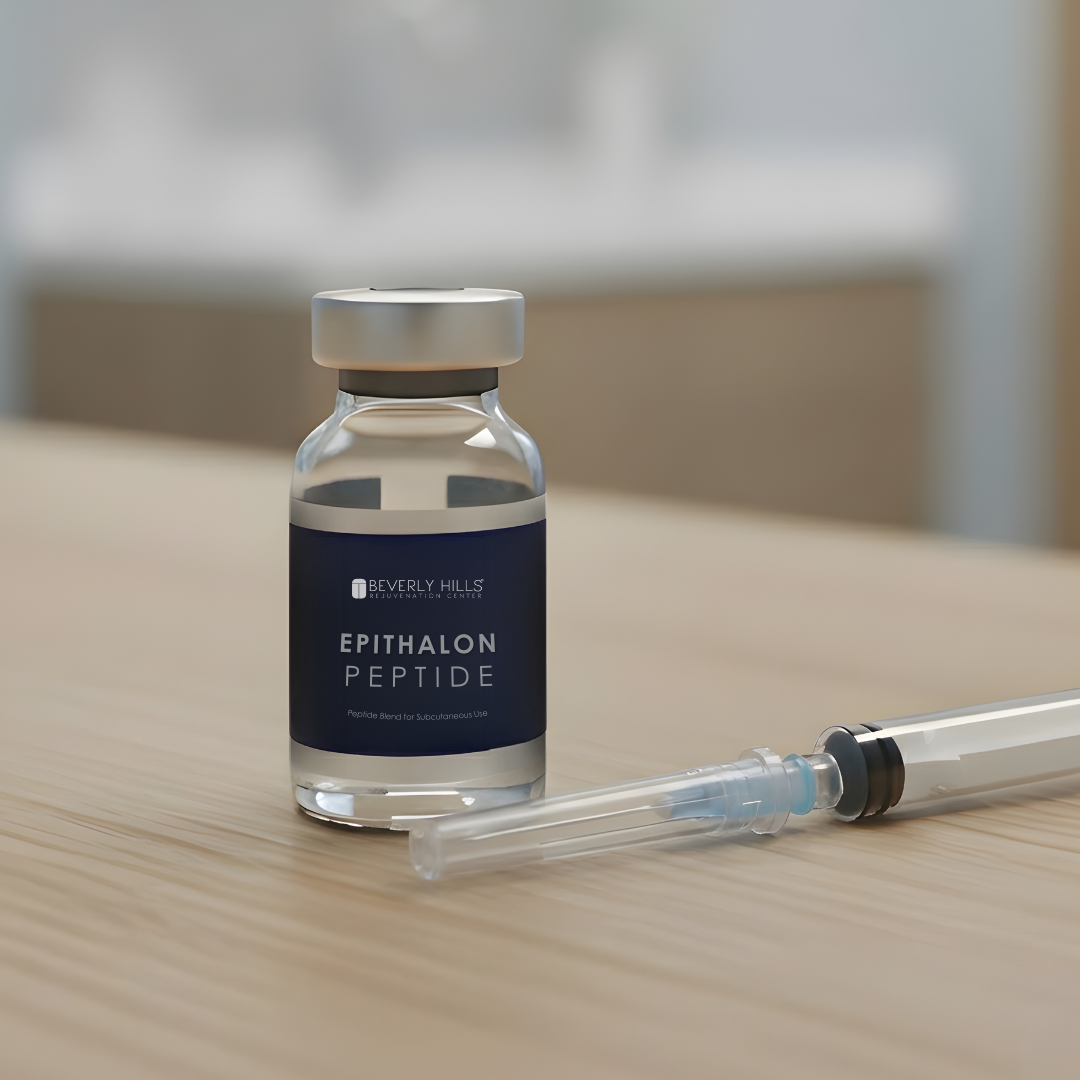
Epitalon is a synthetic tetrapeptide — four amino acids in sequence: alanine, glutamic acid, aspartic acid, glycine. Chemists write it AEDG. Its molecular weight is about 390 daltons, which makes it one of the smallest molecules in the peptide category and small enough to move around the body easily.
It came out of the laboratory of Vladimir Khavinson at the St. Petersburg Institute of Bioregulation and Gerontology, which is also where the most important nuance about it originates.

Read that table twice. Epithalamin is a crude polypeptide extract of bovine pineal glands whose composition varies between batches. Epitalon is the defined synthetic four–amino-acid peptide that was isolated from, or modeled on, that extract. The multi-year human trials reporting reduced mortality — the ones cited in essentially every article you will find on this topic — used the extract. What clinics and online vendors sell is the peptide.
That does not make the peptide worthless. It does mean you cannot transfer the extract’s results onto it, and anyone who tells you otherwise is either not reading carefully or is counting on you not to.
2 · The proposed mechanisms
Four mechanisms show up repeatedly in the literature. They are proposals supported by laboratory work, not established clinical pathways — which is a meaningful distinction when you are deciding what to put in your body.

The telomerase finding, in context
The result that made Epitalon famous is a 2003 paper from Khavinson’s group: adding the peptide to a culture of telomerase-negative human fetal fibroblasts induced expression of hTERT, the catalytic subunit of telomerase, produced measurable telomerase activity, and elongated telomeres. In a dish, that is a striking result.
Here is the part that rarely travels with it: as the Alzheimer’s Drug Discovery Foundation’s researcher review notes, there are no publications independently replicating those results. Twenty-plus years on, a finding of that significance remaining unreplicated outside its originating laboratory is itself information.
3 · What the human studies actually found
There are two human datasets worth knowing about, and one animal study that is frequently misquoted.
Khavinson & Morozov, 2003
266 elderly subjects in St. Petersburg and Kiev, treated during the first two to three years of a six-to-eight-year observation window. The reported mortality reduction versus controls was 1.6–1.8-fold with Epithalamin, 2.0–2.1-fold with Thymalin, 2.5-fold with the two combined, and 4.1-fold with annual combined treatment over six years. Incidence of acute respiratory disease fell 2.0–2.4-fold.
Korkushko, 2006 — the 12-year trial
A randomized trial in elderly patients with coronary disease and accelerated cardiovascular aging. Epithalamin was given as 10 mg intramuscularly, five injections at three-day intervals, repeated every six months for three years, with subjects then followed for another nine years. Reported results: 28% lower all-cause mortality, roughly halved cardiovascular mortality, a two-fold lower incidence of cardiovascular failure and respiratory disease, decreased functional age and improved exercise tolerance.

The mouse study people misquote
Anisimov’s 2003 study in female SHR mice is usually cited as proof that Epitalon extends lifespan. What it actually found, at 1.0 µg per mouse for five consecutive days each month from three months of age until natural death:
- No significant change in mean lifespan
- Maximum lifespan increased 12.3%
- Lifespan of the last 10% of survivors increased 13.3% (P<0.01)
- No effect on total spontaneous tumor incidence
- Leukemia incidence inhibited 6.0-fold
That is a real and interesting result. It is not “Epitalon extends lifespan,” and the distinction between mean and maximum lifespan is exactly the sort of thing that gets flattened in a headline.
4 · Dosing as it appears in the literature
We are going to be specific about where these numbers come from, because the ones circulating online mostly come from nowhere.

5 · Where Epitalon stands with the FDA in 2026
This changed meaningfully in 2026, and most content on the internet is now out of date in one direction or the other. Here is the actual sequence.

Two things are worth pulling out of that.
First, the April removal was not a clearance. Epitalon left FDA’s Category 2 list — the list of substances that may present significant safety risks — because the people who nominated it withdrew the nomination. That is an administrative event, not a safety finding.
Second, FDA’s own scientists recommended against it. In the briefing document for the July 2026 advisory committee meeting, FDA wrote that there is a lack of evidence to support effectiveness for the proposed use, and that a balancing of the criteria weighed against inclusion. The committee voted to recommend it anyway, narrowly. Those votes are advisory. FDA must still run a full notice-and-comment rulemaking before anything changes, and until it does, the legal landscape for peptide compounding is what it was.
6 · Safety — including the risk nobody markets
The reassuring version is real: the two multi-year Russian trials reported no severe adverse events, one with twelve years of follow-up, and preclinical data has been described as favorable.
Here is what that reassurance does not cover.

The telomerase paradox
This deserves its own paragraph because it is the mechanism that makes Epitalon interesting and the mechanism that makes it uncertain, and they are the same mechanism.
Telomere shortening is one of the limits on how many times a cell can divide. Cancer cells characteristically reactivate telomerase precisely to escape that limit. A compound whose headline mechanism is activating telomerase is, by construction, pushing on the same lever. FDA made this point explicitly in 2026 and noted that the animal studies used short, intermittent dosing — so nothing in the record tells us what chronic exposure does.
There is also a dose-dependent signal in mice that cuts the other way from the marketing: Epitalon either reduced maximum lifespan, through debilitation and accumulation of frail animals, or improved survival, depending on the dose.
Who should not take it
- Anyone with current, prior or suspected malignancy, or an undiagnosed mass
- Anyone who is pregnant or breastfeeding
- Children and adolescents
- Anyone who cannot accept an unapproved, structurally uncharacterized injectable of unverified sterility — which, absent pharmacy-grade sourcing, is what this is
7 · How to think about this if longevity is what you are after
Nothing above says peptide therapy is a dead end. It says Epitalon specifically is an interesting molecule with a thin and unreplicated human record, and that the confident protocols circulating online are not built on anything.
If the underlying goal is healthspan, the higher-yield starting point is almost always measurement rather than a molecule. That means advanced diagnostic testing to establish what is actually out of range — metabolic markers, inflammatory markers, hormone panels — and then addressing what the labs show. Peptides with better-characterized mechanisms and clearer regulatory standing, like those used in physician-supervised peptide therapy, sit downstream of that work, not upstream of it.

Physician-supervised peptide and longevity programs are available at all six BHRC studios. Consultations are free, include a review of your history and current labs, and carry no obligation.
We will tell you what the evidence supports — including when the answer is that it does not support much.
Frequently Asked Questions
Is Epitalon FDA-approved?
No. Epitalon is not FDA-approved for any indication. As of September 2026 it is not on the final 503A bulk drug substances list either. An FDA advisory committee voted in July 2026 to recommend adding it, but that vote is non-binding and FDA must complete notice-and-comment rulemaking before anything changes.
What is the difference between Epitalon, Epithalon and Epithalamin?
Epitalon and Epithalon are two spellings of the same synthetic four–amino-acid peptide (Ala-Glu-Asp-Gly). Epithalamin is different — it is a crude extract of bovine pineal glands containing many peptides in batch-variable proportions. Almost all the human mortality data cited for ‘Epitalon’ was generated with Epithalamin, the extract.
What dose is used in the research?
The published literature documents intranasal dosing at 10–30 mg/day for 20–30 days, or intramuscular dosing at 5–10 mg/day for 10–20 days, followed by a four-to-six-month pause. The best-documented human trial protocol used 10 mg intramuscularly, five injections three days apart, repeated every six months. These are literature ranges, not a prescription.
Does Epitalon actually lengthen telomeres in people?
That has not been demonstrated in people. Telomere elongation was shown in cultured human fetal fibroblasts in a 2003 study, and that result has not been independently replicated in the two decades since. No human trial has measured telomere length as an outcome of Epitalon treatment.
Is there a cancer risk?
It is a theoretical risk that has not been studied, and FDA raised it directly in 2026. Telomerase activation and telomere lengthening are the same mechanisms malignant cells use to escape replicative limits. Animal studies used short, intermittent dosing, so chronic-exposure safety is simply untested. Anyone with a current, prior or suspected malignancy should not use it.
Why do so many articles say it reverses biological age?
Because they are transferring results from the crude pineal extract onto the synthetic peptide, and treating a single unreplicated cell-culture study as if it were a clinical outcome. Neither move is justified by the literature.
Can I buy it online?
Products are sold online, usually labeled ‘for research use only.’ FDA issued warning letters to online peptide sellers in March, June and August 2026, taking the position that such products are unapproved new drugs and that research-use labeling does not override evident drug intent. Beyond the legal question, FDA has described epitalon as ‘not well-characterized,’ with certificates of analysis frequently lacking impurity, aggregation and endotoxin data — which matters a great deal for anything injected.
What would you recommend instead?
Start with measurement rather than a molecule. Advanced diagnostic testing establishes what is actually out of range for you, and most people find there is meaningful work to do on metabolic, inflammatory or hormonal markers before an experimental peptide is the highest-value next step.
Does BHRC prescribe Epitalon?
Peptide therapy at BHRC is provided only after physician evaluation, and what is appropriate depends on your history, your labs and current regulatory standing. Book a consultation and a provider will give you a direct answer for your situation.
Keep Reading
- Epithalon at BHRC — Longevity Formula
- What Are Peptides? A Beginner’s Guide to Peptide Therapy
- Peptide Therapy in Los Angeles
- Longevity & Healthspan at BHRC
- Advanced Diagnostic Testing
- Physician-Supervised Peptide Therapy
- FDA Peptide Reclassification 2026 — What It Means for Patients
Peptide Therapy at a BHRC Studio Near You
Physician-supervised peptide and longevity programs are available at BHRC studios nationwide, including our main six. Tap your closest location to book a free consultation:
Westlake VillageConejo Valley, CA
West HollywoodLos Angeles, CA
West Los AngelesLos Angeles, CA
SummerlinLas Vegas, NV
Paradise ValleyScottsdale / Phoenix, AZ
References & Further Reading
- U.S. Food & Drug Administration — Certain Bulk Drug Substances for Use in Compounding that May Present Significant Safety Risks (Category 2 and withdrawn-nomination tables). fda.gov
- U.S. Food & Drug Administration — FDA Briefing Document, Pharmacy Compounding Advisory Committee Meeting, 2026. fda.gov
- U.S. Food & Drug Administration — July 23–24, 2026: Meeting of the Pharmacy Compounding Advisory Committee. fda.gov
- Federal Register — Pharmacy Compounding Advisory Committee; Bulk Drug Substances Nominated for Inclusion on the Section 503A List (Docket FDA-2025-N-6895), April 16, 2026. federalregister.gov
- Bulletin of Experimental Biology and Medicine — Khavinson VKh, Bondarev IE, Butyugov AA. Epithalon peptide induces telomerase activity and telomere elongation in human somatic cells, 2003. pubmed.ncbi.nlm.nih.gov
- Neuroendocrinology Letters — Khavinson VKh, Morozov VG. Peptides of pineal gland and thymus prolong human life, 2003. pubmed.ncbi.nlm.nih.gov
- Bulletin of Experimental Biology and Medicine — Korkushko OV et al. Geroprotective effect of epithalamine in elderly subjects with accelerated aging, 2006. pubmed.ncbi.nlm.nih.gov
- Advances in Gerontology — Korkushko OV et al. Normalizing effect of the pineal gland peptides on the daily melatonin rhythm in old monkeys and elderly people, 2007. pubmed.ncbi.nlm.nih.gov
- International Journal of Molecular Sciences — Araj SK et al. Overview of Epitalon — Highly Bioactive Pineal Tetrapeptide with Promising Properties, 2025. mdpi.com
- Biogerontology — Anisimov VN et al. Effect of Epitalon on biomarkers of aging, life span and spontaneous tumor incidence in female SHR mice, 2003. link.springer.com
- Alzheimer’s Drug Discovery Foundation — Cognitive Vitality — Epithalamin / Epithalon researcher report. alzdiscovery.org
Beverly Hills Rejuvenation Center. This content is for general education and does not create a physician-patient relationship or constitute medical advice. Epitalon is not approved by the FDA for any indication. Dosing ranges cited here are drawn from published literature for informational purposes and are not a recommendation, a protocol or a prescription. Peptide therapy at BHRC is provided only under physician evaluation and supervision. Candidacy, dosing, results and pricing vary by person and are confirmed at a free consultation. Reviewed by the BHRC clinical team.