
BHRC BLOG
Juvederm vs. Restylane vs. RHA — How Fillers Actually Differ
Injectables · Product comparison
Three brand families, roughly thirty approved products, and one blinded head-to-head trial that found a difference of 0.02 points between the two biggest sellers. What actually differs, what doesn’t, and what the FDA documents say that the marketing doesn’t.
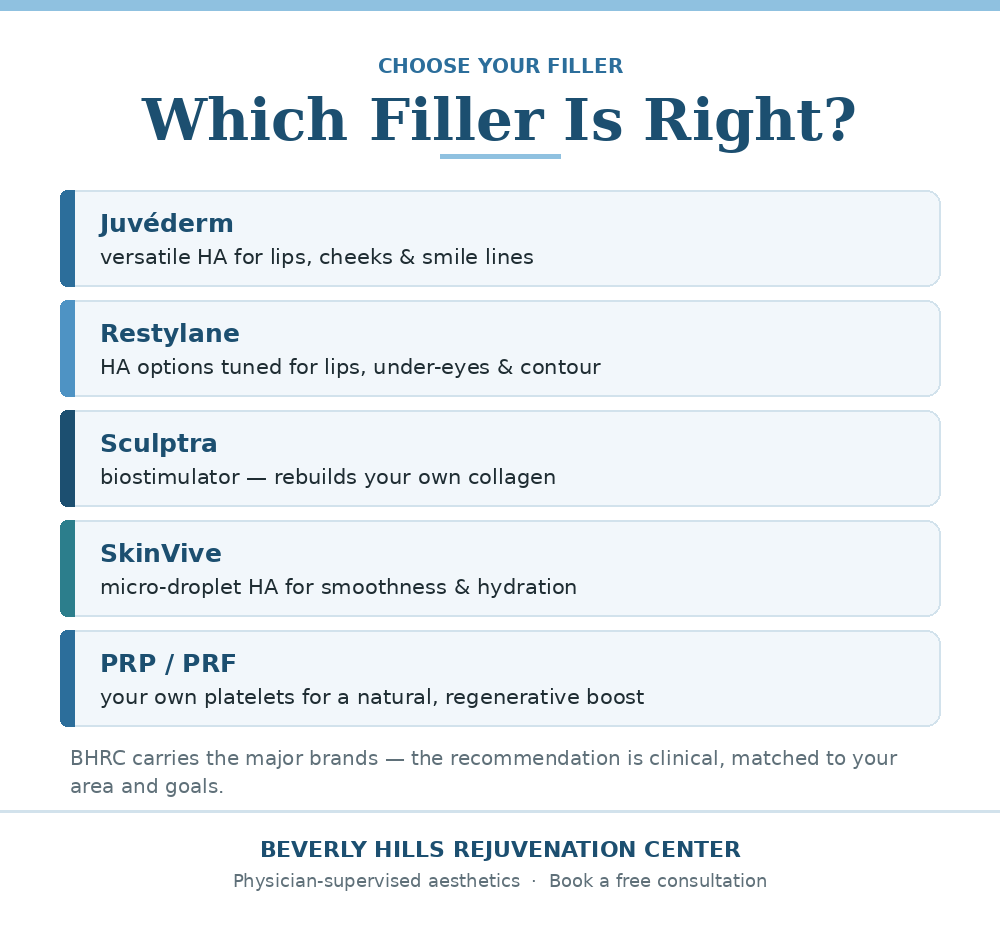
1. They are all the same molecule. The differences are in the manufacturing
Every product in all three families is hyaluronic acid — a sugar your skin already makes, which holds roughly a thousand times its weight in water. Raw HA injected into skin would be gone in a day or two, so manufacturers chemically link the chains together with a crosslinker (BDDE, in every product discussed here). How much crosslinking, what size the HA chains are before you crosslink them, and whether the finished gel is chopped into particles or left as a continuous mass — those three choices produce every difference between every product on the market.
A regulatory note worth understanding. Dermal fillers are Class III medical devices, which means they go through the FDA’s most demanding pathway — premarket approval, with a controlled clinical trial. They are FDA-approved, not “FDA-cleared” (that is the lighter 510(k) route used for things like laser devices) and certainly not “FDA-registered,” which means nothing at all. If a clinic’s website uses the wrong word, that tells you something about how carefully the rest of it was written.

The practical consequence: “Juvéderm” is not one thing and neither is “Restylane.” Juvéderm Ultra and Juvéderm Voluma sit on different FDA approvals and different chemistry. Restylane Lyft and Restylane Kysse are made by different processes and behave differently in tissue. Comparing brand to brand is the wrong unit of analysis. Comparing product to product, for a specific area, is the right one.
2. What each product is actually approved for — and why that matters
This is the most useful table in this article, and it is the one almost no consumer content publishes, because assembling it means reading FDA Summaries of Safety and Effectiveness rather than marketing pages. Every indication below is quoted from the approved labelling.
| Product | Approved for | Approved |
|---|---|---|
| Juvéderm Ultra XC | Facial wrinkles and folds; lips and perioral area | 2015 (lip) |
| Juvéderm Voluma XC | Mid-face (cheek) volume; chin; temple | 2013, 2020, 2023 |
| Juvéderm Vollure XC | Moderate to severe facial wrinkles and folds | 2017 |
| Juvéderm Volbella XC | Lips and perioral lines; infraorbital hollow | 2016, 2021 |
| Juvéderm Volux XC | Jawline definition only | 2022 |
| SKINVIVE by Juvéderm | Intradermal — cheek skin smoothness, not volume | 2023 |
| Restylane / Restylane-L | Facial folds; lip augmentation | 2011 (lip) |
| Restylane Lyft | Folds; cheek augmentation; dorsal hands | 2018 (hands) |
| Restylane Silk | Lip augmentation and perioral lines | 2014 |
| Restylane Refyne / Defyne | Facial wrinkles and folds; Defyne also chin | 2016, 2021 |
| Restylane Kysse | Lips and upper perioral lines | 2020 |
| Restylane Contour | Cheek and mid-face; temple hollowing | 2021, 2026 |
| Restylane Eyelight | Infraorbital hollowing | 2023 |
| RHA 2 / RHA 3 | Dynamic wrinkles and folds; RHA 3 also lips | 2017 |
| RHA 4 / RHA Dynamic Volume | Dynamic folds; mid-face | 2017, 2025–26 |
| RHA Redensity | Dynamic perioral lines | 2021 |
| RHA Redensity Eye | Infraorbital volume deficiency | 2026 |
Now the part that is usually left out. A very large share of filler treatment performed in the United States is off-label — meaning the product is being used somewhere it was not specifically approved for. Nose, temples with Lyft, jawline with anything other than Volux, chin with a product other than Voluma or Defyne: all common, all legal for a licensed practitioner exercising clinical judgment, and all off-label. Off-label is not a scandal. Prescribing off-label is routine in every branch of medicine. But it is not the same as “FDA-approved for this,” and you are entitled to know which one you are getting.
Three things the FDA itself says that the industry tends to skip. The FDA’s consumer guidance advises against injecting filler into the glabella (between the brows), nose, periorbital area, forehead or neck — all sites that are injected routinely in practice. Restylane Lyft’s own labelling states that use in the glabella and nose “has resulted in cases of vascular embolization.” And the FDA has issued a specific warning against needle-free “hyaluron pen” devices for filler. None of this means a skilled injector working in those areas is doing something wrong; it means the risk in those areas is real enough that the regulator put it in writing.
Two products you may see marketed that are not US-approved. Restylane SHAYPE has Health Canada approval for the chin (January 2024) but we found no evidence of FDA approval — if a US clinic offers it, ask. And there is no RHA equivalent of SKINVIVE: RHA Redensity is approved for perioral lines, not for skin quality, however it is marketed.
3. Firmness, flexibility and why the words in the marketing exist
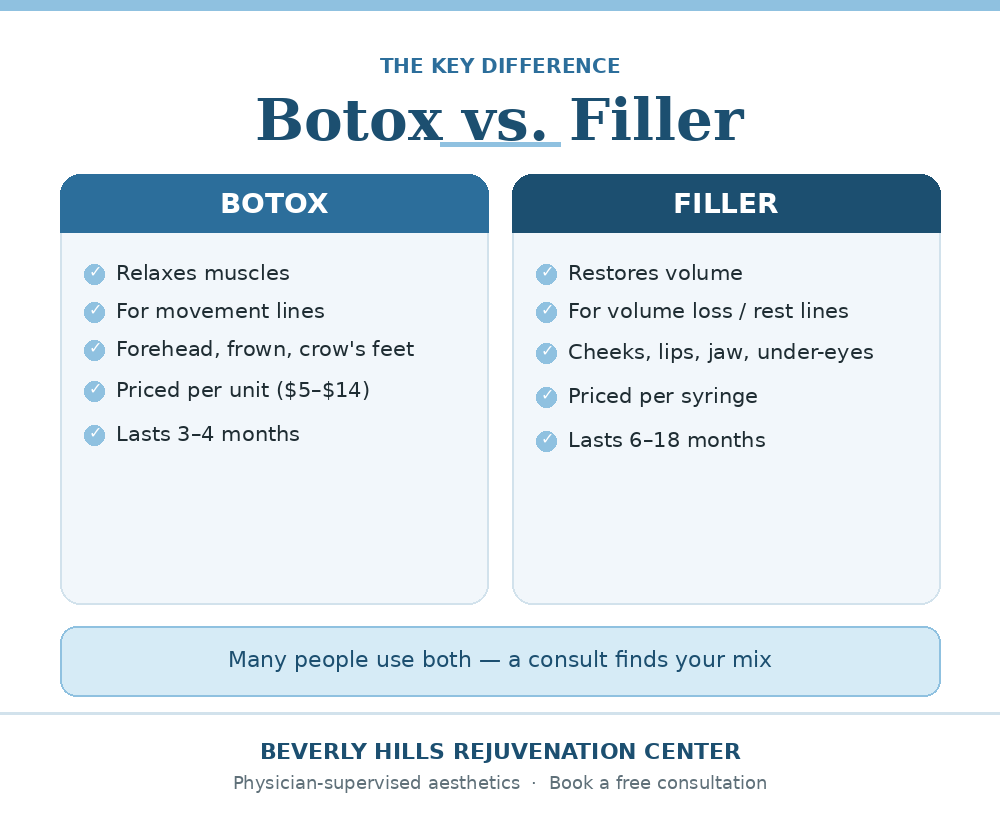
You will hear the term G′ (the elastic modulus) used to rank fillers by firmness. It is a real measurement and it does mean something: higher G′ gels resist deformation and hold projection against tissue pressure, which is what you want on a cheekbone or a chin. Lower G′ gels yield and spread, which is what you want in a lip or under an eye.
We are deliberately not publishing a G′ league table, and here is why. A gel’s measured G′ depends on the oscillation frequency, the strain amplitude, the temperature and the plate geometry used in the lab. Change the settings and the same product returns a meaningfully different number. Two legitimate papers can therefore rank the same two products differently. Any article that gives you a neat G′ ranking without stating its measurement conditions is giving you false precision, and that ranking may be the reason someone talked you into the wrong product.
What can be said accurately, from the manufacturers’ own published descriptions and from independent microscopy:
- Within Restylane, NASHA is the firm end and XpresHAn the flexible end. Galderma says so itself: NASHA is “engineered for precision and structure… a firm gel texture intended for a more pronounced lift”; XpresHAn is “designed for movement and expression… soft gel texture with high flexibility.” That is a genuine design split, not a marketing gradient.
- NASHA is genuinely particulate. Independent microscopy describes it as discrete crosslinked HA “pearls,” around 250 µm across, roughly 100,000 particles per millilitre, suspended in a carrier — and non-cohesive, dispersing immediately on contact with saline. That particulate structure is what lets it hold a sharp, projected shape on bone. It is also why it is unforgiving if placed too superficially in a mobile area.
- Within Juvéderm, HA concentration tracks the intended job: Volux 25 > Ultra 24 > Voluma 20 > Vollure 17.5 > Volbella 15 mg/mL. Concentration is not the same thing as firmness, but it is a verified ordering that gives you the same intuition without inventing numbers.
The VYCROSS trade-off — low swelling, and the thing that comes with it
Juvéderm’s VYCROSS products (Voluma, Vollure, Volbella, Volux) blend high- and low-molecular-weight HA. The low-MW fraction crosslinks more efficiently, which lets the product reach a given firmness at a lower total HA concentration, resist enzymatic breakdown for longer, and — because there is less room in the gel for water — swell less after injection. That last property is a real clinical advantage in the lips and under the eyes, where unpredictable swelling is the thing that ruins a result.
The same chemistry carries a documented downside. The literature that credits VYCROSS with lower swelling and better degradation resistance records, in the same passage, rare inflammatory reactions appearing weeks to years after injection. We deal with that properly in section 6, because it is the single most under-disclosed thing in consumer filler content.
What about RHA’s “resilient” claim?
RHA’s marketing rests on gentler manufacturing that preserves longer native HA chains with a lower degree of chemical modification, producing a gel said to behave more like native tissue under movement. It is a plausible story. But the one independent measurement we could verify — a 2016 study that examined seven HA gels under microscopy — put RHA’s crosslinking at 1.9–4.0% against NASHA’s 1–2% in the final product. That is equal or higher, not lower. The same study found RHA the least stretch-resistant of the seven gels tested.
So what is RHA’s real differentiator? It is regulatory, and it is genuine: the FDA approved RHA 2, 3 and 4 with the word “dynamic” written into the indication — “moderate to severe dynamic facial wrinkles and folds.” No Juvéderm or Restylane product we reviewed carries that wording. An approved indication is not proof of superiority in motion, but it is a real, checkable distinction, and it is a better basis for choosing RHA than an unverified claim about resilience.
The honest version: within a family, the differences are real and matter for placement. Between families, at comparable products, they are much smaller than the marketing implies.
4. Duration — what “lasts up to 18 months” actually means
This is where marketing and evidence diverge most, so it is the most valuable section here. When a product says “results last up to 24 months,” that figure is the last timepoint the trial measured, not what a typical patient gets. The number that matters is what proportion of people were still classed as improved at that point — and it is published, in the FDA documents, for every product.

Read that chart again, because it is the single most useful thing in this article. “Lasts 12 months” is a study endpoint, not a promise. Somewhere around a third of people in every one of these trials had dropped below the improvement threshold by the time the study closed. Your result will depend on the area treated, how much movement it sees, your metabolism, how much product was used, and — as ever — the technique.
Three specific things worth knowing:
- Voluma’s two-year claim is real, but it is area-specific. In the cheek, 85.6% were responders at six months and 67.1% at two years. In the chin, the same product managed 56.3% at six months and 57.6% at twelve. “Voluma lasts two years” is a cheek statement, not a chin statement.
- Kysse’s “12 months” was a 48-week study. Lip fullness responders went 88% at week 8, 77% at week 24, and 60% at week 48. The perioral-line result held up much better — 83% at week 48.
- RHA’s percentages aren’t directly comparable to the others. The RHA trials used an active comparator rather than an untreated control, which is a more demanding design — but it means the control arm also scores 82–90%, so you cannot line RHA’s numbers up against Juvéderm’s and read off a winner. RHA 2’s labelling states that more than 80% maintained clinically significant improvement at 64 weeks (about 15 months).
SKINVIVE is a different animal and should be judged differently. Its approved endpoint is cheek skin smoothness, and it hit 57.9% responders at one month against 4.5% for control, with 55.6% still responding at six months. Those are much lower numbers than a volumising filler — but it is not trying to do the same job. The trial protocol used a median 3.2 mL initially, a 2.0 mL touch-up at about thirty days and an optional 2.7 mL repeat at six months. It is designed as a series, not a single treatment, and should be priced and planned that way.
5. The anaesthetic change almost nobody has updated their website for
Nearly every filler sold in the US contains 0.3% lidocaine mixed into the gel, so the product numbs as it goes in. That has been the standard for well over a decade, and most comparison articles online still say all three families contain lidocaine.
That has not been true of RHA in the US since August 2025. Revance now distributes the Teoxane RHA Collection with mepivacaine instead — RHA 2 Mepi, RHA 3 Mepi, RHA Redensity Mepi, RHA Dynamic Volume and RHA Redensity Eye. The FDA’s own document for the 2025 supplement states it flatly: RHA 4 contains 0.3% lidocaine; RHA Dynamic Volume contains 0.3% mepivacaine. The manufacturer’s stated rationale is that mepivacaine causes less local vasodilation and may therefore bruise less — a mechanistically plausible claim, but a manufacturer’s claim, not an independently demonstrated one.
Why you should care. Two reasons, one trivial and one not.
- The trivial one: if a clinic tells you “RHA has lidocaine in it,” their product knowledge is at least a year out of date. It is a fair, checkable question to ask.
- The one that matters: mepivacaine is also an amide anaesthetic. If you have a genuine amide-anaesthetic allergy, switching to an RHA product does not solve it. Anyone who has ever reacted to lidocaine at the dentist needs to raise that before treatment rather than assume.
And a practical note on comfort generally: integrated anaesthetic numbs as the gel goes in, which means the first pass of any syringe still stings, because the lidocaine has not taken effect yet. It does not remove the need for topical numbing in the lips. Our lip enhancement page covers what the appointment actually feels like.
6. Safety — the numbers, and the one nobody publishes
Vascular events and vision loss
The best available US dataset is the FDA’s own analysis of Medical Device Reports, prepared for its General and Plastic Surgery Devices Panel in March 2021. Between August 2015 and August 2020 the agency received 92 reports of vision problems after filler, 77 of them involving hyaluronic acid. Onset was immediate in 58% of cases, delayed one to twenty-four hours in 20%, and beyond a day in 9%.

Across all vascular events in that dataset — 411 unique reports after deduplication — lips and the perioral area accounted for 38% and nasolabial folds 18%, largely because those are the most-injected sites in the country. But when you look specifically at the events that affected vision, the nose accounts for 41%. That asymmetry is the practical takeaway: the sites where most vascular events happen and the sites where the worst ones happen are not the same sites.
An honest caveat we would rather state than bury. Medical Device Reports are counts of reports submitted to the FDA. There is no denominator — nobody knows how many filler treatments were performed in that window — so these numbers cannot be turned into a risk percentage. Anyone quoting “the risk of blindness from filler is 1 in X” from this data is misrepresenting it. Reporting is also known to be incomplete, so the true counts are higher than 92.
On cannulas versus needles: many injectors prefer a blunt-tipped cannula in higher-risk planes, and the FDA has approved specific products for cannula delivery, including Restylane Lyft, Restylane Silk for lips and Juvéderm Voluma XC. But the FDA’s own review explicitly declined to compare safety outcomes between needles and cannulas, describing the choice as injector preference. Restylane Contour’s pivotal trial studied both and found comparable results. So the accurate sentence is “many injectors prefer cannulas in certain areas” — not “cannulas are safer.” Be sceptical of any clinic that claims otherwise as settled fact.
Delayed-onset nodules — the section most articles skip
Delayed inflammatory reactions are a labelled, recognised adverse event across all three families. Restylane’s labelling says “delayed onset inflammatory papules have been reported following the use of dermal fillers,” and that they “should be considered and treated as a soft tissue infection.” RHA 2’s labelling notes that delayed granulomas have been reported with dermal fillers generally, while recording that none occurred in RHA’s own trials.
RHA 3’s current labelling goes furthest, and it is worth quoting directly, because it names the triggers: delayed-onset inflammation near injection sites occurs “following viral or bacterial illnesses or infections, vaccinations, or dental procedures.” Restylane Kysse’s labelling contains no equivalent mention. Labelling is not uniform across brands on this point — which is itself informative.
Nodule rates recorded in the pivotal trials, for context — and note these are early injection-site nodules, which is a different phenomenon from the delayed inflammatory one:
| Product | Rate | Resolution |
|---|---|---|
| Juvéderm Volux XC (jawline) | 1.5% | Three cases beyond 30 days — resolved at 48, 106 and 176 days |
| Restylane Contour (mid-face) | 1.4% (2 subjects) | — |
| RHA 4 (mid-face) | 11.2% “injection site mass” | ≥82% of all device effects resolved within 14 days; one lasted >90 days |
| Juvéderm Voluma XC (comparator arm) | 6.1% “injection site mass” | — |
What we are not going to tell you, because we could not verify it to a standard we are willing to publish: a percentage for delayed-onset nodules with VYCROSS products specifically, or which of the competing explanations (low-grade bacterial biofilm, delayed hypersensitivity, an immune-complex response) the literature favours. Figures circulate. We could not confirm any of them against a primary source, so they are not here. The qualitative association is documented and we have stated it; the number is not, and we will not invent one.
What to actually do about this. If you develop new swelling or firm lumps at old filler sites days to weeks after an illness, a vaccination, dental work or a resurfacing treatment — go back to your injector. It is a recognised, labelled phenomenon, it is usually treatable, it is not “the filler going bad,” and it is not a reason to panic. It is also worth telling your injector about any filler you have had, ever, before a laser or peel: Juvéderm’s own directions for use warn that procedures based on an active dermal response can elicit an inflammatory reaction at an old implant site.
The blue-grey tinge, and why the under-eye is hard
The Tyndall effect is what happens when gel is placed too superficially: shorter-wavelength blue light scatters off it and the overlying skin takes on a bluish-grey cast. Restylane Kysse’s labelling states it plainly — if injected too superficially, the result may be “visible lumps and/or bluish discoloration.”
It shows up where the skin is thinnest and superficial placement is most tempting: the under-eye hollow above all, then the lip border and fine perioral lines. It is a placement problem rather than a product defect, though firm, particulate, low-cohesivity gels placed shallowly are the classic setup. The good news is that it is among the most reliably correctable filler complications — it is a depth problem, and dissolving the superficial deposit generally resolves it. Our under-eye guide goes through that area in detail.
Reversibility — real, but not absolute
Hyaluronidase, the enzyme that breaks down HA, is referenced in the approved labelling of all three families — both as emergency management of a vascular occlusion and, in Restylane Kysse’s case, for persistent inflammatory symptoms. This is genuinely HA filler’s biggest safety advantage over permanent and semi-permanent products, and it is fair to say so.
But “fully reversible” overstates it. Reversal requires an injector who stocks hyaluronidase and knows how to use it under pressure; it often takes more than one session; and it cannot restore tissue that has already been damaged by an occlusion. It is widely believed among injectors that some products dissolve more stubbornly than others — we could not verify that to a publishable standard, so there is no ranking here. What we can tell you is that “do you keep hyaluronidase on site?” is one of the most informative questions you can ask, and the answer should be immediate and unambiguous.
7. “Filler migration” — separating the real thing from the discourse
Social media has converged on a story: lip filler travels upward into the philtrum, accumulates over years and never breaks down. Here is the honest position.

The core intuition behind the discourse — that HA lasts longer in tissue than the marketing window suggests — is supported, and the trial data itself is the evidence. If 67% of Voluma patients still show measurable aesthetic effect at two years, then material is still present at two years. Duration claims describe aesthetic effect, not material clearance, and those are not the same thing. The Volux trial recorded nodules resolving at 48, 106 and 176 days; an RHA 4 injection-site mass lasted beyond ninety days.
What does not follow is the doom framing. These products are enzymatically reversible. Persistence is a manageable problem, not a permanent one. And the most common cause of lips that look “migrated” is not migration — it is product that was placed above the vermillion border, or layered on top of product that had not yet resolved. The fix for both is the same: go slower, use less, and wait longer between rounds.
There is published MRI work on how long HA remains detectable after injection. We were not able to retrieve and read it during the preparation of this article, so we are not quoting a figure from it. If you see a specific “still present at X years on MRI” number online, check whether whoever wrote it read the paper.
8. The trial that should change how you choose
Head-to-head trials between filler brands barely exist, because no manufacturer has an incentive to run one. But one does exist in the FDA record, and it is recent.
The design: randomised, blinded-evaluator, multicentre, prospective, eight US sites, 201 subjects randomised 3:1, followed for about sixteen months. RHA 4 against Juvéderm Voluma XC for mid-face volume. Primary endpoint at eight weeks on a validated volume-deficiency scale.

A fair caveat: this was a non-inferiority trial, designed to show RHA 4 was not worse rather than to prove the two identical. It cannot establish equivalence in the strict sense. But it places a very tight bound on how different they can be — and that bound is far narrower than the marketing on either side would lead you to expect.
Three other findings point the same way. Restylane Contour’s trial found comparable results whether the product was delivered by cannula or by needle — same product, different technique, similar outcome. In the RHA 4 trial, about three-quarters of subjects were injected in both superficial and deep fat layers, meaning the result came from a multi-layer technique rather than from the gel. And when the FDA approved Voluma XC for the temple in 2023, it imposed a restricted-distribution condition: the product may only be sold to providers who complete device-specific training. That is a regulator stating, in a legally binding way, that for a demanding anatomical area who is injecting is a safety variable.
Choose the injector, not the brand. Two comparable fillers from different families produced statistically indistinguishable results under blinded assessment — while the adverse-event data shows outcomes turning on anatomy, site and technique.
9. What actually drives the choice at a consultation

- Tissue plane and depth. Structural work on bone — chin, jawline, cheekbone, temple — is a different job from superficial dermal work on fine lines, and needs a different firmness.
- How much the area moves. Static folds tolerate firm gels. Lips, perioral and nasolabial areas move constantly, which is the real argument for the XpresHAn and RHA gels.
- Skin thickness. Thin under-eye and lip skin punishes firm, particulate, shallow placement with lumps and Tyndall.
- What is approved for the area — and whether you are being told when something is off-label.
- Sequence. Volume decisions should come after any skin-tightening work, because tightening changes how the face sits. Our facial balancing guide works through that properly, and it is the most common route to being overfilled.
Questions worth asking
- Which product, and is it approved for this area or being used off-label?
- What plane are you injecting in, and why that one?
- Needle or cannula here, and what drove that choice?
- Do you keep hyaluronidase on site, and what is your protocol if I blanch?
- How much training do you have specifically for this area?
- What happens at the two-week review, and is it included?
None of those questions are aggressive and none of them should make a good injector defensive. They predict your result far better than the logo on the syringe does.
What we charge
| What you book | Price |
|---|---|
| Single syringe | from $750 |
| Two syringes | from $1,400 |
| Full-face refresh | from $2,800 |
| What you book | Price |
|---|---|
| Lip flip (neurotoxin) | $150 |
| Lip filler, one syringe | from $700 |
| Lip flip plus filler | from $850 |
One thing to know about comparing prices per syringe. Syringe volume is not standard across products. The RHA 4 syringe used in the FDA trial was 1.2 mL; Restylane syringes have been supplied in 0.4, 0.7, 1 and 2 mL sizes; most are 1 mL. A “cheaper syringe” may simply be a smaller one. And because the trial protocols for several products build in a touch-up at around thirty days, a realistic first-year cost usually includes more than one appointment. Ask what volume you are getting and whether a review is included, not just the headline number.
Where we do this
Injectable work is available at all six of our locations. West Hollywood and West Los Angeles carry the fullest range and do the most combination planning; every clinic works from the same protocols and the same pricing.
8550 Santa Monica Blvd, Suite 101, West Hollywood, CA 90069
(323) 859-1257 · Monday–Friday 9:00 AM – 6:00 PM, Saturday 9:00 AM – 4:00 PM
Megan La Fuente, NP · Medical direction by Dr. Stacey Naito, MD
4.8 stars across 312 verified reviews
Dermal fillers, lip enhancement, neurotoxin and full facial planning.
Consultations are free and carry no obligation.
Questions we get asked
Which brand is best?
There is no best brand — there are products suited to particular areas and tissue planes. The one blinded head-to-head trial in the FDA record compared RHA 4 with Juvéderm Voluma XC for the mid-face and found a difference in mean outcome of 0.02 points on a five-point scale. Within a family the differences matter a great deal; between comparable products in different families, much less.
How long will it really last?
Across the published trials, roughly 55% to 70% of people were still classed as improved at the final measured timepoint — which means about a third were not. Voluma in the cheek is the most durable result with published data, at 67.1% at two years. Lips move constantly and consistently come in lower: Kysse was 60% at 48 weeks, Volbella 61.8% at twelve months.
Is one brand safer than another?
Nothing in the evidence we reviewed supports a brand-level safety ranking. Vascular occlusion risk is a property of injecting hyaluronic acid into the face, and every family’s labelling carries essentially identical warning language. Risk tracks anatomy, site and technique far more than it tracks product.
Does filler migrate?
Product can spread along tissue planes, and HA persists in tissue longer than the marketed duration — both are real. But most lips that look ‘migrated’ are the result of product placed too superficially or above the lip border, or of re-treating before the previous round resolved. All of it is correctable with hyaluronidase.
What’s the difference between Juvéderm and Restylane?
Less than the brand names imply, and more than a single comparison can capture — because each brand runs two different gel technologies. Juvéderm Ultra and Juvéderm Voluma are chemically different products on different FDA approvals; so are Restylane Lyft and Restylane Kysse. The useful comparison is product against product, for one specific area.
Should I be worried about the delayed nodules I read about?
They are a recognised, labelled adverse event across all three families, and RHA’s labelling specifically names illness, vaccination and dental procedures as triggers. They are uncommon and usually treatable. The right response is to tell your injector about any filler you have ever had before a laser or peel, and to go back to them promptly if new swelling appears at an old site.
Can I get it dissolved if I don’t like it?
Yes — hyaluronidase breaks down hyaluronic acid, and reversibility is the biggest safety advantage HA has over permanent fillers. It sometimes takes more than one session, and it will not undo tissue damage from a vascular event, so it is not a licence to be casual. Ask whether your injector keeps it on site before you are treated, not after.
Keep reading
- Dermal fillers at BHRC — what we offer
- Lip enhancement — filler, flip, and what each does
- Facial balancing — sequencing volume against skin quality
- Under-eye bags and dark circles — what actually works
- Botox per unit — what the numbers mean
- Under-eye treatments at BHRC
- Botox, lip filler and dermal fillers near you
Book at any of our six locations
References
- U.S. Food and Drug Administration — Dermal fillers (soft tissue fillers) — consumer information, updated 6 July 2023. fda.gov
- U.S. Food and Drug Administration — FDA-approved dermal fillers — product codes LMH and PKY. fda.gov
- U.S. Food and Drug Administration — General and Plastic Surgery Devices Panel executive summary: dermal filler adverse events, 23 March 2021. fda.gov
- U.S. Food and Drug Administration — Summary of Safety and Effectiveness Data — Juvéderm Voluma XC, PMA P110033 (24-month responder data). accessdata.fda.gov
- U.S. Food and Drug Administration — Summary of Safety and Effectiveness Data — Juvéderm Voluma XC chin indication, P110033/S047. accessdata.fda.gov
- U.S. Food and Drug Administration — Approval order — Juvéderm Voluma XC temple indication with restricted distribution condition, P110033/S070. accessdata.fda.gov
- U.S. Food and Drug Administration — Summary of Safety and Effectiveness Data — Juvéderm Volbella XC, lips, P110033/S018. accessdata.fda.gov
- U.S. Food and Drug Administration — Summary of Safety and Effectiveness Data — Juvéderm Volux XC, jawline, P110033/S065. accessdata.fda.gov
- U.S. Food and Drug Administration — Summary of Safety and Effectiveness Data — SKINVIVE by Juvéderm, P110033/S059. accessdata.fda.gov
- U.S. Food and Drug Administration — Juvéderm Ultra XC — Summary of Safety and Effectiveness Data and Directions for Use, P050047/S044. accessdata.fda.gov
- U.S. Food and Drug Administration — Restylane Lyft — Summary of Safety and Effectiveness Data and labeling, P040024/S099. accessdata.fda.gov
- U.S. Food and Drug Administration — Restylane Silk — Summary of Safety and Effectiveness Data, P040024/S072. accessdata.fda.gov
- U.S. Food and Drug Administration — Restylane Kysse — Summary of Safety and Effectiveness Data and labeling, P140029/S021. accessdata.fda.gov
- U.S. Food and Drug Administration — Restylane Contour — Summary of Safety and Effectiveness Data, P140029/S032. accessdata.fda.gov
- U.S. Food and Drug Administration — Restylane Refyne and Defyne — original PMA Summary of Safety and Effectiveness Data, P140029. accessdata.fda.gov
- U.S. Food and Drug Administration — RHA 2, 3 and 4 — original PMA Summary of Safety and Effectiveness Data and RHA 2 labeling, P170002. accessdata.fda.gov
- U.S. Food and Drug Administration — RHA 3 labeling — delayed-onset inflammation following illness, vaccination or dental procedures, P170002/S030. accessdata.fda.gov
- U.S. Food and Drug Administration — RHA 4 and RHA Dynamic Volume — Summary of Safety and Effectiveness Data including head-to-head trial against Juvéderm Voluma XC, P170002/S048. accessdata.fda.gov
- U.S. Food and Drug Administration — RHA Redensity — Summary of Safety and Effectiveness Data, P170002/S012. accessdata.fda.gov
- Galderma — Restylane science — NASHA and XpresHAn Technology gel platforms. restylaneusa.com
- Revance Therapeutics — Teoxane RHA Collection with mepivacaine — US launch, 27 August 2025. revance.com
- Galderma — FDA approval of Restylane Contour for correction of temple hollowing, 23 March 2026. galderma.com
- Micheels P, Sarazin D, Tran C, Salomon D — Effect of different crosslinking technologies on hyaluronic acid behavior: a visual and microscopic study of seven hyaluronic acid gels. J Drugs Dermatol 2016;15(5). pubmed.ncbi.nlm.nih.gov
- Fagien S, Bertucci V, von Grote E, Mashburn JH — Rheologic and physicochemical properties used to differentiate injectable hyaluronic acid filler products. Plast Reconstr Surg 2019;143(4):707e–720e. pubmed.ncbi.nlm.nih.gov
Beverly Hills Rejuvenation Center. This content is for general education and does not create a physician-patient relationship or constitute medical advice. Dermal fillers are prescription medical devices and must be administered by a qualified, licensed provider. Approved indications, trial results and safety information in this article are taken from FDA premarket approval documents current at the time of writing; product labelling changes, and the labelling supplied with your treatment is the authoritative version. Nothing here is a recommendation of one product over another for your face — that is a clinical judgment made in person. Candidacy, dosing, results and pricing vary by person and are confirmed at a free consultation. Reviewed by the BHRC clinical team.