
BHRC BLOG
Facial Balancing in Beverly Hills — What It Costs and What It Actually Involves
Facial Balancing · Beverly Hills & West Hollywood
Filling the line you can see is usually the wrong move. Here is what balancing actually means, what it costs, and the one question to ask before anyone injects you.
1. What “balancing” actually means
The face is not a collection of independent problems. Volume loss in the midface drops support for everything below it, which deepens the nasolabial fold, softens the jawline and makes the chin look recessive. Treating the fold in isolation fills a symptom and leaves the cause. That is why some people end up with heavy, over-filled cheeks and a fold that is still there.
Facial balancing starts from proportion instead. The injector assesses the whole structure — temples, midface, chin projection, jaw definition, the relationship between the upper and lower thirds — and decides where a small amount of support does the most work. Frequently the answer is somewhere other than where you are looking.

2. The areas, and what each one is actually doing

3. What it costs at West Hollywood
| What you book | Price |
|---|---|
| Single syringe | from $750 |
| Two syringes | from $1,400 |
| Full-face refresh | from $2,800 |
Rejuvenation Club members save 20% on every treatment plus priority scheduling. Pricing is per syringe, so a staged plan costs the same in total as doing it all at once — you simply pay for it across visits, and you get to change your mind partway through. That flexibility is worth more than it sounds.

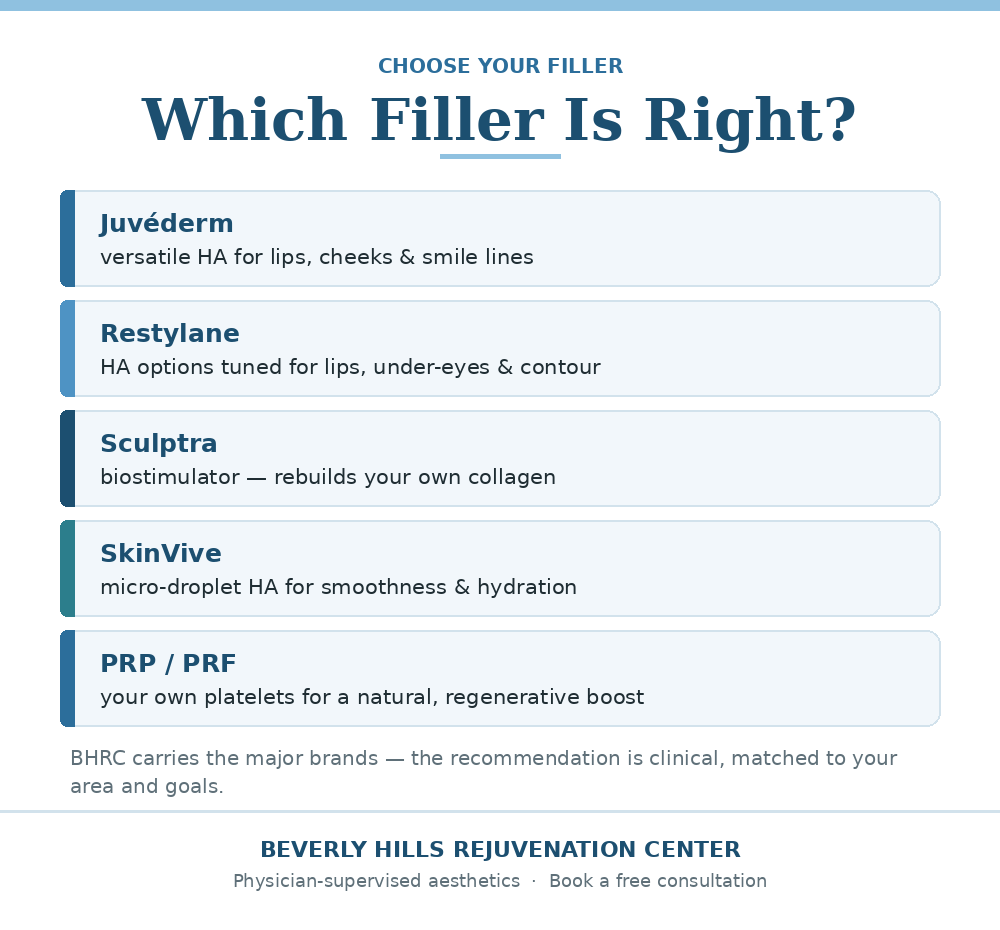
4. Which filler goes where — and why it is not one product
Hyaluronic acid fillers differ in how tightly cross-linked they are, which determines how firm they are and how much lift they provide. A firm, highly cross-linked gel is right for building chin projection or jaw definition; it is wrong for lips, where it will feel like a ridge. A soft, low-cohesivity gel is right for lips and fine lines; it is wrong for structural support, where it will simply spread.
Then there are the biostimulators — poly-L-lactic acid and calcium hydroxylapatite — which do something different again: rather than occupying space, they stimulate your own collagen over months. They suit diffuse volume loss across a broad area better than they suit a defined structural change, and the result builds gradually rather than appearing on the table. We wrote about them in our Sculptra and biostimulator guide.
If someone offers you one product for every area of your face, they are working around what they have in the fridge, not around your anatomy.
5. Where facial balancing goes wrong
Being direct about this is more useful than another before-and-after gallery.

The cumulative problem is subtler and more common than a single bad treatment. Hyaluronic acid filler is often described as lasting six to eighteen months, but small residual amounts can persist longer, and someone treating twice a year for a decade may be carrying more product than they realise. The face slowly widens and flattens. Nobody notices in the mirror because it happens gradually. This is a real phenomenon and an honest injector will bring it up before you do.
6. Why faces change — and why filler only addresses part of it
Facial aging is not one process. It is at least four, happening at different rates in different layers, and filler only directly addresses one of them. Knowing which layer your concern lives in is what keeps you from spending money on the wrong solution.

The bone change is the one people never expect. The eye socket widens with age, the maxilla loses projection, and the jaw angle becomes less defined. That is skeletal remodelling, and no amount of skincare touches it. It is also why restoring a small amount of structural support at the chin or jaw can make a face look markedly more rested without touching a single line.
The fat change is the one people misread. The deep fat pads of the midface do not simply shrink — they also descend. So the midface flattens and the tissue accumulates lower down, which is what creates a jowl. Filling the jowl makes it bigger. Restoring support above it is what lifts the appearance of the region, which is why an injector who treats your cheek when you complained about your jawline may be doing exactly the right thing.
The skin change is the one filler cannot help with at all. If your concern is crepey texture, visible pores, dullness or uneven tone, no amount of volume will fix it — the surface itself needs treating. That is what Clear + Brilliant, chemical peels and RF microneedling are for. Many balancing plans pair structural work with a resurfacing series for exactly this reason.
7. Safety — the part that matters most
Dermal fillers are FDA-approved devices, and the FDA maintains public safety communications about them. The risks worth understanding:
- Vascular occlusion is the serious one — filler entering or compressing a blood vessel, which can cause tissue loss and, very rarely, vision loss. It is uncommon, it is why anatomy training matters more than product choice, and it is why hyaluronidase should be on the premises before the first syringe is opened.
- Nodules and lumps are usually technique- or product-related and often resolve or can be dissolved.
- Delayed-onset nodules can appear weeks to months later, sometimes after an immune trigger such as an illness or vaccination. They are treatable.
- Bruising and swelling are expected. Lips swell the most; plan around anything important.
- The FDA has specifically warned against needle-free devices such as “hyaluron pens” for injecting filler. Do not let anyone use one on you.
8. Booking in Beverly Hills and West Hollywood
Our West Hollywood clinic on Santa Monica Boulevard serves Beverly Hills, Hollywood, Hancock Park, Fairfax, Los Feliz, Silver Lake and Studio City. If you are coming from the Westside, our West Los Angeles location runs the same protocols and is often an easier drive from Santa Monica, Brentwood or Culver City.
8550 Santa Monica Blvd, Suite 101, West Hollywood, CA 90069
(323) 859-1257 · Monday–Friday 9:00 AM – 6:00 PM, Saturday 9:00 AM – 4:00 PM
Treatment by the BHRC clinical team
4.8 stars across 312 verified reviews
Consultations are free and carry no obligation.
Questions we get asked
How much does facial balancing cost in Beverly Hills?
At BHRC West Hollywood, filler starts at $750 per syringe, two syringes from $1,400 and a full-face refresh from $2,800. Most balancing plans use two to four syringes staged across visits, so a realistic first-phase budget is roughly $1,400 to $2,800 depending on what your assessment shows.
How long does it last?
Commonly six to eighteen months depending on the product, the area and how much movement it sits in. Structural areas like the chin and jaw often last longest; lips the shortest. Biostimulators work on a different timeline — building over months and lasting longer.
Will it look obvious?
That is a dosing and planning question, not a property of the product. Obvious results come from treating too many areas at once, using too much in one sitting, or filling a fold instead of restoring the support above it. Staged, conservative treatment is how you avoid it.
Can it be reversed?
Hyaluronic acid fillers can be dissolved with hyaluronidase, which is one of the main reasons they dominate the market. Biostimulators cannot be dissolved — that is a meaningful difference and should factor into your choice, especially for a first treatment.
Do I need Botox as well?
Often the two are complementary rather than alternatives: neurotoxin softens movement-driven lines, filler restores structure. Whether you need both depends on what you are seeing at rest versus in motion. Our neurotoxin page covers the pricing side.
How soon can I see the result?
Immediately, though swelling makes the first week unreliable. Judge at two weeks. That is also the right moment for a follow-up, when small refinements are easy.
Keep reading
- Dermal fillers at BHRC West Hollywood
- Dermal fillers at BHRC West Los Angeles
- Sculptra and biostimulators in West LA — cost and results
- Botox, lip filler and dermal fillers near me
- Neurotoxins — per-unit pricing and areas
- RF microneedling — when the answer is skin quality, not volume
- The Rejuvenation Club — 20% off every treatment
Book at any of our six locations
References
- U.S. Food and Drug Administration — Dermal fillers (soft tissue fillers) — approved uses, risks and FDA safety information. fda.gov
- U.S. Food and Drug Administration — BOTOX Cosmetic prescribing information — the approved neurotoxin indications, for distinguishing movement-driven lines from volume loss. accessdata.fda.gov
- International Journal of Environmental Research and Public Health (2023) — A systematic review of the efficacy of microfocused ultrasound for facial skin tightening — the measured limits of non-surgical lifting. mdpi.com
- Niaz G, Ajeebi Y, Alshamrani HM, et al. — Fractional radiofrequency microneedling as monotherapy in acne scar management: a systematic review. Clin Cosmet Investig Dermatol 2025;18:19–29. dovepress.com
- U.S. Food and Drug Administration — De Novo classification DEN080006 — Ulthera System, the non-surgical lifting indications and where they stop. accessdata.fda.gov
- American Academy of Dermatology — Chemical peels: overview — for the skin-quality layer that filler cannot address. aad.org
Beverly Hills Rejuvenation Center. This content is for general education and does not create a physician-patient relationship or constitute medical advice. Dermal fillers are FDA-approved devices. Treatment of areas outside a given product’s approved indications is off-label use. Vascular complications, though uncommon, are serious; discuss them with your provider before treatment. Candidacy, dosing, results and pricing vary by person and are confirmed at a free consultation. Reviewed by the BHRC clinical team.