
BHRC BLOG
IV Drip Therapy & NAD+ Infusions — What They Do, and What They Don’t
IV Drip Therapy & NAD+ Infusions
We offer this, and here is the honest evidence: one placebo-controlled trial of the Myers’ Cocktail, and it was negative. Read it anyway before you book — anywhere.

1. What the Myers’ Cocktail is, and where it came from
The formulation is named for the late John Myers, MD, of Baltimore. It entered the literature through a 2002 narrative review in Alternative Medicine Review — a paper reporting the author’s uncontrolled clinical experience. It was not a controlled trial and was never presented as one.
Composition varies by clinic; there is no standard. The Merck Manual describes it as “high doses of B vitamins, vitamin C, minerals (magnesium and calcium), hydroxocobalamin, pyridoxine, and dexpanthenol, mixed with sterile water.”
We are a clinic that offers IV therapy, and we are telling you this. That should tell you something about how seriously we take the alternative.
2. What IV delivery genuinely does — and what it does not
The real pharmacological argument for IV is bypassing saturable intestinal absorption. Oral vitamin C absorption has a ceiling; intravenous administration reaches plasma concentrations that oral dosing cannot. That is a genuine and uncontested pharmacokinetic fact.
It is also not an efficacy claim. Reaching a higher plasma concentration only matters if a higher plasma concentration produces a clinical benefit, and for the wellness indications — fatigue, immunity, “detox,” hangover, anti-aging — that has not been demonstrated.

That last point is worth spelling out. ASCOR (ascorbic acid injection) was approved in October 2017, and its indication reads: “for the short term (up to 1 week) treatment of scurvy in adult and pediatric patients age 5 months and older for whom oral administration is not possible, insufficient or contraindicated.” The label goes further and states it is “not indicated for treatment of vitamin C deficiency that is not associated with signs and symptoms of scurvy.”
3. The part about where the bag comes from
Most wellness IV drips use compounded preparations. The FDA’s position on compounded drugs generally is unambiguous: “Compounded drugs are not FDA-approved. This means that FDA does not verify the safety, effectiveness or quality of compounded drugs before they are marketed.” And: “Poor compounding practices can result in serious drug quality problems, such as contamination or a drug that contains too much or too little active ingredient.”
This is not theoretical. The FDA’s drug recall database shows a consistent pattern of Class II recalls of compounded injectable vitamin products for lack of assurance of sterility — including an “IV Cocktail” multivitamin formulation recalled nationwide, multiple vitamin B complex recalls, and one cholecalciferol injectable recalled over “insanitary conditions at the facility.”

4. The G6PD problem, stated precisely
The FDA-approved IV vitamin C label states that “patients with glucose-6-phosphate dehydrogenase deficiency are at risk of severe hemolysis” and directs prescribers to monitor hemoglobin and blood count and use a reduced dose.
Note what that implies. The label’s own logic presumes G6PD status is already known. It does not mandate screening. A large 2010 survey of complementary practitioners found IV vitamin C generally well tolerated across more than 11,000 patients — while noting that published reports document serious adverse events, including two deaths in patients known to be at risk. The authors’ conclusion was careful: “Other than the known complications of IV vitamin C in those with renal impairment or glucose-6-phosphate dehydrogenase deficiency, high dose intravenous vitamin C appears to be remarkably safe.”
G6PD deficiency is most common in people of African, Mediterranean, Middle Eastern and Southeast Asian ancestry, and many people who have it do not know. If you are being offered multi-gram IV ascorbate anywhere, this is a conversation you should have first. The same label also warns that acute and chronic oxalate nephropathy have been reported with prolonged high-dose administration, with elevated risk in renal disease and in people with a kidney-stone history.
5. NAD+ infusions
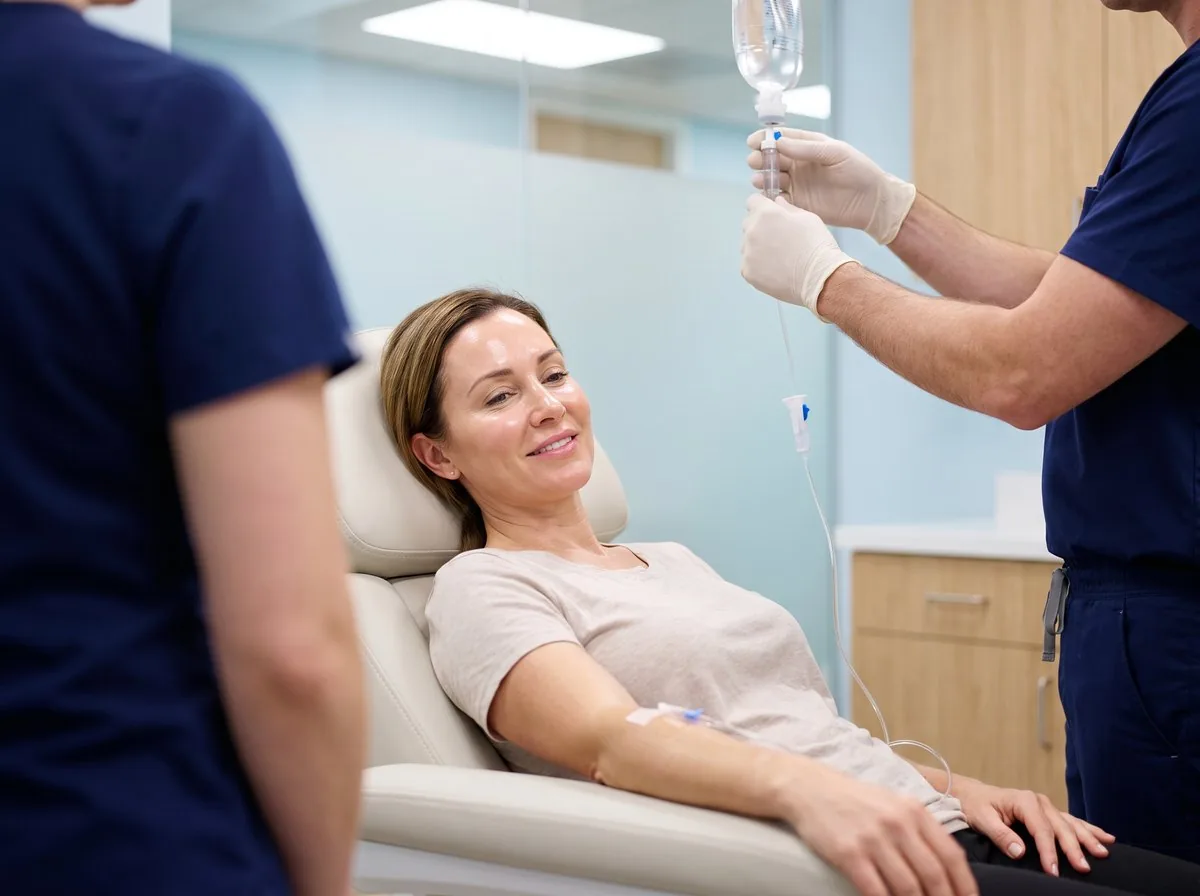
The published human record for IV NAD+ is thin. The main citable study is a 2019 pilot: eleven men, 750 mg infused over six hours, saline-controlled. Plasma NAD+ did not change for the first two hours, then rose substantially by hour six. No adverse events were observed. It was a pharmacokinetic and metabolomic study — there was no clinical efficacy endpoint at all.
A real-world comparison published in Frontiers in Aging reported a mean infusion time of 97 minutes for IV NAD+ against 37 minutes for IV nicotinamide riboside, attributing the difference explicitly to tolerability requiring slower administration. Patients on the NAD+ arm reported moderate-to-severe gastrointestinal symptoms, increased heart rate and chest pressure, all resolving after the infusion.
NAD+ is not an FDA-approved drug and appears on neither FDA compounding bulks list. When the agency’s Pharmacy Compounding Advisory Committee reviewed it in 2017 it found minimal clinical data on which to identify a safe dose and recommended against listing it. We go through all of this in detail — including the oral precursors — in our provider-led protocols piece and in our NAD+ page.

6. What the FTC has already done about marketing in this category
In September 2018 the FTC brought its first-ever action targeting an IV cocktail therapy marketer. The complaint alleged the company marketed IV cocktails as treatments for cancer, congestive heart failure, multiple sclerosis, diabetes, fibromyalgia and neurodegenerative disease; claimed “fast, lasting results”; claimed the products were more effective and better tolerated than conventional therapy; and claimed they were “clinically or scientifically proven.” Sessions cost $100–$250.
The consent order, finalised in February 2019, bars disease-treatment claims absent “competent and reliable scientific evidence,” bars claims of fast or lasting results without evidence, and requires retention of substantiation data.
If a clinic tells you an infusion treats a disease, that claim is subject to a legal standard — and someone has already been ordered to stop making it.
7. So when does IV therapy make sense?
We offer it, and here is the honest case for it.
- A documented deficiency where oral repletion is not working or not possible. This is the clearest indication and it starts with a lab result, not a symptom.
- Genuine volume depletion — significant illness, heat, or an inability to keep fluids down. In a healthy person with an intact gut and normal thirst, oral fluid does the same job without vascular access.
- A supervised protocol where the infusion is one part of something being monitored — which is different from a drip bar.
- Wanting it, with accurate information. Plenty of people find an infusion pleasant and restorative. That is a legitimate reason to choose one. It is a different reason from believing it treats something, and we would rather you chose it for the first reason.
What would move this conversation forward more than any drip: knowing your actual numbers. Advanced lab testing tells you whether you have a deficiency worth correcting — and frequently tells you the fatigue is thyroid, iron, sleep or a genuine hormone problem, all of which have specific treatments.
1825 Festival Plaza Dr #180, Las Vegas, NV 89135
(725) 525-6821 · Monday–Friday 9:00 AM – 7:00 PM, Saturday 9:00 AM – 4:00 PM
Treatment by the BHRC clinical team
5.0 stars across 167 verified reviews
IV drip therapy and NAD+ therapy are offered here.
Consultations are free and carry no obligation.
What it costs
| What you book | Price |
|---|---|
| Basic hydration | from $149 |
| Myers’ Cocktail | from $199 |
| Recovery / immunity | from $249 |
Rejuvenation Club members save 20% on every treatment plus priority scheduling.
Questions we get asked
Does IV vitamin therapy actually work?
For correcting a documented deficiency where oral repletion is inadequate, yes — that is what the route is for. For fatigue, immunity, detox, hangovers or anti-aging in someone who is not deficient, the evidence is not there. The Myers’ Cocktail has one placebo-controlled trial and it was negative on every outcome.
Is IV better than taking vitamins orally?
It reaches higher plasma concentrations, because it bypasses saturable intestinal absorption. That is a pharmacokinetic fact, not an efficacy claim. Higher plasma levels only matter if they produce a clinical benefit, and for wellness indications that has not been shown.
Are the drips FDA-approved?
Most wellness IV preparations are compounded, and the FDA does not verify the safety, effectiveness or quality of compounded drugs before marketing. Ask whether your clinic sources from a 503A pharmacy or a 503B outsourcing facility — 503B facilities must comply with current Good Manufacturing Practice.
What is the risk with G6PD deficiency?
Severe hemolysis with high-dose IV vitamin C. The FDA-approved label directs a reduced dose and hematologic monitoring in patients known to be deficient — but it does not mandate screening, which means someone who does not know their status would not be identified. If you are being offered multi-gram ascorbate, raise it.
How long does an NAD+ infusion take, and why?
A published real-world comparison reported a mean of 97 minutes for IV NAD+ versus 37 minutes for IV nicotinamide riboside — and attributed the difference to tolerability requiring slower administration. Nausea, flushing, increased heart rate and chest pressure are the dose-limiting effects. The long session is a ceiling, not a feature.
Can IV therapy cure a hangover?
It can make you feel better, largely through fluid and rest. There is no controlled evidence that it treats anything, and claiming it does is the kind of statement the FTC has already taken action over.
Keep reading
- IV drip therapy at BHRC Summerlin
- NAD+ therapy at BHRC Summerlin
- NAD+ — precursors, infusions and the evidence
- Advanced lab testing — find out whether you’re actually deficient
- The BHRC longevity program
- Med spa in Summerlin — services and pricing
Book at any of our six locations
References
- Ali A, Njike VY, Northrup V, et al. — Intravenous micronutrient therapy (Myers’ Cocktail) for fibromyalgia: a placebo-controlled pilot study. J Altern Complement Med 2009;15(3):247–257. scholars.duke.edu
- Merck Manual Professional Edition — Intravenous vitamin therapy (Myers’ Cocktail) — composition, evidence and adverse effects. merckmanuals.com
- U.S. Food and Drug Administration — Compounding and the FDA: questions and answers — compounded drugs are not FDA-approved. fda.gov
- Padayatty SJ, Sun AY, Chen Q, et al. — Vitamin C: intravenous use by complementary and alternative medicine practitioners and adverse effects. PLoS One 2010;5(7):e11414. doi.org
- U.S. Federal Trade Commission — FTC brings first-ever action targeting an ‘IV cocktail’ therapy marketer, 20 September 2018. ftc.gov
- U.S. Federal Trade Commission — FTC approves final consent order against company and owner who allegedly made unsupported health claims for intravenously injected therapy products, February 2019. ftc.gov
- Grant R, et al. — Changes in the human plasma and urine NAD+ metabolome during a 6-hour intravenous infusion of NAD+. Frontiers in Aging Neuroscience 2019;11:257. frontiersin.org
- U.S. Food and Drug Administration — Pharmacy Compounding Advisory Committee briefing document — nicotinamide adenine dinucleotide (NAD+), 2017. regulations.gov
Beverly Hills Rejuvenation Center. This content is for general education and does not create a physician-patient relationship or constitute medical advice. IV vitamin preparations used in wellness settings are generally compounded and are not FDA-approved. NAD+ is not an FDA-approved drug and appears on neither FDA compounding bulks list. IV therapy is not a treatment for any disease. Candidacy, dosing, results and pricing vary by person and are confirmed at a free consultation. Reviewed by the BHRC clinical team.