
BHRC BLOG
Peptides for Weight Loss — The Complete 2026 Guide to What’s Approved and What Isn’t
Medical Weight Loss · Peptides & the 2026 Evidence
Two new oral GLP-1s are approved, the compounding window has closed, and three of the four peptides most advertised for weight loss have no positive human evidence at all.

1. What is actually approved, and what each one delivers
These are the drugs with FDA approval for chronic weight management, with the headline result from the pivotal trial that got each one approved.

The older non-incretin options are still on the shelf and still appropriate for some people: phentermine/topiramate (Qsymia) at −9.8% in CONQUER, naltrexone/bupropion (Contrave) at −6.1% in COR-I, and orlistat, whose XENDOS trial ran four years and showed a 37% relative risk reduction for incident type 2 diabetes. Setmelanotide (Imcivree) is a genuinely different thing — approved only for rare monogenic obesity.
2. The oral GLP-1 story, corrected
Most content on this topic still describes oral GLP-1s as “coming.” They arrived.
Oral semaglutide 25 mg was approved as Wegovy tablets on 22 December 2025 — the first oral GLP-1 for weight loss — and carries both a weight-management indication and a cardiovascular risk-reduction indication for adults with established cardiovascular disease plus overweight or obesity.
Orforglipron, approved 1 April 2026 as Foundayo, is the more structurally interesting one: it is a non-peptide small molecule, which means no food or water timing restrictions, unlike oral semaglutide. Titration runs 0.8 to 2.5 to 5.5 mg with a maximum of 17.2 mg daily.
The honest caveat: at −11.2% over 72 weeks, orforglipron’s efficacy is meaningfully lower than injectable semaglutide or tirzepatide. Convenience is a real benefit and a real reason some people will do better on it. Parity with the injectables is not a claim the data supports.
3. What is not approved — and where retatrutide actually stands
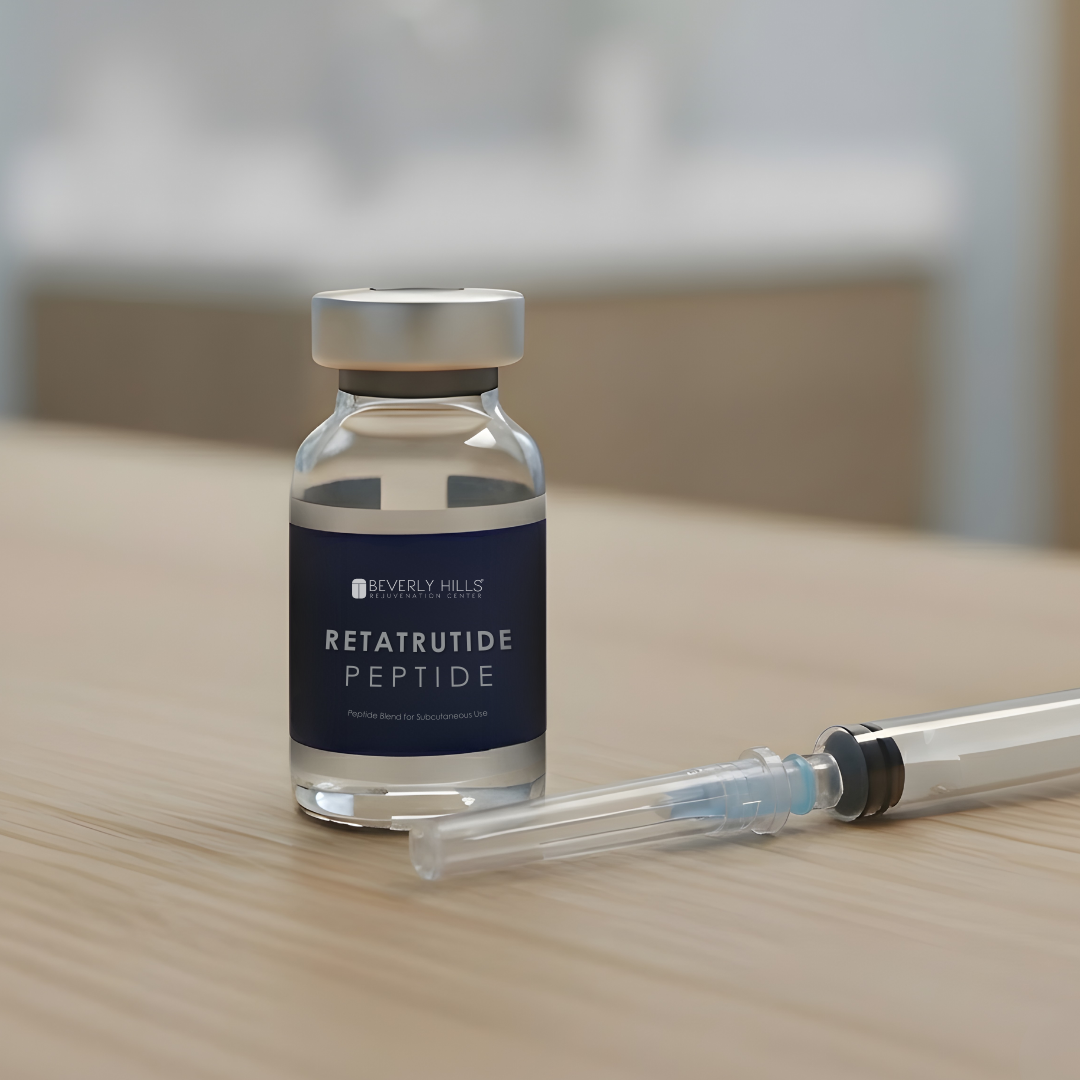
Retatrutide is a triple GIP / GLP-1 / glucagon receptor agonist and its numbers are the largest in the field: −24.2% at 48 weeks in phase 2, and in the phase 3 TRIUMPH-1 trial −28.3% at 80 weeks with −30.3% in a 104-week extension. In July 2026 Lilly said it would file in Q1 2027, citing manufacturing and quality-control data needs.
Until then it is an investigational drug. It is not approved, not prescribable, and not lawfully compoundable. Any clinic offering it today is operating outside the regulatory framework, whatever they tell you about it.
CagriSema — cagrilintide plus semaglutide — posted −20.4% in REDEFINE-1 and was submitted to the FDA on 18 December 2025, with review expected during 2026. We wrote about the amylin analogue side of it in our cagrilintide and CagriSema guide.
4. Compounded GLP-1s: what changed, and what is lawful now
This section exists because a lot of people are still being offered compounded semaglutide and tirzepatide, and the legal ground underneath those offers has moved.

On 27 August 2026 the Fifth Circuit affirmed the district court, upholding the FDA’s removal of semaglutide from the shortage list. Separately, on 30 April 2026 the FDA proposed to exclude semaglutide, tirzepatide and liraglutide from the 503B bulks list entirely, stating it “did not identify a clinical need” for outsourcing facilities to compound them. That proposal is not yet final, but if it is finalised it forecloses 503B bulk compounding of those three permanently — regardless of any future shortage.
5. The peptides marketed for weight loss that do not work
Every category with real winners attracts imitators. Here is the honest evidence for the four you will see advertised most.

AOD-9604 is a fragment of human growth hormone. It went through a phase 2b trial with 536 participants; the results were never published in a peer-reviewed journal, and a review states plainly that the results “did not support the commercial viability of the drug as a treatment for obesity.” It is a failed candidate, not an emerging one.
Tesamorelin is the interesting case, because it is FDA-approved — for reduction of excess abdominal fat in HIV patients with lipodystrophy. Its own label carries a Limitations of Use statement saying it is “not indicated for weight loss management as it has a weight neutral effect.” It reduces visceral adipose tissue without reducing body weight. Selling it as a weight-loss peptide contradicts the label of the very approval being cited.
5-Amino-1MQ and MOTS-c both have interesting mechanisms and no interventional human trials. MOTS-c has hundreds of publications, but the human ones are observational — measuring naturally circulating levels against phenotype. That an endogenous peptide correlates with metabolic health is not evidence that injecting it produces metabolic health. We covered both honestly in our 5-Amino-1MQ dosage guide and our MOTS-c mechanism piece.
6. Muscle loss on GLP-1s — the real numbers
This is the most-discussed risk and the most-distorted. Here is what the body-composition substudies actually found.

The key sentence from the SURMOUNT-1 substudy is that roughly 75% of the loss was fat mass and 25% lean mass for both tirzepatide and placebo. In STEP 1, lean body mass fell 9.7% in absolute terms while rising 3.0 percentage points as a proportion of total body mass, with the lean-to-fat ratio improving most in those losing the most weight.
A 2025 joint advisory from four professional societies quantifies it differently: of an average 13.6 kg reduction, 8.3 kg was fat and 5.3 kg lean body mass — and since muscle is roughly half of lean body mass, about 20% of total weight reduction is muscle. Modelling suggests 10–15% in women and 20–25% in men absent structured strength training.
7. How this works at BHRC
Our medical weight loss program is provider-directed and starts with labs and an examination, because “I want to lose weight” is a goal, not a diagnosis. Thyroid dysfunction, genuine hormone deficiency, medication effects and sleep apnea all present as weight that will not move, and all have specific treatments that are not a GLP-1.
Programme pricing is quoted after that assessment. If you want a range before booking, call the location nearest you and describe your situation — they will tell you honestly what it looks like. Rejuvenation Club members save 20% on every treatment plus priority scheduling.
1825 Festival Plaza Dr #180, Las Vegas, NV 89135
(725) 525-6821 · Monday–Friday 9:00 AM – 7:00 PM, Saturday 9:00 AM – 4:00 PM
Treatment by the BHRC clinical team
5.0 stars across 167 verified reviews
Medical weight loss and hormone optimisation are run here.
Consultations are free and carry no obligation.
Questions we get asked
Which is more effective, semaglutide or tirzepatide?
On pivotal trial numbers, tirzepatide at −20.9% over 72 weeks is higher than semaglutide 2.4 mg at −14.9% over 68 weeks. High-dose semaglutide 7.2 mg narrowed that to −18.7%. Trials are not head-to-head across every comparison, and tolerability differs between people — the more effective drug is the one you can actually stay on.
Can I still get compounded semaglutide?
Not as a routine cheaper alternative. The shortages were declared resolved in 2024 and 2025, the enforcement deadlines passed, and the FDA won on appeal in August 2026. 503A compounding survives only for narrow, documented, patient-specific clinical needs — and cost is not one of them.
Is retatrutide available anywhere legitimately?
No. It is investigational. Lilly announced in July 2026 that it would file in Q1 2027. Anyone selling it now is outside the regulatory framework.
Will I lose muscle?
You will lose some lean mass, as you would with any equivalent weight loss — roughly a 75/25 fat-to-lean split, which is the same split seen in placebo groups. Resistance training and adequate protein are the evidence-supported mitigations, and they should start on day one, not after you notice.
What happens if I stop?
Weight regain is common after discontinuation across this drug class. That is a reason to think of these as long-term metabolic treatments rather than a course you complete, and a reason to build the behavioural side in from the start.
Does insurance cover it?
Coverage for obesity indications varies enormously by plan and is frequently excluded. We can provide documentation but cannot predict a determination — ask your plan directly before you budget.
Keep reading
- Medical weight loss at BHRC
- Tirzepatide vs. semaglutide vs. retatrutide, compared
- Semaglutide dosage chart and titration schedule
- Cagrilintide and CagriSema — the amylin story
- 5-Amino-1MQ dosage guide and the evidence
- How MOTS-c works — mechanism and metabolic claims
- Medical weight loss at BHRC Summerlin
Book at any of our six locations
References
- U.S. Food and Drug Administration — FDA approves higher dose semaglutide (Wegovy HD), 19 March 2026. fda.gov
- Wharton S, et al. — Once-weekly semaglutide 7.2 mg in adults with obesity (STEP UP). Lancet Diabetes Endocrinol 2025;13(11):949–963. thelancet.com
- U.S. Food and Drug Administration — Approval letter — Wegovy (semaglutide) tablets, NDA 218316, 22 December 2025. accessdata.fda.gov
- U.S. Food and Drug Administration — Approval letter — Foundayo (orforglipron) tablets, NDA 220934, 1 April 2026. accessdata.fda.gov
- Jastreboff AM, et al. — Tirzepatide once weekly for the treatment of obesity (SURMOUNT-1). N Engl J Med 2022;387(3):205–216. nejm.org
- U.S. Court of Appeals for the Fifth Circuit — Outsourcing Facilities Association v. FDA, No. 25-10758, decided 27 August 2026. ca5.uscourts.gov
- U.S. Food and Drug Administration — FDA proposes to exclude semaglutide, tirzepatide and liraglutide from the 503B bulks list, 30 April 2026. fda.gov
- DailyMed / U.S. FDA — EGRIFTA SV (tesamorelin) prescribing information — Limitations of Use: not indicated for weight loss management. dailymed.nlm.nih.gov
- Look M, et al. — Body composition changes during weight reduction with tirzepatide in SURMOUNT-1. Diabetes Obes Metab 2025;27(5):2720–2729. doi.org
- Mozaffarian D, et al. — Nutritional priorities to support GLP-1 therapy for obesity: a joint advisory. Am J Clin Nutr 2025;122(1):344–367. doi.org
Beverly Hills Rejuvenation Center. This content is for general education and does not create a physician-patient relationship or constitute medical advice. Retatrutide is investigational and not FDA-approved. AOD-9604, 5-Amino-1MQ and MOTS-c are not FDA-approved for weight management and do not appear on either FDA compounding bulks list. BHRC prescribes FDA-approved products. Candidacy, dosing, results and pricing vary by person and are confirmed at a free consultation. Reviewed by the BHRC clinical team.