BHRC BLOG
Cagrilintide Dosage Guide + CagriSema: Titration, Trial Data & How It Works
BHRC · Peptide & Metabolic Research · Cagrilintide + CagriSema
Cagrilintide Dosage Guide + CagriSema: Titration, Trial Data & How It Works
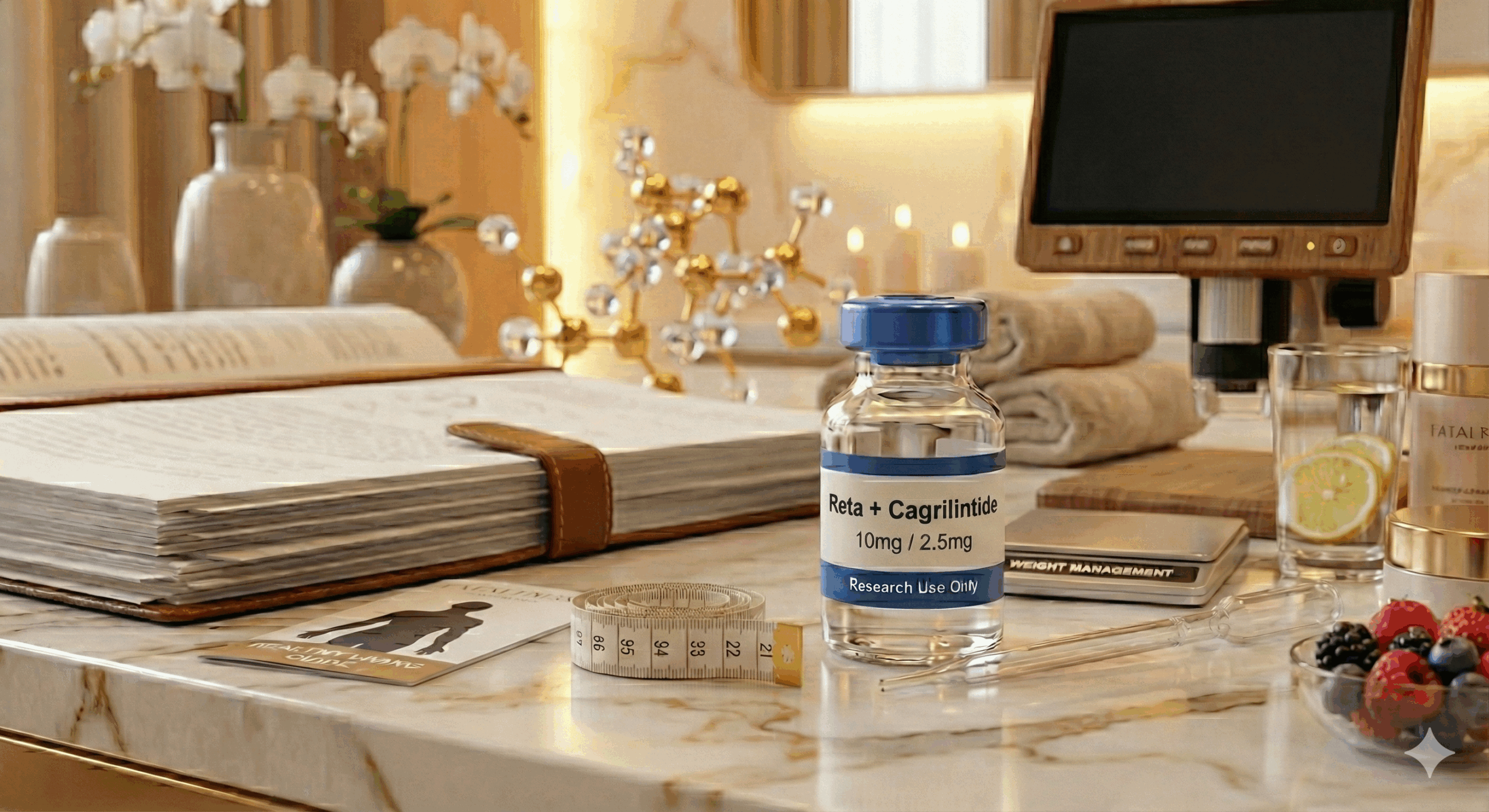
Semaglutide and tirzepatide taught the world the words “GLP-1.” Cagrilintide is the next chapter — and it plays a completely different instrument. It’s a long-acting amylin analog, and when it’s paired with semaglutide in a single weekly shot (a combination Novo Nordisk calls CagriSema), the two work through separate appetite pathways and push weight loss into territory that was previously the domain of surgery. This guide gives you the real, research-based version: what cagrilintide is, how it’s dosed and titrated, what the landmark REDEFINE trials actually showed, the honest safety picture, and how it fits into a physician-supervised weight-loss plan.
- What it is: cagrilintide is a long-acting amylin analog — a hormone mimic, not a GLP-1.
- Route: once-weekly subcutaneous injection, titrated over months.
- CagriSema: cagrilintide + semaglutide in one shot — two appetite pathways at once.
- Headline data: ~22.7% mean weight loss at 68 weeks in REDEFINE 1.
- Status: investigational; filed for FDA review, not yet approved. Provider-supervised only.
1 · What Is Cagrilintide?
Cagrilintide (developed as NNC0174-0833) is a long-acting analog of amylin, a hormone your pancreas releases alongside insulin every time you eat. Amylin’s job is to tell your brain “that’s enough” — it slows how fast your stomach empties, blunts the after-meal glucagon spike, and promotes a feeling of fullness. Natural amylin breaks down in minutes, so it’s useless as a once-weekly drug. Cagrilintide is engineered to resist that breakdown and last a full week, which is what makes weekly dosing possible.
Mechanistically, cagrilintide is a dual agonist at the amylin (AMY) and calcitonin (CTR) receptors in the brainstem and hypothalamus — the appetite-control centers of the brain. Crucially, this is a different door than the one GLP-1 medications knock on. That’s the whole strategic point: two complementary satiety signals instead of one. It sits in the same broader family as the other peptide and metabolic therapies BHRC works with, and if you’re new to the category, our what are peptides primer is a good starting point.

2 · Why Pair It With Semaglutide? (The CagriSema Logic)
Here’s the elegant part. Semaglutide is a GLP-1 receptor agonist; cagrilintide is an amylin analog. They reduce appetite through two independent hormonal systems that evolved to work together after a meal. Stack them, and you don’t just add the effects — you get a broader, more complete “I’m full” signal that’s harder for the body to compensate against.
That’s the thesis behind CagriSema: cagrilintide 2.4 mg + semaglutide 2.4 mg, co-formulated in a single once-weekly injection. It’s the first combination to marry a GLP-1 and an amylin analog in one shot — and, as you’ll see below, the combination outperformed either drug on its own by a wide margin.

3 · Cagrilintide Dosage & Titration
Amylin analogs, like GLP-1s, work best when you start low and climb slowly. The gradual ramp gives your digestive system time to adapt, keeps nausea manageable, and — most importantly — helps people stay on therapy long enough to actually see results. The Phase 3 REDEFINE program used a clean, every-four-weeks escalation:
| Weeks | Cagrilintide dose (once weekly) | Phase |
|---|---|---|
| 1–4 | 0.25 mg | Starting dose |
| 5–8 | 0.5 mg | Escalation |
| 9–12 | 1.0 mg | Escalation |
| 13–16 | 1.7 mg | Escalation |
| 17 onward | 2.4 mg | Maintenance |
A few practical notes that matter more than the numbers:
- 2.4 mg is the target in the CagriSema program, but it isn’t mandatory. In REDEFINE 1, only about 57% of patients climbed to the top dose — and the group still averaged strong results, because providers were allowed to hold people at a comfortable, effective “submaximal” dose.
- Higher isn’t automatically better. Earlier Phase 2 monotherapy studied cagrilintide up to 4.5 mg, but 2.4 mg is the dose carried into the pivotal combination trials.
- Slow beats fast. Rushing the titration is the single most common reason people quit — the ramp exists to keep you in the game.

4 · The REDEFINE Trial Data
The reason cagrilintide is suddenly everywhere is a pair of large Phase 3 trials — REDEFINE 1 and REDEFINE 2 — presented at the American Diabetes Association’s 2025 Scientific Sessions and published simultaneously in the New England Journal of Medicine in June 2025. Both ran for 68 weeks.
REDEFINE 1 — adults with overweight/obesity (no diabetes)
This is the headline trial. CagriSema delivered a mean weight reduction of about 22.7% — and the comparison arms tell the real story of why the combination matters:
| Treatment (68 weeks) | Mean weight reduction |
|---|---|
| CagriSema (cagrilintide 2.4 + semaglutide 2.4) | ~22.7% |
| Semaglutide 2.4 mg alone | ~16.1% |
| Cagrilintide 2.4 mg alone | ~11.8% |
| Placebo | ~2.3% |
The distribution was just as striking: roughly 60% of CagriSema patients lost at least 20% of their body weight, and about 23% lost 30% or more — percentages that used to be associated with bariatric surgery, not an injection.
REDEFINE 2 — adults with obesity and type 2 diabetes
Weight loss is typically harder to achieve in people with type 2 diabetes, yet CagriSema still delivered a clinically meaningful reduction (on the order of ~13–14% versus roughly 3% on placebo, depending on the analysis), alongside strong glycemic results — a large majority of participants reached an HbA1c target of ≤6.5%, and blood pressure, waist circumference, and lipids improved as well.

5 · Safety & Side Effects
The side-effect profile of cagrilintide and CagriSema looks a lot like the GLP-1 medications people already know — because both classes work largely through the gut and appetite system. The most common effects are gastrointestinal: nausea, constipation, and vomiting, which were reported far more often than on placebo but were mostly mild-to-moderate and transient, easing as the body adjusted to each dose step.
- Most common: nausea, constipation, vomiting, reduced appetite, and occasional injection-site reactions.
- Usually temporary: GI symptoms tended to peak around dose increases and settle with time — another reason the slow titration matters.
- Discontinuation was low: relatively few participants stopped because of side effects (single-digit percentages in the trials).
- Metabolic monitoring: as with any potent weight-loss therapy, providers watch blood sugar, hydration, and overall tolerance — and pace the dose to you.
This is precisely why an amylin analog belongs in a supervised setting rather than a self-sourced protocol: the difference between a rough experience and a smooth one is usually how carefully the dose is escalated and monitored.

6 · Where Cagrilintide Fits at BHRC
CagriSema isn’t FDA-approved yet — it’s been filed for review and is moving through the pipeline — so it isn’t something to chase from a gray-market vial. What BHRC offers today is the right home for this category when it arrives, and proven options you can start now:
- Physician-supervised weight loss. Our medical weight-loss programs are built around labs, monitoring, and a titration paced to you — the exact framework amylin therapy needs.
- Proven GLP-1 options now. Start with semaglutide or tirzepatide while newer combinations complete review.
- A full metabolic toolbox. From 5-Amino-1MQ to growth-hormone peptide blends, your provider matches the tool to your goals.
- Pharmaceutical-grade, always. Everything is sourced from licensed compounding pharmacies, prescribed and monitored — not sold over the counter.


Book a complimentary consultation with a licensed BHRC provider. We’ll review your goals and labs, explain where CagriSema and today’s proven options fit, and build a physician-supervised plan with transparent pricing — no pressure, no guesswork.
Book Your Free Consultation →Frequently Asked Questions
What is cagrilintide?
Cagrilintide is a long-acting amylin analog — a once-weekly injectable that mimics amylin, a natural satiety hormone. It acts on amylin and calcitonin receptors in the brain to slow gastric emptying and curb appetite, through a pathway separate from GLP-1 medications.
What is CagriSema?
CagriSema is a combination of cagrilintide 2.4 mg plus semaglutide 2.4 mg in a single once-weekly injection. It’s the first therapy to pair a GLP-1 and an amylin analog together, targeting two appetite systems at once for greater weight loss than either alone.
What is the cagrilintide dosage and titration schedule?
In the Phase 3 program, cagrilintide starts at 0.25 mg weekly and escalates about every 4 weeks: 0.5 mg, 1.0 mg, 1.7 mg, then a 2.4 mg maintenance dose from around week 17. The slow ramp improves tolerability. Your provider sets and adjusts the pace.
How much weight did people lose in the trials?
In the 68-week REDEFINE 1 trial (adults without diabetes), CagriSema produced about 22.7% mean weight loss, versus roughly 16% for semaglutide alone, 12% for cagrilintide alone, and 2% for placebo. Around 60% of patients lost 20% or more of their body weight.
Is cagrilintide or CagriSema FDA-approved?
Not yet. As of 2026, CagriSema has been filed for FDA review but is not approved, and cagrilintide on its own remains investigational. Any use should occur only within a physician-supervised setting.
What are the side effects?
Mostly gastrointestinal — nausea, constipation, and vomiting — which were common in trials but generally mild-to-moderate and transient, easing as the body adapts. Discontinuation due to side effects was low. Medical monitoring helps manage them.
How is cagrilintide different from semaglutide or tirzepatide?
Semaglutide is a GLP-1 agonist; tirzepatide is a dual GIP/GLP-1 agonist. Cagrilintide is an amylin analog — a different hormone class entirely. That’s why combining cagrilintide with semaglutide (CagriSema) is additive: it engages an appetite pathway the GLP-1s don’t.
Can I start a weight-loss program at BHRC now?
Yes. While CagriSema completes FDA review, BHRC offers physician-supervised weight-loss programs using proven options like semaglutide and tirzepatide, with labs, monitoring, and personalized titration. Book a free consultation to see what fits.
Is it safe to buy cagrilintide online?
Self-sourcing research peptides carries real risks — unverified purity, incorrect dosing, and no monitoring. Amylin therapy works best with careful titration and provider oversight, which is why BHRC keeps it physician-supervised and pharmaceutical-grade.
What’s the first step?
Book a complimentary consultation. You’ll meet a provider, review your goals and labs, and get an honest plan — including where cagrilintide, CagriSema, and today’s approved options fit — with transparent pricing before committing to anything.
Keep Reading — Weight-Loss & Peptide Guides
- The Best Peptides for Weight Loss
- Semaglutide Weight-Loss Program & Cost
- 5-Amino-1MQ Dosage Guide
- Tesamorelin + Ipamorelin Blend Guide
- What Are Peptides? A Beginner’s Guide
Medical Weight Loss Near You — BHRC Locations
Physician-supervised GLP-1 and metabolic programs are available at BHRC studios nationwide, including our main six:
- Medical weight loss in West Hollywood, CA
- Medical weight loss in West Los Angeles, CA
- Medical weight loss in Valencia, CA
- Medical weight loss in Westlake Village, CA
- Medical weight loss in Summerlin / Las Vegas, NV
- Medical weight loss in Paradise Valley / Phoenix, AZ
References & Further Reading
- Garvey WT, et al. Coadministered Cagrilintide and Semaglutide in Adults with Overweight or Obesity (REDEFINE 1). New England Journal of Medicine (2025). nejm.org
- Davies MJ, et al. Cagrilintide–Semaglutide in Adults with Overweight or Obesity and Type 2 Diabetes (REDEFINE 2). New England Journal of Medicine (2025). nejm.org
- REDEFINE 1 (coadministered cagrilintide + semaglutide) — abstract. PubMed. pubmed.ncbi.nlm.nih.gov
- Cagrilintide (NNC0174-0833) Phase 2 dose-finding in overweight/obesity. ClinicalTrials.gov NCT03856047. clinicaltrials.gov
- American Diabetes Association — 85th Scientific Sessions (2025), CagriSema REDEFINE presentations. diabetes.org
Beverly Hills Rejuvenation Center. This content is for general education and does not create a physician-patient relationship or constitute medical advice. Cagrilintide and CagriSema are investigational and, as of publication, not FDA-approved; dosing figures reflect clinical-trial protocols, not a recommendation. Weight-loss and peptide therapies at BHRC are provided only under medical supervision after individualized evaluation and appropriate lab work; candidacy, protocols, results, and pricing vary by person and are confirmed at consultation. Statements have not been evaluated by the FDA and are not intended to diagnose, treat, cure, or prevent any disease. Reviewed by the BHRC clinical team; information current as of August 2026.