
BHRC BLOG
Semaglutide Weight-Loss Program & Cost
BHRC Blog · Medical Weight Loss · GLP-1 Therapy
Semaglutide Weight-Loss Program & Cost
You’ve seen the headlines — Ozempic, Wegovy, semaglutide — and the before-and-afters. Behind the buzzwords is one active ingredient and a genuinely new way to treat weight: a GLP-1 medication that quiets appetite, slows digestion, and helps your body feel full on less. As of 2026 it even comes as a once-daily pill. Here’s a plain-English guide to what semaglutide is, how it works, what results and side effects to actually expect, what a supervised program costs, and how to start safely with a licensed provider.
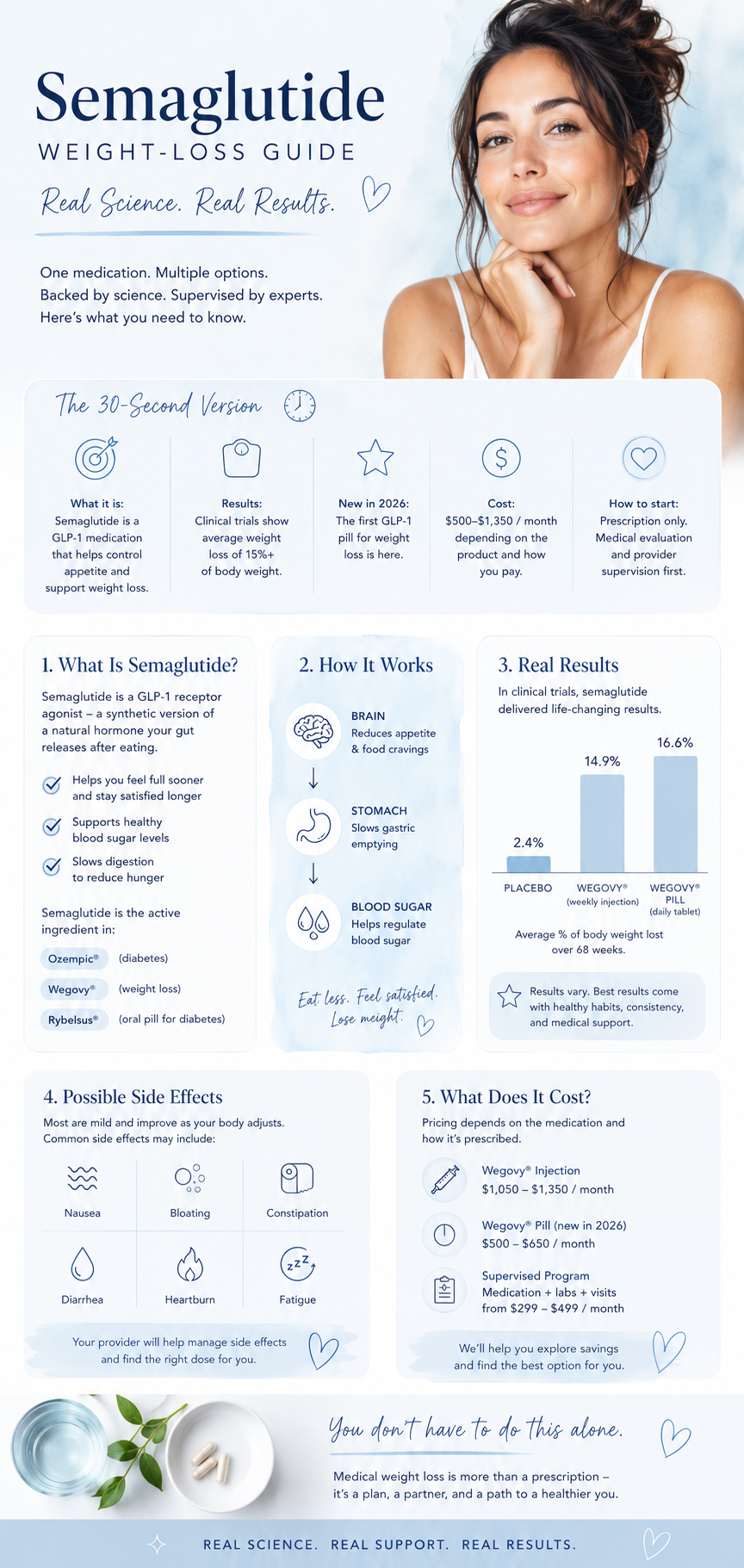
- What it is: semaglutide is a GLP-1 receptor agonist — the same molecule in Ozempic (diabetes), Wegovy (weight loss), and Rybelsus (oral, diabetes).
- Results: in the landmark trial, weekly semaglutide produced about 15% average body-weight loss over 68 weeks; the new oral Wegovy showed ~16.6% in its trial.
- New in 2026: the FDA approved the Wegovy pill (oral semaglutide 25 mg) in December 2025 — the first GLP-1 pill for weight loss.
- Cost: brand list prices run roughly $500–$1,350/month depending on the product and how you pay; a supervised program bundles the medication with labs, dosing, and provider visits.
- How to start: semaglutide is prescription-only and provider-supervised. It is not for everyone — a medical evaluation comes first.
1 · What Is Semaglutide (and What’s a GLP-1)?
Let’s clear up the alphabet soup, because searches like “what is GLP-1,” “what is semaglutide,” and “is Ozempic a peptide” are all really asking the same thing.
GLP-1 stands for glucagon-like peptide-1 — a hormone your gut naturally releases after you eat. It tells your pancreas to release insulin, signals your brain that you’re full, and slows how fast your stomach empties. Semaglutide is a lab-made molecule that mimics that hormone but lasts far longer, so a single weekly injection (or a daily pill) keeps that “I’ve had enough” signal switched on.
So yes — semaglutide is technically a peptide, and it is a GLP-1. The brand names are just different products built on that one ingredient, made by Novo Nordisk:
Ozempic
Semaglutide injection, FDA-approved for type 2 diabetes; widely used off-label for weight.
Wegovy
Semaglutide approved specifically for weight management — as a weekly injection and, now, a daily pill.
Rybelsus
The original oral semaglutide tablet, approved for type 2 diabetes.

2 · How Semaglutide Works for Weight Loss
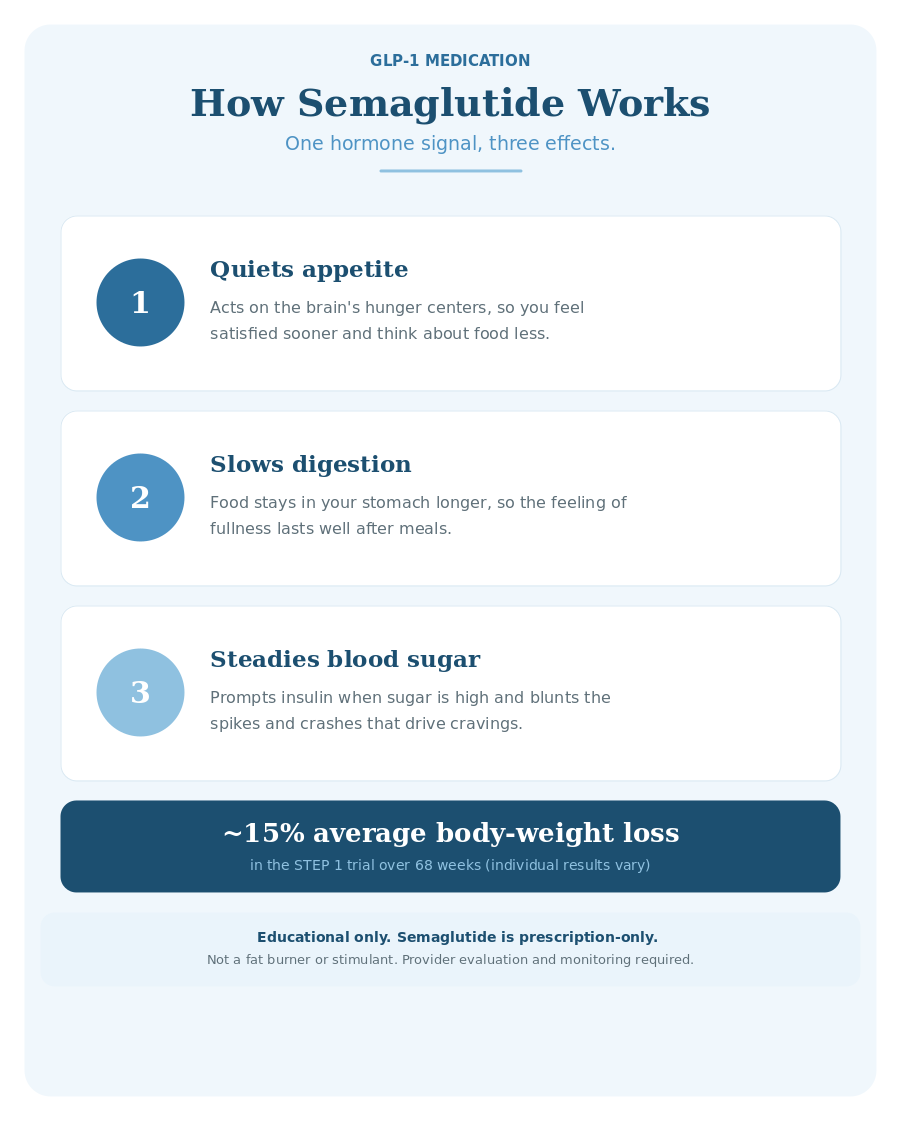
Here’s the honest mechanism behind “how does semaglutide work” and “how does Ozempic help you lose weight.” Semaglutide works on appetite from several angles at once:
- Turns down appetite. It acts on hunger centers in the brain, so you feel satisfied sooner and think about food less (that quieting of “food noise” is the effect people describe most).
- Slows gastric emptying. Food stays in your stomach longer, so you feel full longer after meals.
- Steadies blood sugar. It prompts insulin when your sugar is high and blunts the spikes and crashes that drive cravings.
The net effect: you naturally eat less without white-knuckling through constant hunger. It is a medical tool that makes the healthy choices easier — not a magic wand, and not a replacement for nutrition and movement, which is why it works best inside a real program.
3 · Real Results — What to Expect
Expectations matter, so let’s use the actual data rather than social-media hype. In the pivotal STEP 1 trial published in the New England Journal of Medicine, adults with overweight or obesity taking weekly semaglutide 2.4 mg lost on average about 14.9% of their body weight over 68 weeks, versus 2.4% on placebo — a difference of roughly 12+ percentage points. For the new once-daily oral Wegovy, the OASIS 4 trial reported about 16.6% mean weight loss when taken as directed, with a third of adherent participants losing 20% or more.
| Product | Form | Average weight loss (trial) | Timeframe |
|---|---|---|---|
| Wegovy (semaglutide 2.4 mg) | Weekly injection | ~14.9% body weight | 68 weeks (STEP 1) |
| Wegovy pill (semaglutide 25 mg) | Daily tablet | ~16.6% body weight | OASIS 4 trial |
| Tirzepatide (Zepbound/Mounjaro) | Weekly injection | ~20%+ body weight | 72 weeks (SURMOUNT-1) |
Timeline: most people notice reduced appetite within the first week or two, but meaningful weight loss builds gradually over months as the dose is increased. Answering “how long does it take semaglutide to work” — appetite effects are fast; scale results are a marathon, not a sprint. And these are averages: individual results vary widely based on dose, adherence, diet, activity, and biology.
4 · Semaglutide vs Tirzepatide — Which Is “Better”?
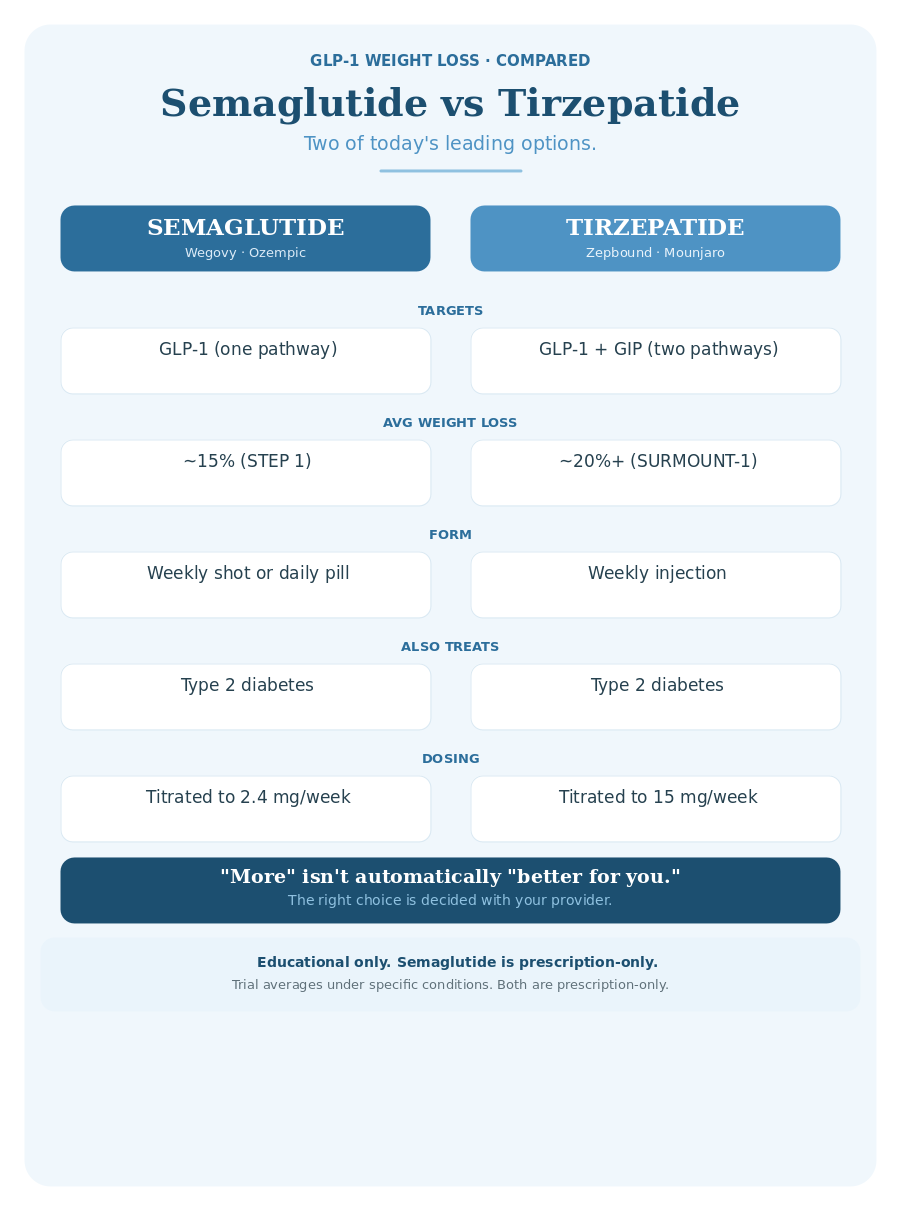
This is one of the most-searched questions in the category (“semaglutide vs tirzepatide,” “which is better”), so here’s the straight answer. Semaglutide targets one hormone pathway (GLP-1). Tirzepatide targets two (GLP-1 and GIP), and in head-to-head-style trial data it tends to produce more weight loss on average. But “more” isn’t automatically “better for you”: tolerability, side effects, cost, insurance, and how your body responds all matter. The right choice is the one you and your provider land on together. We break the two down in depth in our Semaglutide vs Tirzepatide comparison.
5 · Semaglutide Dosing — The Titration Schedule
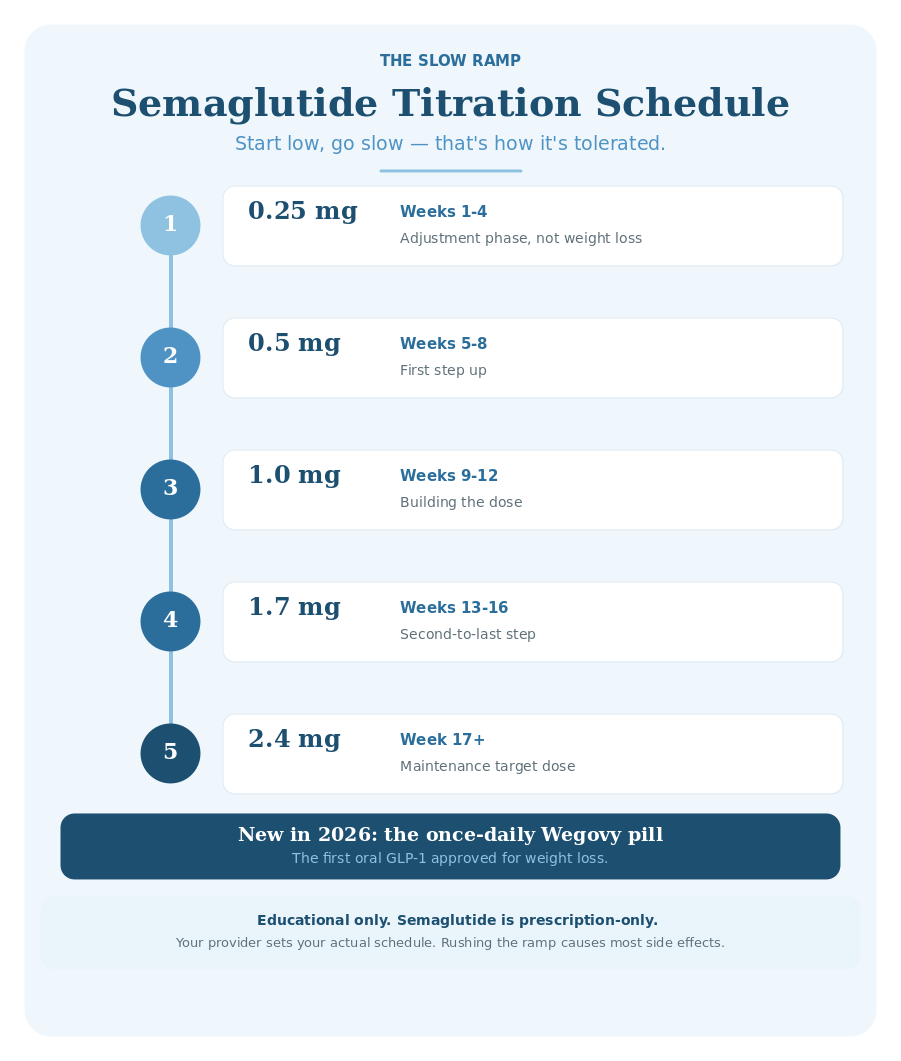
You don’t start at the full dose. Semaglutide is titrated — increased slowly — to let your body adjust and to minimize nausea. A typical weekly-injection schedule looks like this (your provider sets your actual plan):
| Phase | Weekly dose | Typical duration |
|---|---|---|
| Starting | 0.25 mg | 4 weeks (adjustment, not weight loss) |
| Step up | 0.5 mg | 4 weeks |
| Step up | 1.0 mg | 4 weeks |
| Step up | 1.7 mg | 4 weeks |
| Maintenance | 2.4 mg | Ongoing target dose |
The slow ramp is the single biggest reason people tolerate semaglutide well. Rushing it is the most common cause of miserable side effects — which is exactly what supervision prevents.
6 · Semaglutide Cost — What You Actually Pay
Now the question that brought a lot of you here: what does semaglutide cost? The honest answer is “it depends on the product, your insurance, and how you pay.” Here’s the landscape:
| Path | Typical cost (without insurance) | Notes |
|---|---|---|
| Brand Wegovy / Ozempic (list) | ~$1,000–$1,350 / month | Manufacturer list price; many pay far less with coverage |
| Manufacturer self-pay programs | ~$499 / month | Cash-pay options have emerged for eligible patients |
| Insurance / copay | $0–$300 / month | Varies widely; some plans cover weight-loss GLP-1s, many don’t |
| BHRC supervised program | from $299–$499 / month | Includes evaluation, labs, dosing & provider visits — confirmed at consultation |
What actually drives your cost: which medication you’re on, your dose, whether you have insurance coverage, and what’s bundled into the program (labs, provider visits, and monitoring have real value — cheaper isn’t cheaper if you’re unsupervised). A quality medical weight-loss program is priced for the whole journey, not just a vial.
7 · Side Effects & Safety
Searches like “semaglutide side effects,” “is semaglutide safe,” “ozempic side effects,” and “what are the bad side effects of ozempic” deserve a straight answer. Semaglutide is FDA-approved and well-studied, but it’s a real medication with real effects.
Common side effects
- Nausea (the most common, usually early and dose-related)
- Diarrhea, constipation, or vomiting
- Reflux, burping, or bloating
- Fatigue, especially in the first weeks
- Injection-site reactions (injectable forms)
Most GI side effects are mild and fade as your body adjusts — and slow titration keeps them manageable. Staying hydrated, eating smaller and lower-fat meals, and not rushing dose increases all help.
Serious considerations — who should not take it
- Do not use if you or a family member has had medullary thyroid carcinoma or MEN 2 (a boxed warning based on rodent studies).
- Caution with a history of pancreatitis, gallbladder disease, severe GI disease, or diabetic retinopathy.
- Not for use during pregnancy or breastfeeding.
- Rare but serious risks include pancreatitis and gallbladder problems — which is why medical screening and monitoring are non-negotiable.
This is the whole reason a program exists: to screen you properly, choose the right medication, monitor labs, and manage side effects — not to hand you a pen and wish you luck. For a deeper dive, see our complete semaglutide side-effects & safety guide.
8 · How to Start a Semaglutide Program at BHRC
Answering “how to get semaglutide” / “do you need a prescription for Ozempic”: yes, it’s prescription-only, and the responsible path is a medical evaluation first. Here’s how it works with us:
- Consultation & screening — health history, goals, and whether a GLP-1 is right and safe for you.
- Labs & baseline — so your provider prescribes and monitors responsibly.
- Personalized plan — the right medication and titration schedule for your body and budget.
- Ongoing support — dose adjustments, side-effect management, and progress checks.

Start with a consultation at Beverly Hills Rejuvenation Center — supervised, personalized, and safe.
Start Your Weight-Loss Consultation →Frequently Asked Questions
What is GLP-1, and is semaglutide a GLP-1?
GLP-1 (glucagon-like peptide-1) is a natural gut hormone that controls appetite, fullness, and blood sugar. Semaglutide is a long-acting medication that mimics GLP-1 — so yes, it’s a GLP-1 receptor agonist. Ozempic, Wegovy, and Rybelsus are all brand-name semaglutide products.
How does semaglutide work for weight loss?
It reduces appetite by acting on hunger centers in the brain, slows how fast your stomach empties so you feel full longer, and steadies blood sugar to reduce cravings. The result is that you naturally eat less without constant hunger.
How much weight can you lose on semaglutide?
In the STEP 1 trial, weekly semaglutide 2.4 mg produced about 14.9% average body-weight loss over 68 weeks; the new oral Wegovy showed about 16.6% in its trial. Individual results vary based on dose, adherence, diet, and activity.
How long does semaglutide take to work?
Most people notice reduced appetite within the first week or two. Meaningful weight loss builds gradually over months as the dose is titrated up. It’s a long-term treatment, not a quick fix.
Semaglutide vs tirzepatide — which is better?
Semaglutide targets one hormone pathway (GLP-1); tirzepatide targets two (GLP-1 and GIP) and tends to produce more average weight loss. “Better” depends on your response, tolerability, cost, and coverage — a provider helps you choose.
Is semaglutide safe? What are the side effects?
It’s FDA-approved and well-studied, but it has real side effects — most commonly nausea and other GI symptoms that usually fade with slow dose increases. It shouldn’t be used by people with a personal/family history of medullary thyroid cancer or MEN 2, or during pregnancy. Medical screening and monitoring are essential.
Is there a semaglutide pill (Wegovy pill)?
Yes. The FDA approved the oral Wegovy pill (semaglutide 25 mg, once daily) in December 2025 — the first oral GLP-1 approved for weight loss. Rybelsus is an older oral semaglutide approved for type 2 diabetes.
Is compounded semaglutide still available?
Mostly no. The FDA declared the semaglutide shortage resolved in February 2025, and the grace periods for mass compounding ended in May 2025. Compounded semaglutide is now limited to specific, patient-tailored medical needs — so be cautious of cheap online “semaglutide.”
How much does semaglutide cost?
Brand list prices run roughly $1,000–$1,350/month, though manufacturer self-pay options (around $499/month) and insurance can lower that substantially. A supervised program bundles the medication with labs, dosing, and provider visits — we confirm your exact cost at consultation.
Do I need a prescription, and how do I start?
Yes, semaglutide is prescription-only. You start with a medical consultation and screening, baseline labs, a personalized titration plan, and ongoing monitoring. Book a consultation to find out if it’s right for you.
Keep Reading — Related Guides
- Semaglutide vs Tirzepatide: Which GLP-1 Is Right for You?
- Semaglutide Side Effects: Complete Safety Profile & Management
- How to Prepare for Semaglutide Therapy
- GLP-1 Peptides: How They Work
- Best Peptides for Weight Loss
- Tirzepatide Weight-Loss Program — Cost & How to Start
Semaglutide & Medical Weight Loss by Location
Semaglutide programs are available through BHRC’s licensed providers. Find medical weight loss near you:
References & Further Reading
- Wilding JPH, et al. Once-Weekly Semaglutide in Adults with Overweight or Obesity (STEP 1). N Engl J Med. 2021;384:989-1002. DOI: 10.1056/NEJMoa2032183
- U.S. Food & Drug Administration. FDA Approves New Drug Treatment for Chronic Weight Management (Wegovy). fda.gov
- U.S. Food & Drug Administration. FDA Clarifies Policies for Compounders as National GLP-1 Supply Begins to Stabilize (semaglutide shortage resolved). fda.gov
- Novo Nordisk. FDA Approves the Wegovy Oral Pill for Weight Management (December 2025). novonordisk.com
- National Institute of Diabetes and Digestive and Kidney Diseases (NIDDK). Prescription Medications to Treat Overweight & Obesity. niddk.nih.gov
Beverly Hills Rejuvenation Center — Medical Weight-Loss Library. This educational content does not create a physician-patient relationship and is not a substitute for individualized medical advice, diagnosis, or treatment. Semaglutide is a prescription medication that requires evaluation, prescription, and monitoring by a licensed provider; it is not appropriate for everyone. Individual results vary and are not guaranteed. Weight-loss trial figures reflect study averages under specific conditions. Pricing is illustrative, changes over time, and is confirmed at consultation. Always discuss risks, benefits, and alternatives with a qualified clinician. This content has been reviewed by the BHRC clinical team. Information current as of August 2026.