BHRC BLOG
Peptide Stacking Guide: Which Peptides Can Be Combined Safely
BHRC · LONGEVITY & WELLNESS · PEPTIDES
Search for peptide stacking and you will find charts. Which peptides pair well, which to avoid together, how to sequence a cycle — laid out with a confidence that suggests somebody studied it. Almost nobody did. We went looking for controlled human trials of the commonly promoted combinations and could not find one, including for the pairing that appears in nearly every protocol on the internet. This guide covers what is actually known: where these substances stand legally in 2026, the five considerations that hold up without a study behind them, why simultaneous starts destroy your ability to learn anything, and the handling and syringe arithmetic that genuinely are knowable.
1 · The regulatory reality, first
Before the pharmacology, the law — because it determines what is even available.
Under the Federal Food, Drug and Cosmetic Act, a bulk drug substance may be compounded only if it meets one of three conditions: it complies with a USP or NF monograph, it is a component of an FDA-approved drug, or it appears on the 503A Bulks List established by regulation.

FDA said this directly to a compounding pharmacy in a warning letter: these substances are not the subject of an applicable USP or NF monograph, are not a component of an FDA-approved human drug, and do not appear on the 503A bulks list. The agency has continued issuing warning letters to online peptide sellers through 2026, taking the position that a “research use only” label does not override evident drug intent.
2 · The one combination people always cite
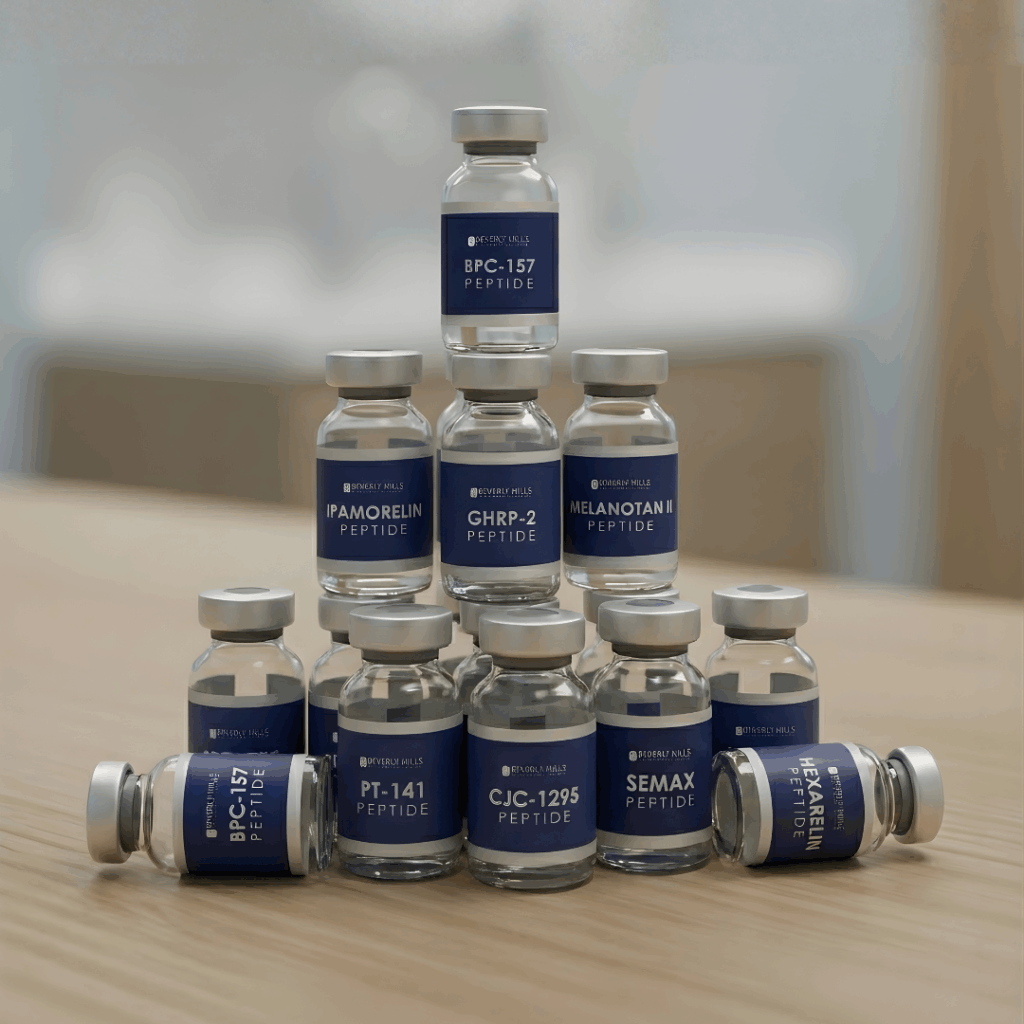
CJC-1295 with ipamorelin is the canonical stack: a GHRH analogue paired with a ghrelin-receptor agonist, on the theory that hitting two inputs to growth hormone release produces more than either alone.
The theory is reasonable. The evidence is not there. We could not identify a controlled human trial of the combination. Single-agent human pharmacokinetic data for CJC-1295 exists, but the combination itself has not been studied in the way the confident protocols imply.
And the regulatory picture is worse than most articles admit. Ipamorelin acetate is currently in FDA’s Category 2 — substances that may present significant safety risks — with FDA citing immunogenicity risk and literature reports of serious adverse events including death when ipamorelin was administered intravenously. CJC-1295 was reviewed in December 2024 and FDA proposed it not be added to the list.
3 · The five considerations that are actually defensible
None of these require a study to state, and all of them are the kind of thing a good prescriber raises before a patient starts three things at once.

Why attribution matters more than it sounds
Suppose you start three peptides on the same Monday and by week six you feel meaningfully better. Which one did it? Suppose instead you develop an injection-site reaction, or your fasting glucose drifts up, or you get a headache that will not settle. Which one caused it, and which one do you stop?
You cannot know. And because you cannot know, you also cannot make a sensible decision about what to continue, what to drop and what to adjust. A sequential approach — one agent, long enough to judge, with labs before and after — produces information. A stack produces a feeling.
4 · Product quality compounds with every addition
FDA’s reviews of these substances return repeatedly to the same concern, and it is worth quoting the shape of it. For BPC-157 the agency wrote that the product may pose a significant risk for immunogenicity, potentially amplified by aggregation as well as potential peptide-related impurities. Near-identical language appears in the TB-500 and GHK-Cu reviews.
Immunogenicity means your immune system recognising an injected protein as foreign and mounting a response to it. Aggregated peptide — clumped rather than properly dissolved — is the substrate for that. Impurities make it worse. And neither is visible to you in a vial.

5 · Bacteriostatic vs sterile water, and the syringe math
Two practical things that are genuinely knowable, unlike most of what circulates on this topic.
Bacteriostatic water contains benzyl alcohol at 0.9% — 9 mg per millilitre — and is supplied in 30 mL multiple-dose vials. The preservative suppresses microbial growth between withdrawals, which is why it suits a vial you will access more than once. Sterile water has no preservative and is for single-dose use; it is the required form for neonates, because benzyl alcohol has been associated with toxicity in newborns. Neither should be injected intravenously undiluted — it can cause hemolysis.
At typical subcutaneous volumes the benzyl alcohol question is a non-issue in adults: a 0.2 mL injection delivers about 1.8 mg, against an adult reference figure orders of magnitude higher.

6 · What a defensible approach looks like


If the underlying goal is recovery, body composition, immune resilience or healthspan, the higher-yield starting point is nearly always measurement rather than a molecule — and certainly rather than four of them. Most people have something meaningful out of range in their metabolic, inflammatory, thyroid or hormone panels, and addressing that is both better evidenced and legally uncomplicated.
Physician-supervised peptide programs, with baseline and follow-up labs, are available at all six BHRC studios. Consultations are free and carry no obligation.
We will tell you what is currently available, what is evidenced, and what is neither.
Frequently Asked Questions
Which peptides can be safely stacked together?
There is no evidence-based answer to that question, which is why this article does not contain a compatibility chart. We could not identify a single controlled human trial of any commonly promoted combination. The charts circulating online come from vendor and clinic marketing rather than from data.
What about CJC-1295 and ipamorelin?
It is the most-cited stack and it has not been studied as a combination in a controlled human trial that we could identify. Separately, ipamorelin acetate currently sits in FDA’s Category 2 for substances that may present significant safety risks, and FDA recommended against adding CJC-1295 to the 503A list in December 2024.
Did the July 2026 FDA vote make these legal?
No. An advisory committee voted to recommend six peptides — BPC-157, KPV, TB-500, MOTS-c, semax and epitalon — for the 503A Bulks List, against the recommendation of FDA’s own scientists. Those votes are advisory and non-binding. FDA must complete notice-and-comment rulemaking before anything changes, and it has not.
Why is starting several peptides at once a problem?
Because you lose the ability to interpret your own result. If you feel better you cannot say which agent did it; if something goes wrong you cannot say which to stop. Sequential use — one agent, long enough to judge, with labs at both ends — is the only version that produces information.
What is immunogenicity and why does it come up so often?
It is your immune system recognising an injected protein as foreign and responding to it. Aggregated peptide is the main substrate, and impurities make it worse. FDA cites it repeatedly in its reviews of these substances, and neither aggregation nor impurity is visible to you in a vial.
Bacteriostatic or sterile water — which should I use?
Bacteriostatic water contains benzyl alcohol 0.9% as a preservative and is intended for multiple-dose vials. Sterile water is preservative-free and for single-dose use, and is the required form for neonates. Neither should be injected intravenously undiluted.
How do I work out how many units to draw?
Divide the vial strength in milligrams by the diluent volume in millilitres to get the concentration. Divide your dose by that concentration and multiply by 100. A U-100 syringe reads 100 units per millilitre. Crucially, changing the diluent volume changes every number — which is why a dose given only in units is meaningless.
Does more injections mean more results?
There is no data supporting that, and several reasons to doubt it. Multiple daily subcutaneous injections concentrate tissue trauma at a limited number of sites, each unapproved peptide adds its own immunogenicity exposure, and no interaction data exists for any combination.
What should I do instead of stacking?
Start with baseline labs, address what is actually out of range, and if a peptide is appropriate introduce one at a time under supervision with follow-up testing. Slower, but it is the only approach that tells you anything.
Does BHRC prescribe peptide stacks?
Peptide therapy at BHRC is provided only after physician evaluation, and what is appropriate depends on your history, your labs and current regulatory standing. Book a consultation and you will get a direct answer for your situation.
Keep Reading
- What Are Peptides? A Beginner’s Guide to Peptide Therapy
- FDA Peptide Reclassification 2026 — What It Means for Patients
- Sermorelin Dosage Guide: Protocol, Timing & Results Timeline
- Tesamorelin + Ipamorelin Blend: Dosage, Ratios & Protocol
- Epitalon Dosage Guide: Cycling Protocol & Longevity Research
- Peptide Therapy in Los Angeles
- Advanced Diagnostic Testing
- Longevity & Healthspan at BHRC
Peptide Therapy at a BHRC Studio Near You
Physician-supervised peptide programs are available at BHRC studios nationwide, including our main six. Tap your closest location to book a free consultation:
References & Further Reading
- U.S. Food & Drug Administration — Interim Policy on Compounding Using Bulk Drug Substances Under Section 503A (guidance), January 2025. fda.gov
- U.S. Food & Drug Administration — Bulk Drug Substances Used in Compounding Under Section 503A of the FD&C Act. fda.gov
- U.S. Food & Drug Administration — Certain Bulk Drug Substances for Use in Compounding that May Present Significant Safety Risks. fda.gov
- U.S. Food & Drug Administration — July 23–24, 2026 Meeting of the Pharmacy Compounding Advisory Committee. fda.gov
- U.S. Food & Drug Administration — Pharmacy Compounding Advisory Committee Transcript — CJC-1295, December 4, 2024. fda.gov
- U.S. Food & Drug Administration — Warning Letter — Tailor Made Compounding LLC, April 2020. fda.gov
- U.S. Food & Drug Administration — Warning Letter — Royal Peptides LLC, August 2026. fda.gov
- DailyMed / U.S. Food & Drug Administration — Bacteriostatic Water for Injection, USP — approved labeling. dailymed.nlm.nih.gov
- Centers for Disease Control and Prevention — Safe Injection Practices to Prevent Transmission of Infections to Patients. cdc.gov
- United States Pharmacopeia — General Chapter <797> Pharmaceutical Compounding — Sterile Preparations. usp.org
- Holland & Knight — FDA Advisory Committee Endorses Compounding of Certain Peptides, August 2026. hklaw.com
Beverly Hills Rejuvenation Center. This content is for general education and does not create a physician-patient relationship or constitute medical advice. Several peptides discussed here are not approved by the FDA and are not currently eligible for compounding in the United States. Nothing in this article is a dosing recommendation or a protocol. Peptide therapy at BHRC is provided only under physician evaluation and supervision. Candidacy, dosing, results and pricing vary by person and are confirmed at a free consultation. Reviewed by the BHRC clinical team.